Dirty Water
Real-World Phenomenon
After a heavy rain, puddles of muddy water form on the ground. The water looks brown and cloudy at first, but after sitting for a while, some material settles to the bottom. This muddy water can be investigated to show that it is a mixture made of different substances combined together.
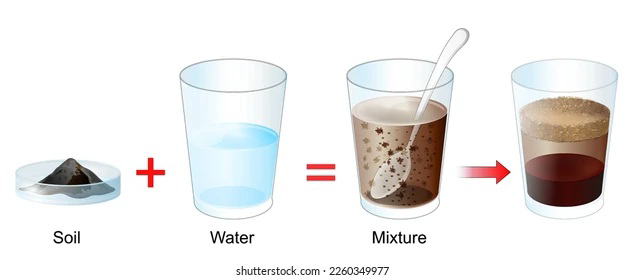
Diagram 1.
 Source: https://www.shutterstock.com/search/separating-mixture-sand-water
A mixture is a combination of two or more substances that are physically combined, not chemically changed. In a mixture, each substance keeps its own properties. Because no new substance is formed, the parts of a mixture can often be separated using physical methods.
Muddy water is a common mixture made of water, sand, and soil. When these substances are stirred together, the mixture looks uniform at first. However, the substances do not dissolve into one another. Sand and soil particles are still present as solid pieces mixed with the water.
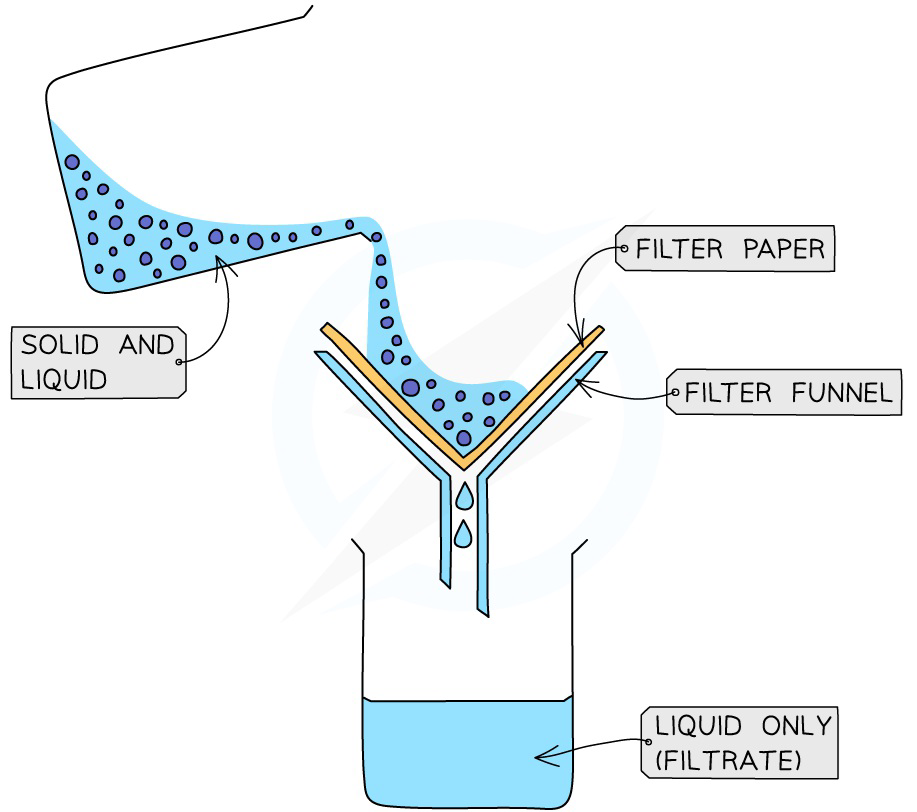
Over time, gravity causes the heavier particles to settle to the bottom of the container. This process is called settling. Finer particles may remain suspended longer, making the water cloudy. If the mixture is poured through a filter, the solid particles are trapped while the water passes through. Filtration is another physical method used to separate mixtures.
Diagram 2.
 Source: https://www.savemyexams.com/igcse/chemistry/edexcel/19/revision-notes/1-principles-of-chemistry/
These separation methods show that muddy water is not a new substance. The sand and soil can be collected, dried, and examined, and the water can be separated from them. Each substance keeps its own properties throughout the process.
By planning and conducting investigations using settling and filtration, students can collect evidence that mixtures are combinations of substances. The ability to separate the components of muddy water supports the idea that mixtures are made of different substances combined together without chemical change.
Table 1.
Material | Mass (g) |
|---|
Water | 200 |
Sand | 50 |
Soil | 30 |
Graph of Information - Figure 1.
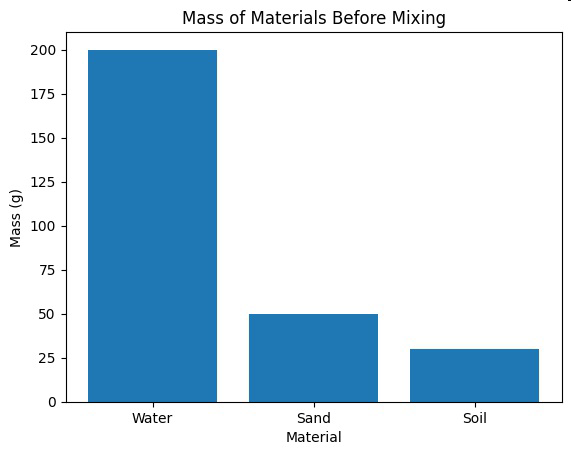
Table 2.
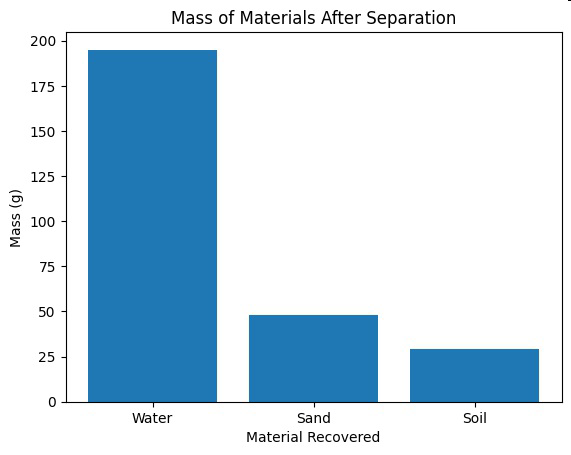
Material Recovered | Mass (g) |
|---|
Water | 195 |
Sand | 48 |
Soil | 29 |
Graph of Information - Figure 2.