Heating and Cooling Candle Wax
Diagram 1.

Real-World Phenomenon
A candle is solid at room temperature, but when it burns, the wax near the flame melts into a liquid puddle. After the candle is blown out, the melted wax cools and turns solid again. This repeating change shows how adding or removing thermal energy affects particle motion, temperature, and the phase (state) of a substance.
All matter is made of particles that are always moving. Temperature is related to how fast those particles move on average. When thermal energy is added to a substance, particles usually move faster, causing temperature to rise. When thermal energy is removed, particles move more slowly, and temperature decreases.
Diagram 2.
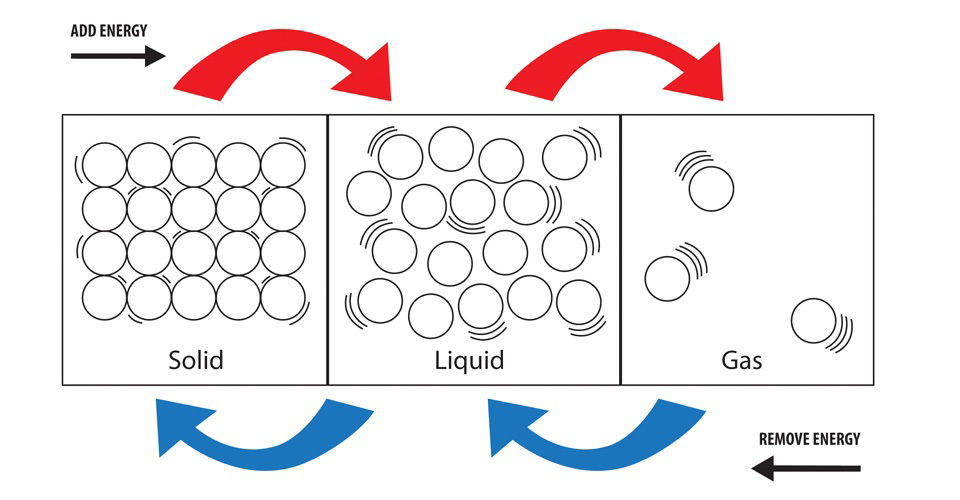 Source: https://reczynoexwiring.z21.web.core.windows.net/particle-model-motion-diagrams.html
Candle wax is a solid at room temperature because its particles are packed close together and can only vibrate in place. When the wax is heated near the candle’s flame, it absorbs thermal energy. As the particles gain energy, they move faster and the temperature rises. When the wax reaches its melting point, the wax begins to change from a solid to a liquid.
During melting, the temperature may stay nearly constant even though thermal energy is still being added. This happens because the energy is being used to overcome attractions between particles so they can move past one another as a liquid. Once the wax is fully melted, adding more thermal energy increases particle motion in the liquid and the temperature rises again.
When the candle is blown out, the wax begins to cool. Thermal energy transfers from the warm wax to the cooler air and surrounding surfaces. As energy is removed, particles slow down and move closer together. When the wax reaches its freezing point, it begins to solidify. During freezing, energy continues to leave the wax, but the temperature may remain nearly constant while particles rearrange into a solid structure.
Scientists develop models that connect thermal energy changes to particle motion, temperature, and phase. Using data about temperature over time, students can predict when wax will be solid, melting, liquid, freezing, or solid again.
Diagram 3.
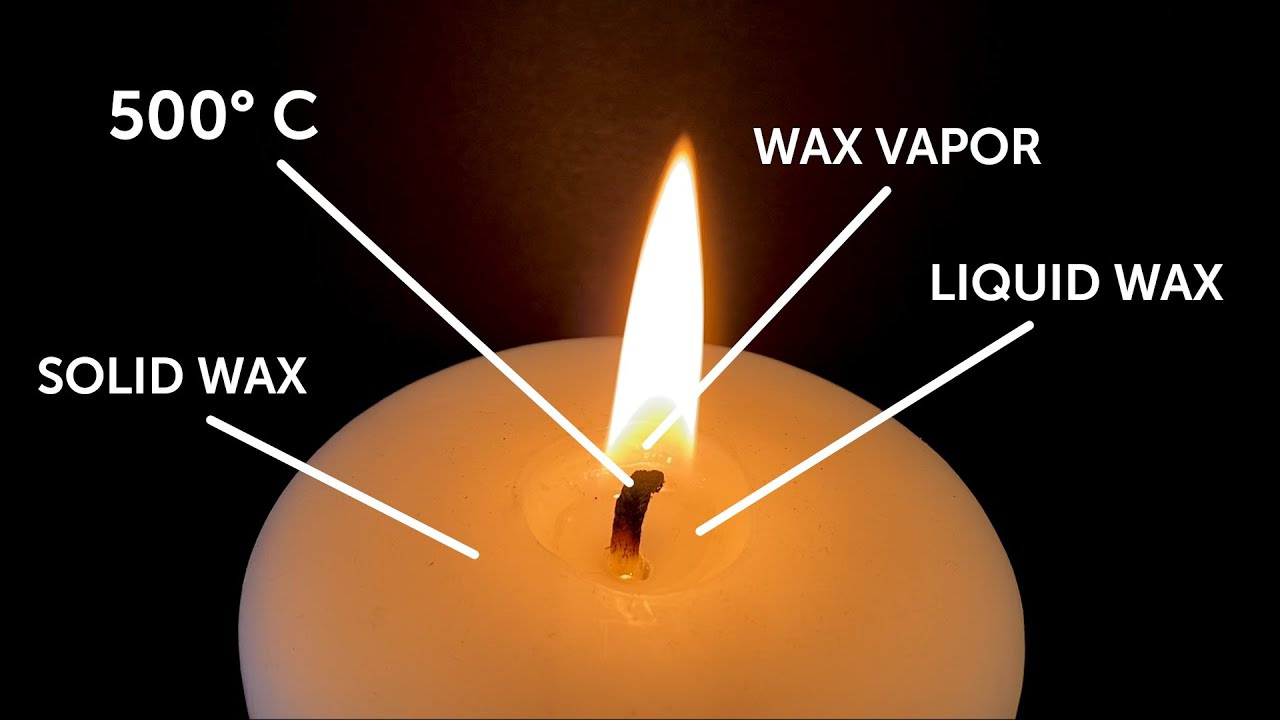
Source:
https://asktheman.xyz/
Table 1.
Time (minutes) | Temperature (oC) | Observation |
|---|
0 | 22 | Solid wax |
4 | 40 | Solid wax |
6 | 50 | Solid wax |
8 | 55 | Melting |
10 | 55 | Melting |
12 | 55 | Melting |
16 | 65 | Liquid wax |
20 | 58 | Cooling liquid |
22 | 55 | Freezing |
26 | 55 | Freezing |
32 | 30 | Solid wax |
Graph of Information - Figure 1.
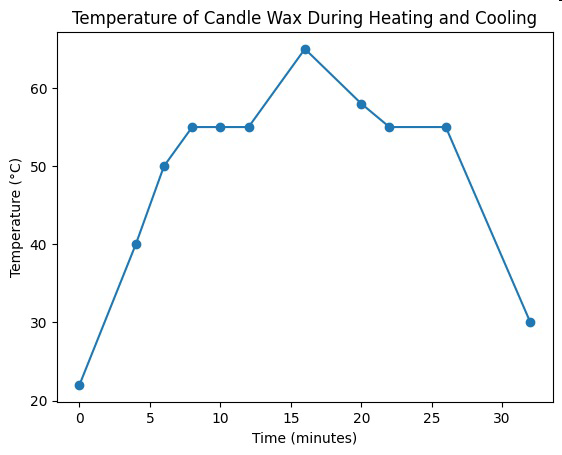
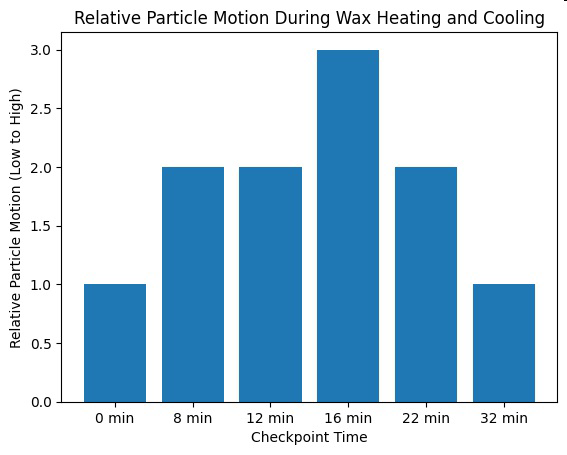
Table 2.
Checkpoint Time (minutes) | Phase | Relative Particle Motion | Thermal Energy Change |
|---|
0 | Solid | Low | Added |
8 | Solid + Liquid | Medium | Phase change |
12 | Solid + Liquid | Medium | Phase change |
16 | Liquid | High | Added |
22 | Liquid + Solid | Medium | Phase change |
32 | Solid | Low | Removed |
Graph of Information - Figure 2.