Steam and Condensation
Real-World Phenomenon
When a pot of hot water is covered with a cold metal lid, water droplets quickly form on the underside of the lid. Steam rising from the water cools when it touches the cold surface and changes back into liquid water. This visible change happens because thermal energy is removed from the water vapor.
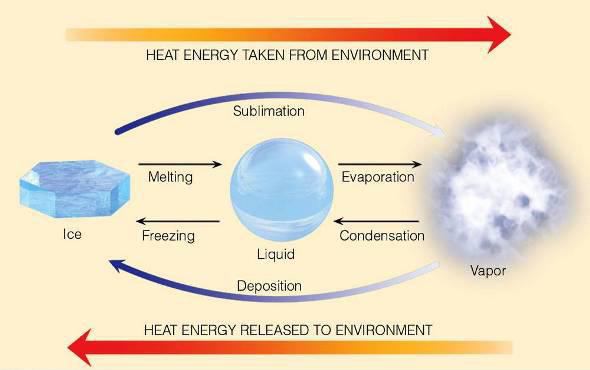
Diagram 1.
 Source: https://www.semanticscholar.org/paper/Are-You-Smarter-Than-a-Sixth-Grader-Textbook-for-Kembhavi-Seo/
Matter is made of particles that are constantly moving. The faster particles move, the higher the temperature of the substance. When thermal energy is added to a substance, particles gain energy and move faster. When thermal energy is removed, particles lose energy and move more slowly.
Water vapor is water in the gas state. In a gas, particles move quickly and spread far apart. When water is heated, liquid water particles gain energy and move fast enough to escape into the air as vapor. This is why steam rises from hot water.
When water vapor touches a cold surface, such as a metal lid, thermal energy transfers from the vapor to the lid. As energy is removed, the particles in the vapor slow down. When they lose enough energy, the particles move closer together and change from a gas back into a liquid. This process is called condensation.
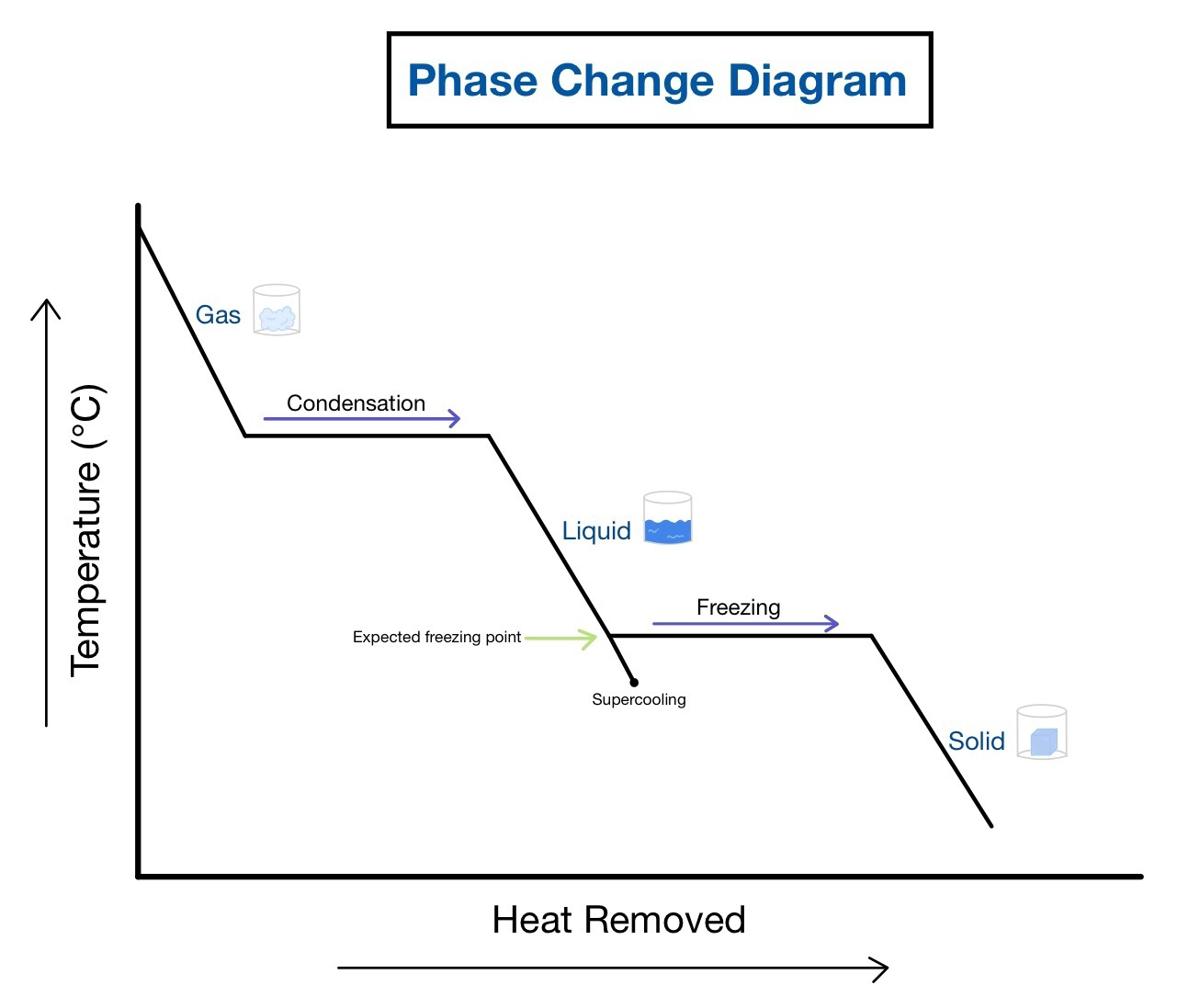
During condensation, temperature does not always change smoothly. As particles slow down and form liquid water, thermal energy is released even though the temperature of the vapor stays nearly the same during the phase change. This energy transfer explains why water droplets form rapidly on cold surfaces.
Scientists develop models to describe how changes in thermal energy affect particle motion and phase. By tracking temperature, observing condensation, and modeling particle behavior, students can predict when a gas will condense into a liquid as thermal energy is removed.
Diagram 2.
Source:
https://www.expii.com/t/heating-and-cooling-curves-overview-examples-11108
Table 1.
Time (minutes) | Temperature (oC) | Observation |
|---|
0 | 100 | Gas (steam) |
2 | 90 | Gas (steam) |
4 | 80 | Cooling gas |
6 | 75 | Condensing |
8 | 75 | Condensing |
10 | 75 | Liquid droplets |
14 | 65 | Liquid droplets |
Graph of Information - Figure 1.
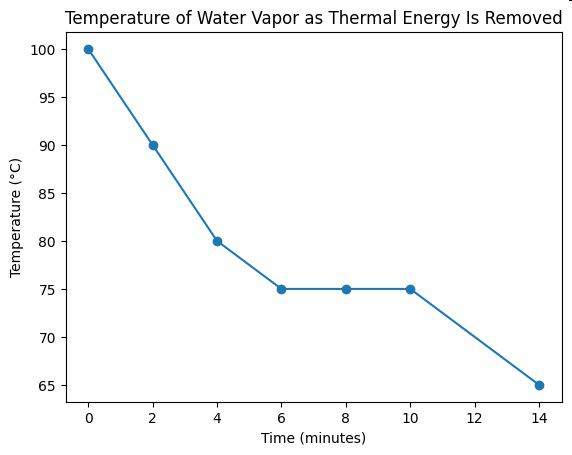
Table 2.
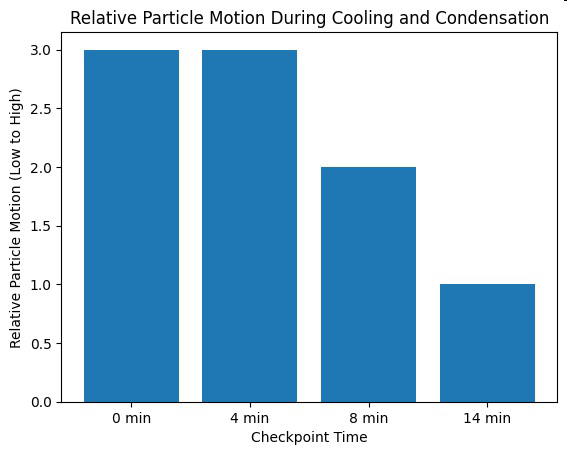
Checkpoint Time (minutes) | Phase | Relative Particle Motion | Thermal Energy Change |
|---|
0 | Gas | High | Energy removed |
4 | Gas | High | Energy removed |
8 | Gas + Liquid | Medium | Phase change |
14 | Liquid | Low | Energy removed |
Graph of Information - Figure 2.