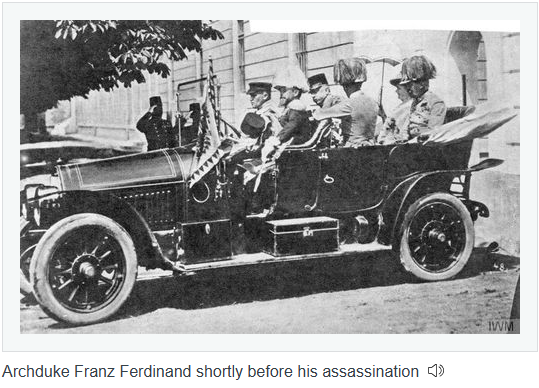
Austria-Hungary felt its power slipping after the Archduke’s assassination. It wanted to assert itself and try to regain control. Austria-Hungary prepared to take action against Serbia. First, however, Austria-Hungary went to seek help and support from its neighbor Germany. Germany assured Austria-Hungary that the German government would support any Austro-Hungarian action against Serbia. On July 28, 1914, Austria-Hungary declared war on Serbia. World War I began.
As Germany supported Austria-Hungary, Russia supported Serbia. As soon as Austria-Hungary declared war, Russia started preparing troops for battle.
Germany took Russia’s preparation as an act of war against Austria-Hungary. Germany declared war on Russia.
France was tied to Russia by a separate treaty. France declared war on Germany to keep its promise to Russia.
In response to France’s declaration of war, Germany invaded a neutral country, Belgium. Belgium was close to France and Germany wanted to take over France.
Britain was bound by a treaty to France and Belgium. Britain declared war on Germany.
In 1914 Britain was still an empire. All of Britain’s territories overseas entered the war on Britain’s side. Their entrance extended the war beyond the boundaries of Europe. Australia, Canada, India, New Zealand, and the Union of South Africa joined the fighting.
Japan had military ties to Britain. Soon Japan declared war on Germany. In response, Austria-Hungary declared war on Japan.
The United States declared that it would remain neutral. However, this policy of neutrality could not last forever.

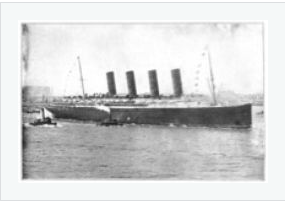
In 1916, United States citizens elected President Wilson for a second term. His campaign slogan was, “He kept us out of war.” Less than a year later, the country entered the war reluctantly, but determined. The biggest change of American public opinion about the war came after the sinking of a British supply ship, the RMS Lusitania. Here is the story of the famous ocean liner.
In February 1915, the German government announced a new policy of unrestricted submarine warfare. Their underwater U-boats would sink any vessels around Great Britain. Before, Germany had captured enemy ships. Now they would simply destroy ships, passengers and all.
On May 1, 1915, the British ship Lusitania set course from New York to Liverpool, England. The passengers and crew knew about Germany’s policy. Many ships had been sunk already. However, the Lusitania was famous for its speed. The passengers were confident that the ship would be safe. When the ship approached dangerous waters, fog blanketed the air. Worried by the weather, Captain William Turner slowed down. At less than top speed, the Lusitania made an easier target.
Off the southern coast of Ireland, a German submarine spotted the ship. The submarine shot a single torpedo. The shot crashed into the hull, or main body of the ship. The torpedo exploded on contact. A few seconds later, another explosion rocked the ship. Experts think that coal storage areas caught on fire during the first explosion and caused the second explosion. In 18 minutes, the ship was under water. Over 1,100 people out of more than 1,900 on board died, including more than 120 Americans.
The United States was outraged. President Wilson and U.S. citizens could no longer ignore the war. Germany did not want the United States to get involved. Temporarily, Germany stopped sinking vessels with civilian passengers, but this policy change was only temporary. In February 1917, Germany again declared unrestricted submarine warfare. To make matters worse, Germany decided to shoot neutral ships, including United States vessels—not just the ships of the countries already at war. (Remember that the Lusitania was British.)
U.S. ships had been supplying Great Britain food and vital supplies. Germany wanted to cut off trade routes between the two countries and starve Great Britain into surrender. Great Britain could not survive without American supplies, and President Wilson and the American people could not ignore Germany’s announcement. Great Britain was only six weeks away from running out of food supplies. On April 2, 1917, President Wilson asked the Congress of the United States to declare war.
The question below is an incomplete sentence. Choose the answer that best completes the sentence.
Germany did not want the US involved in the war, they stopped sinking vessels with civilians aboard.

After World War I ended in the late 1910s, the United States economy was booming in the 1920s. The nickname for the 1920s in the U.S. is the “Roaring Twenties” because wealth seemed to be everywhere. The wealth was really just an illusion.
On October 29, 1929, the United States stock market crashed. The prices of companies on the stock market had skyrocketed to unrealistic amounts. Companies just weren’t worth that much. When people wanted to get their money out of the stock market, the companies had nothing to give them. Money no longer had the same value. People who had once been working class citizens were now poor. Soon, many people lost their jobs. The day became known as Black Tuesday. It was the first day of the Great Depression.
To most Americans, the Great Depression was a time of scarcity. All of a sudden, the economic boom of the 1920s ended. In 1929, all of this wealth collapsed, and people had trouble finding work and even finding food. Banks had to close because they just did not have enough money to give people. When banks closed, several people lost their entire life savings. By 1932, one out of every four Americans was unemployed. By 1933, the money value of the New York Stock Exchange was only one fifth of what it had been in 1929. The United States did not fully recover from the Great Depression until later in the 1930s.
In the United States presidential election of 1932, Franklin D. Roosevelt ran against Herbert Hoover for U.S. president. Hoover was president running for reelection. Franklin remained determined, realistic, and optimistic. In his campaign speeches around the country, he promised to use all of the government’s power to draw the country out of the depression. Roosevelt received 22,800,000 votes to Hoover's 15,700,000, and Roosevelt was the clear winner.
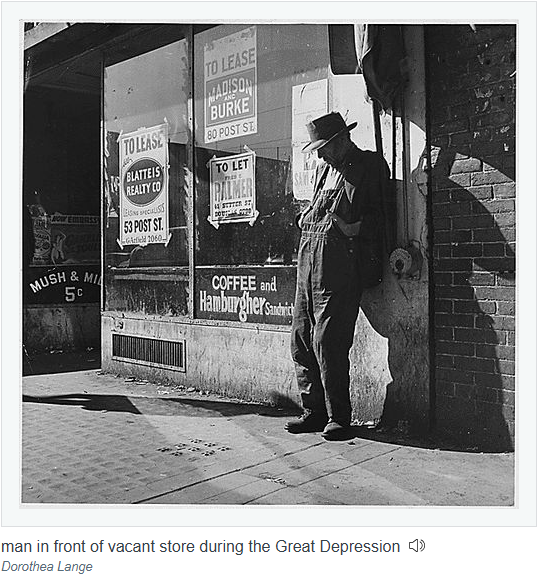
Roosevelt promised to put people back to work. People wanted jobs, and he promised to supply them. His plan was called the New Deal. He was going to use the government’s money to make jobs for people. For example, he hired photographers to capture images of people around the country in their daily life. First of all, their photographs would become part of a national archive, or library, of photographs. Secondly, the photographers now had a job and an income. The government would pay the photographers, and then they would spend their money. They could buy food and clothing. Money would keep changing hands. If the photographers bought something at a store, then the storekeeper would now have some money to spend. Roosevelt hoped to spark the economy by giving people money to spend. He started many new government programs to put people back in jobs and give them a way to provide food, housing, and clothing for themselves and their families.
Choose the answer that best completes the sentence.
The Great Depression was a very difficult time in the U.S. the country experienced an economic boom in the decade before the depression.
On December 8, 1941, President Roosevelt gave this speech to Congress, asking Congress to declare war on Japan.
Yesterday, December 7, 1941—a date which will live in infamy—the United States of America was suddenly and deliberately attacked by naval and air forces of the Empire of Japan.
The United States was at peace with that nation and, at the solicitation of Japan, was still in conversation with its Government and its Emperor, looking toward the maintenance of peace in the Pacific. Indeed, one hour after Japanese air squadrons had commenced bombing in Oahu, the Japanese Ambassador to the United States and his colleague delivered to the Secretary of State a formal reply to a recent American message. While this reply stated that it seemed useless to continue the existing diplomatic negotiations, it contained no threat or hint of war or armed attack.
It will be recorded that the distance of Hawaii from Japan makes it obvious that the attack was deliberately planned many days or even weeks ago. During the intervening time the Japanese Government had deliberately sought to deceive the United States by false statements and expressions of hope for continued peace.
The attack yesterday on the Hawaiian Islands has caused severe damage to American naval and military forces. Very many American lives were lost. In addition, American ships have been reported torpedoed on the high seas between San Francisco and Honolulu.
Yesterday the Japanese Government also launched an attack against Malaya.
Last night Japanese forces attacked Hong Kong.
Last night Japanese forces attacked Guam.
Last night Japanese forces attacked the Philippine Islands.
Last night Japanese forces attacked Wake Island.
This morning the Japanese attacked Midway Island.
Japan has, therefore, undertaken a surprise offensive extending throughout the Pacific area. The facts of yesterday and today speak for themselves. The people of the United States have already formed their opinions and well understand the implications to the very life and safety of our nation.
As Commander in Chief of the Army and Navy, I have directed that all measures be taken for our defense.
Always will we remember the character of the onslaught against us.
No matter how long it may take us to overcome this premeditated invasion, the American people in their righteous might will win through to absolute victory.
I believe I interpret the will of the Congress and of the people when I assert that we will not only defend ourselves to the uttermost, but will make very certain that this form of treachery shall never again endanger us.
Hostilities exist. There is no blinking at the fact that our people, our territory, and our interests are in grave danger.
With confidence in our armed forces—with the unbounded determination of our people—we will gain the inevitable triumph—so help us God.
I ask that the Congress declare that since the unprovoked and dastardly attack by Japan on Sunday, December 7, 1941, a state of war has existed between the United States and the Japanese Empire.
Choose the answer that best completes the sentence.
According to President Roosevelt, the United States was at peace with Japan the attack on Hawaii.
Winning contest essay describes women at bat during World War II.
I’m sure you know what baseball is. You might have seen it on TV once or twice, or you might be the biggest fan in the world! And I’ll bet you know that only men play in the professional league. But have you ever heard of women playing professional baseball? This is the amazing story of a woman who was part of women’s minor league baseball during World War II (1939–1945).
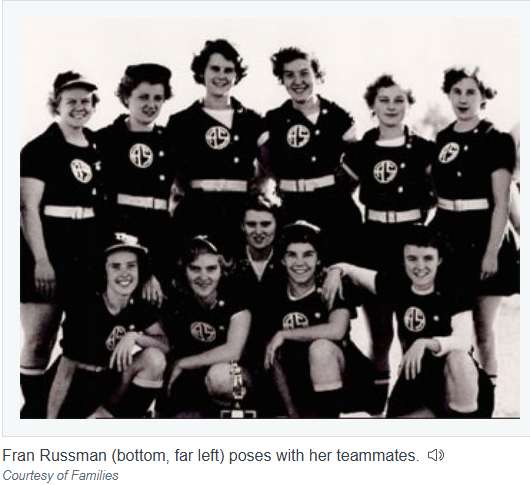
Throughout the United States, young men, including popular baseball players, were sent off to fight in the war. The owner of the Chicago Cubs, Philip K. Wrigley, decided to start a women’s baseball league to keep the sport going. [The league ran from 1943–1954, with hundreds of women hitting the baseball diamond to play for teams throughout the Midwest.] That’s how Mrs. Fran Russmann came to play ball! Her team, the Blue Island Dianas, was a minor league team in Chicago, Ill.
Mrs. Russmann was 22 years old when she started playing. A few boys she knew asked her whether she wanted to play baseball, and she replied yes. She was very sports-minded and decided to try it. She traveled all over Illinois to play games, and she had to take a streetcar to practices! [That is a bus-like vehicle that moves on rails around cities. Streetcars were common in the 1940s.] The Blue Island Dianas played mostly on the South Side of Chicago and in small towns throughout Illinois.
People reacted differently when women started playing baseball. “We were a novelty, seeing girls play,” Mrs. Russmann told me. A novelty is something unique or different. Female players had to be ladylike as well.
She remembers how she felt while playing baseball. Her favorite position to play was second base, and she loved the game, though she was a bit nervous—but excited—when everyone was watching. [Thousands of fans filled stadiums to watch the women’s teams play games.] Mrs. Russmann’s favorite thing about baseball was hearing the crowd cheer because she knew she was entertaining them. Back then, there was no TV or Internet, so this was entertainment.
When I asked Mrs. Russmann about the thing she disliked the most, she chuckled and answered, “Sliding into second base. When you did, you got strawberries.” A strawberry is a bright red bruise that can sometimes bleed. Female baseball players got them more because they had to wear skirts as part of their uniform, unlike men, who wore pants. [When women slid in skirts, their legs often got scraped and bruised. ]
Mrs. Russmann told me the most important thing she will always remember was having fun and learning sportsmanship. That is fair and respectful behavior by an athlete. “Just being out there was wonderful to me,” she said.
When I asked how she felt about being part of a historic event, she said, “I never thought I was part of a [historic] event until I watched the movie A League of Their Own. Then I realized I was!” Mrs. Russmann played baseball for two years. “I’m so happy I tried out,” she told me. “It was a wonderful experience.”

“It doesn’t matter whether you’re a guy or a girl, whether you have dark skin or light skin, whether you’re young or old. All that matters is that if you want to do something, then go for it! You might just think it was one of the best things you’ve ever done. And you might just make history!" —Maria Cieslarczyk, fifth grade
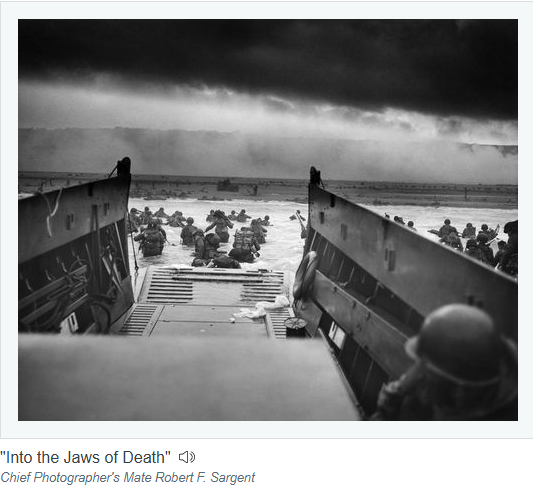
Today we finally moved. The action has begun. For the past few months I have been in England. We have trained and studied. Now it is time to go. The code name for our movement is Operation Overlord. I do not know when we will strike the Germans. I do know that our ultimate hope, months from now, is to liberate Paris. But first, we need to get our foot in the door of Europe. I am afraid that Germany will slam the door in our face. Germany now controls most of the continent. But we will win.
We have left Britain now. We are heading towards the coast of France. The English Channel is rough and choppy. Our ships rock back and forth. The air is foggy outside, but very few men go up on the deck of the ship anyway. We are all kept below to prepare for the fight. Most of the men are quiet and keep to themselves. We know that our job is necessary, but we also know that many of us will die. It is clear now that we will invade France on the beaches of Normandy. By morning, we will have landed. Who knows how long the fight will take, or who will survive… anything is possible for us, except defeat. We will win.
Today was the hardest day of my life. But we are succeeding. Over 150,000 Allied troops and 5,000 ships landed together along the coast of Normandy. We fought the waves to reach the shore and fought for every inch of sand up to the hills. We had nowhere to retreat except to the cold ocean. Our only choice was to push forward and make the Germans move backward. I found out that our generals had staged an invasion in Calais. Thousands of rubber tanks landed - empty, of course - in that town far away from here. While the Germans tried to defend themselves against balloons, we stormed the beaches here. Thank goodness for the distraction. I cannot imagine what today would have been like with more German troops facing us.
Paris is ours. Today Allied soldiers marched into Paris and liberated France. After four years of German occupation, Paris is finally free.
Choose the answer that best completes the sentence.
the Allied soldiers took the beaches at Normandy, they were able to move forward toward Paris with the goal of liberating France.
According to the text, which country did Austria-Hungary seek help from?
What does the author describe for each country in the text?
Read these sentences from the text.
Austria-Hungary prepared to take action against Serbia. First, however, Austria-Hungary went to seek help and support from its neighbor Germany. Germany assured Austria-Hungary that the German government would support any Austro-Hungarian action against Serbia. On July 28, 1914, Austria-Hungary declared war on Serbia. World War I began.
What can you conclude about World War I from this evidence?
Read these sentences from the text.
The United States declared that it would remain neutral. However, this policy of neutrality could not last forever.
Based on the text, what does the author likely mean by writing that the United States' "neutrality could not last forever"?
What is this text mostly about?
Read these sentences from the text.
Austria felt its power slipping after the Archduke’s assassination. The country wanted to assert itself and try to regain control.
As used in these sentences, what does the word "assert" mean?
A U-boat is
Why does the author describe the sinking of the Lusitania?
Read this paragraph from the text.
“U.S. ships had been supplying Great Britain food and vital supplies. Germany wanted to cut off trade routes between the two countries and starve Great Britain into surrender. Great Britain could not survive without American supplies, and President Wilson and the American people could not ignore Germany’s announcement regarding cutting off trade routes. Great Britain was only six weeks away from running out of food supplies. On April 2, 1917, President Wilson asked the Congress of the United States to declare war.”
What can you conclude based on this evidence?
The saying “fog blanketed the air” means that the sky was
This passage is mainly about
Read the following sentence:
“Germany stopped sinking vessels with civilian passengers, but this policy change was only temporary. In February 1917, Germany again declared unrestricted submarine warfare.”
The word temporary means
According to the text, what was Black Tuesday?
Based on the text, what was the effect of money no longer having the same value?
Read these sentences from the text.
To most Americans, the Great Depression was a time of scarcity. All of a sudden, the economic boom of the 1920s ended. In 1929, all of this wealth collapsed, and people had trouble finding work and even finding food. Banks had to close because they just did not have enough money to give people. When banks closed, several people lost their entire life savings. By 1932, one out of every four Americans was unemployed.
What can you conclude based on this information?
Based on the text, what was probably the biggest issue for voters in the U.S. presidential election of 1932?
What is this text mostly about?
Read these sentences from the text.
The prices of companies on the stock market had skyrocketed to unrealistic amounts. Companies just weren’t worth that much.
Based on the text, what does the word “skyrocketed” mean?
According to President Roosevelt's speech, where were many American lives lost?
The second paragraph of Roosevelt’s speech begins,
“The United States was at peace…”.
How does the information in that paragraph relate to the rest of the speech?
Read these sentences from the speech.
Indeed, one hour after Japanese air squadrons had commenced bombing in Oahu, the Japanese Ambassador to the United States and his colleague delivered to the Secretary of State a formal reply to a recent American message. While this reply stated that it seemed useless to continue the existing diplomatic negotiations, it contained no threat or hint of war or armed attack.
What can you conclude based on this information?
Based on the speech, what was probably true about the attacks by Japan?
What was President Roosevelt’s address to Congress mainly about?
Read these sentences from the speech.
Japan has, therefore, undertaken a surprise offensive extending throughout the Pacific area. The facts of yesterday speak for themselves. The people of the United States have already formed their opinions and well understand the implications to the very life and safety of our nation.
As used in these sentences, what does the word “implications” mean?
Why did Philip K. Wrigley start a women’s baseball league?
The author describes a sequence of events related to the development of a women’s baseball league. What event takes place first?
Based on the information in the second paragraph, what can the reader most likely conclude about Phillip K. Wrigley, the person who started the women’s baseball league?
What can be concluded about the experience of the women who played in minor league baseball?
What is the essay mainly about?
Why did the author include quotes from Mrs. Russmann?
The question below is an incomplete sentence. Choose the answer that best completes the sentence.
she was nervous to play in front of thousands of fans, Mrs. Fran Russman enjoyed hearing the crowds cheering.
According to the text, what was the ultimate hope of the movement Operation Overlord?
The text is a series of journal entries, describing a sequence of events. Which event happened first in the text?
Read the journal entry dated "May 30, 1944."
What can you conclude based on this journal entry?
Based on the text, what was the result of Operation Overlord?
What is this text mostly about?
Read these sentences from the text.
Paris is ours. Today Allied soldiers marched into Paris and liberated France. After four years of German occupation, Paris is finally free.
As used in these sentences, what does the word “occupation” mean?