Joan of Arc - Reading & Questions
star
star
star
star
star
Last updated 6 months ago
11 Nsɛmmisa
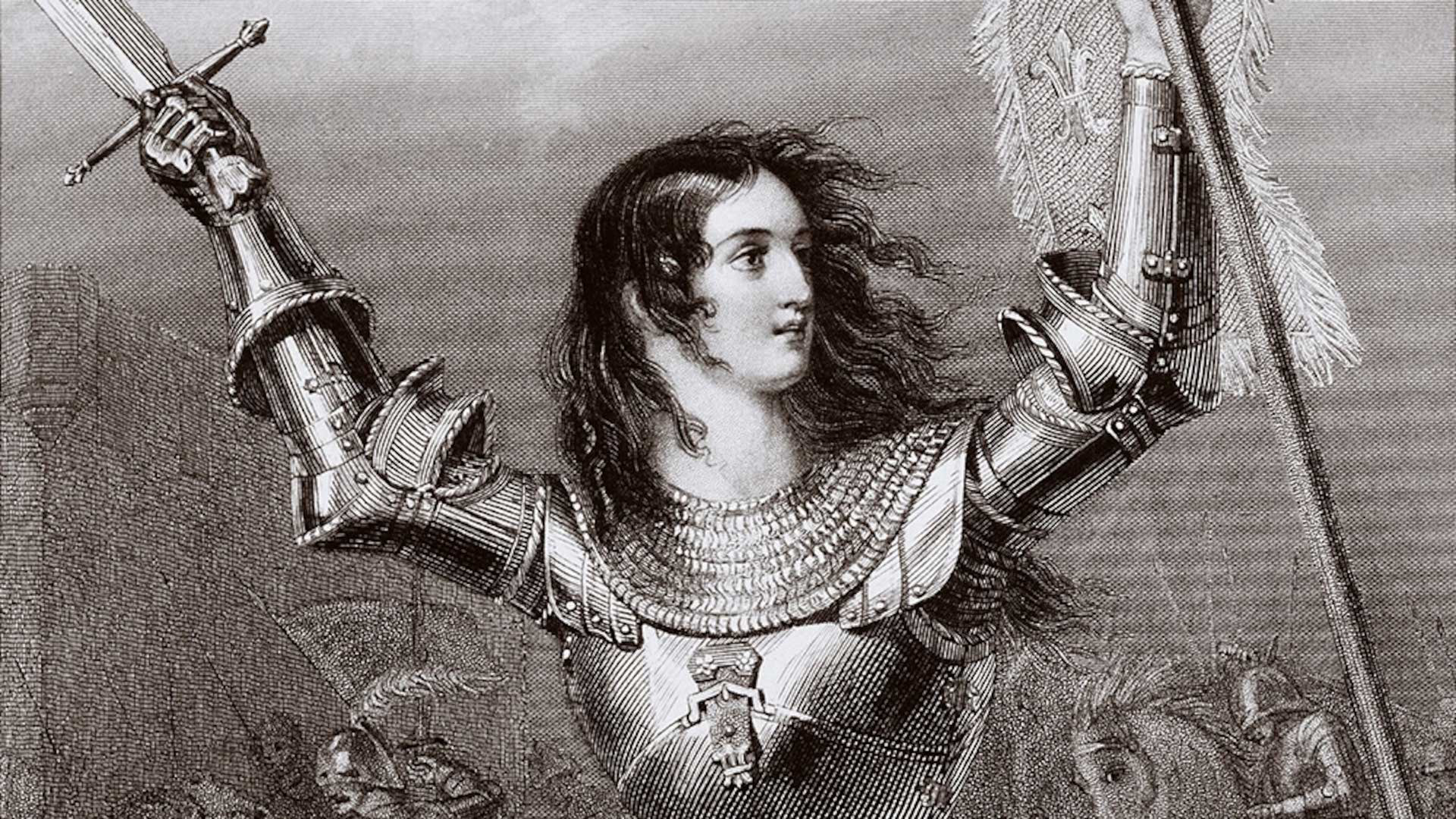
In 1429, during the weakening of Europe's feudal system, a teenage girl named Joan of Arc bravely helped a prince become the king of France. How did Joan's extraordinary life demonstrate the new ways that were about to replace old traditions in Europe?
The visions and the voices came without warning, like a flash of lighting. In 1425, Joan of Arc, the daughter of northern French peasants, had just turned 13. Until then, she had had a normal childhood, attending mass and praying frequently to God.
Then the voices and visions started when Saints Michael, Catherine, and Margaret suddenly came to her. “I was terrified,” Joan remembered later. “There was a great light all about.” But soon she was reassured by the sweet, kind voices and stopped being afraid.
Joan lived in a religious time, and it wasn't unheard of for people to report that saints spoke to them. But Joan's voices gave her a daunting task of helping Charles, the dauphin (DOE-fehn), or French heir to the throne, to become king. They also wanted her to free France from the English, who had conquered portions of the country.
The year when Joan's voices began, France was in chaos. Since 1337, the English and French had been fighting the Hundred Years' War, and, in 1420, English king Henry V obtained the French throne. Upon Henry's death in 1422, the dauphin Charles insisted that he, and not Henry's infant son, was the rightful king. His claim led to even bloodier fighting between the English and French.
Tensions within the borders were also high, as France itself was deeply divided. The feudal lords of the powerful province of Burgundy helped the English seize northern France. Those loyal to Charles controlled the southern half of the country. Even though Charles was the dauphin, he hadn't been crowned.
Since the 11th century, all French kings had been crowned in Reims (RAHNZ), but the English controlled land around the city. However, Joan's voices informed her that she should lead Charles to Reims and see that he was crowned king.
At the age of 17, Joan set out to find Charles. It was dangerous for a female to travel alone, so she disguised herself by cutting her hair and putting on men's clothing. Without telling her parents, she rode to a nearby fort to ask the commander for soldiers to protect her.
When she reached the fort, the commander merely laughed at her request. But Joan soon convinced him, and he ordered a group of soldiers to accompany her. On February 13, 1429, they set out for Charles' court at Chinon (shee-NOHN).
Charles heard she was on her way. He had heard prophecies, or predictions, that this young peasant woman would rescue France from the English. When she arrived at Chinon, Charles tested Joan's claims by disguising himself and had court officials introduce another man to Joan as the dauphin. However, Joan immediately picked out Charles from the crowd. She knelt before him, announcing, “Very noble Dauphin, I am come and sent by God to bring succor [help] to you and your kingdom.” Charles agreed that God had sent Joan to save France.
Joan's first challenge on the way north to Reims was to free the city of Orléans (OR-lay-uhn). Charles had a suit of armor made for her, but she still needed a sword. She predicted that priests would find one for her in a nearby church, and sure enough, they dug behind the altar and discovered a sword. Armed with her sword and carrying a banner that she had made, Joan filled the French with hope.
In the spring of 1429, Joan guided Charles's troops toward Orléans, which the English had had under siege for six months. The French feared that if they lost that city, they would lose all of France. On May 4, Joan led the French troops into battle for the first time.
At a monastery near Orléans held by the English, French soldiers attacked. They were on the verge of defeat when Joan suddenly galloped into the battle, carrying her banner and flashing her sword, and the French soldiers soon overwhelmed the English.
Three days later, the French attacked Orléans itself. Joan was hit by an arrow in the middle of the battle, but, grimacing in pain, she pulled it out and threw herself back into the fight. She then led French troops across a moat and stormed the city's walls, where the French soon poured into Orléans, and the English beat a rapid retreat.
After the victory, thirty thousand grateful residents of Orléans cheered Joan as she rode with her soldiers through the streets. Forever after, she would be known as the “Maid of Orléans.” In the following weeks, Joan's forces freed more surrounding towns from the English.
After these victories, Joan returned to Charles and persuaded him to travel to Reims to be crowned. At last, on July 17, 1429, with Joan at his side, the dauphin became King Charles VII. After the coronation, Joan burst into tears of joy.
Unfortunately, the coronation proved to be the high point for Joan. Charles started to distance himself from her, perhaps fearing her enormous popularity. In the fall of 1429, Charles and Joan led troops toward Paris, which the English and their allies controlled. But without Joan's knowledge or input, Charles reached a ceasefire agreement with the Duke of Burgundy. When Joan learned about the agreement, she was outraged, for she wanted to fight to free Paris. “I am not satisfied with this manner of truce,” she fumed.
Meanwhile, French troops, now with a king to follow and tired of fighting, were deserting Joan's army. In May 1430, Burgundy's army of 6,000 soldiers prepared to attack Compiègne (komp-YANE), a French-held town near Paris. Joan's army had only 300 soldiers. At five in the evening, she launched a surprise attack.
At first, the French held their own, but thousands of English soldiers soon joined the battle. The French were forced to retreat to Compiègne. When the town's mayor saw English troops approaching, he closed the drawbridge, trapping Joan outside. The Burgundian leaders captured her and threw her into prison, and Charles made no effort to rescue or ransom the woman to whom he owed so much. After several months, the English paid the Burgundians an enormous ransom for her.
The English and the Catholic Church put Joan on trial in Rouen (ROO-ahn) for witchcraft and for heresy, or spreading beliefs that violate accepted religious teachings. They hoped that, by proving that God did not guide Joan, they could undermine Charles VII's right to the French throne. Bishop Pierre Cauchon, an ally of the English, led the proceedings. When the trial started in February 1431, Joan boldly warned the bishop, “You say that you are my judge. Take thought over what you are doing. For, truly, I am sent from God, and you are putting yourself in great danger.”
The warning did not prevent Bishop Cauchon from drilling Joan with questions, such as, “Did God command you to put on men's clothing?” Joan responded, “I did not put on this clothing, or do anything else, except at the bidding of God and the angels.” Ordinary people watching the trial loved Joan's courageous answers. She was following her conscience and standing up to the bishop and to the English.
The court made 70 accusations against Joan, and in May, to save her life, she signed a confession. But after several days, she took it back, saying, “What I said, I said for fear of the fire.” She had made the brave decision to stay true to her beliefs—even though she faced execution as punishment.
A huge crowd gathered in Rouen on May 30, 1431, to watch Joan be burned at the stake, a common death sentence for heretics and witches. Through her horrible ordeal, she showed great courage.
Charles VII remained king for 40 years, forced the English out of France, and united the country. During that time, Joan's life became a legend.
In 1455, Joan's family requested that the pope reopen her case, and Joan was found innocent of all charges. In 1920, Joan was recognized as a Catholic saint. Today, Saint Joan is one of the most beloved of French heroes, the patron saint of the nation and of its soldiers. She inspired her country and helped to restore the throne to a French king. She also proved that women could be brave and effective leaders. Finally, her remarkable life shows that with faith, courage, and determination, someone from ordinary beginnings can make history.
Summary
Joan of Arc, a brave young girl, helped Charles become the King of France in 1429.
Joan heard voices and had visions that told her to help Charles and free France from the English.
She led French troops to victory in battles, but was later captured and put on trial, eventually becoming a symbol of French courage and faith.
What was Joan of Arc’s main goal, according to the voices she heard?
What year did Joan of Arc start having visions and hearing voices?
Why was it significant that French kings were traditionally crowned in Reims?
What action did Joan of Arc take to travel safely to Charles’ court?
What was Joan of Arc known as after her victory in Orléans?
What ultimately happened to Joan of Arc after her capture?
Who led the trial against Joan of Arc?
Describe the state of France when Joan of Arc began hearing voices and explain why Charles, the dauphin, had not yet been crowned king.
Explain the significance of Joan of Arc's victory at Orléans and how it impacted the French soldiers and people.
What were the accusations against Joan of Arc during her trial, and what was the ultimate outcome of the trial?
Write five interview questions for Joan of Arc about her mission from God, her choices to serve/lead in the military under the disguise of a man., and the consequences she faced for her actions.
All questions must be based off of information your read in the sources provided. All questions MUST written with the intention of receiving more than a “yes” or “no” answer for full credit.