Preskoči na glavni sadržaj
Prijava
Sign up for FREE
arrow_back
Biblioteka

12/1- 12/2 - SEQUENCES

star
star
star
star
star
Posljednje ažuriranje 4 months ago
22 questions
1
1
1
1
1
1
1
1
1
1
1
1
1
1
1
1
1
1
1
1
1
Obavezno
1
Pitanje 1
1.

Ellis wants to find a function to describe the sequence given in the box, where n represents consecutive integers starting at 1.
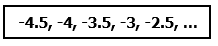
A sequence of numbers starting from -4.5, increasing by 0.5 each time.

Which function represents this sequence?
Pitanje 2
2.

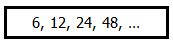
Study the geometric sequence in the box.

A sequence of numbers starting from 6, doubling each time.

Which best defines the sequence where n is the term number?

Pitanje 3
3.

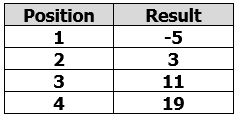
The table shows a sequence, where n is the position of a term in the sequence.

A table with two columns labeled 'Position' and 'Result'. Position 1 has a result of -5, position 2 has a result of 3, position 3 has a result of 11, and position 4 has a result of 19.

Which rule models the table?

Pitanje 4
4.

Which integer would be the next in the sequence?

8, 27, 64, 125, . . . THE ANSWER IS 216!!!

Pitanje 5
5.

Which linear equation passes through the points $(0, -2)$ and $(4, 10)$?

Pitanje 6
6.

A population of bacteria doubles in size 3 times a month. If the initial population at week 0 is 300, which equation represents the amount of bacteria present $(P)$ after $t$ months?

Pitanje 7
7.

Franco drops a ball from a height of 5 feet. The ball continues to bounce off the ground repeatedly until finally coming to a stop. He notices that each time the ball bounces, it reaches a height $\frac{3}{4}$ times the previous height. Which equation best models relationship between the number of bounces $(x)$ and the height of the ball $(y)$?

Pitanje 8
8.

The sequence shows the total number of coconuts harvested from a grove of palm trees at the end of weeks 1, 2, 3, and 4.

14, 30, 46, 62, . . . . .

Assuming this pattern continues, which function could be used to find the total number of coconuts harvested at the end of week $n$?

Pitanje 9
9.
Drugi mogući odgovor:
7
18
12
23
15

25

Pitanje 10
10.

A sequence is defined recursively as follows.

$a_1 = 2.5$
$a_n = -1 + a_{n-1}$

What are the first five terms of this sequence?

Pitanje 11
11.

Which is most likely the equation that describes this sequence?

2, -8, 32, -128, _____, _____

Pitanje 12
12.

Consider the sequence.

-1, 2, 5, 8, 11, . . . . .

Which function represents this sequence, where n is the term in the sequence?

Pitanje 13
13.

The explicit function for a geometric sequence is $f(n) = 2(5)^{n-1}$, what is the 8th number in this sequence?

Pitanje 14
14.

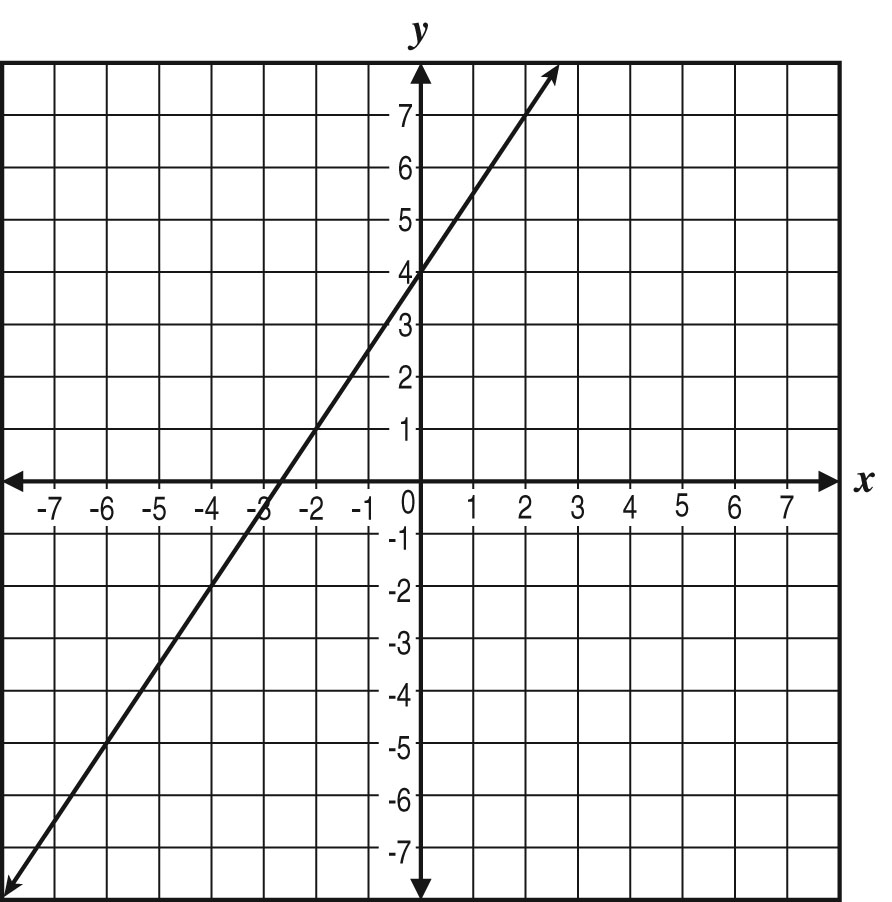
Which of the following equations is graphed below?
Graph showing a diagonal line passing through the origin on a grid with x and y axes labeled from -7 to 7.

Pitanje 15
15.

Which equation represents the line that passes through the points $(3,4)$ and $(1,-2)$?

Pitanje 16
16.

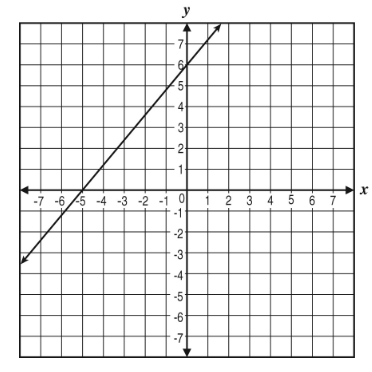
Which equation best represents the graph below?

Pitanje 17
17.

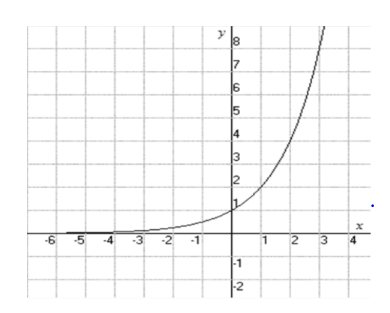
An exponential function is graphed in the coordinate grid.

Which equation matches the graph of this function?

Pitanje 18
18.

Which equation represents the line that passes through the points $(4, 8)$ and $(2, -6)$?

Pitanje 19
19.

A group of 600 bacteria is placed in a dish at 1 p.m. and observed. An hour later, at 2 p.m., 2,400 bacteria are observed.

Which function models the number of bacteria in the dish $h$ hours after the bacteria were first placed there?

Pitanje 20
20.

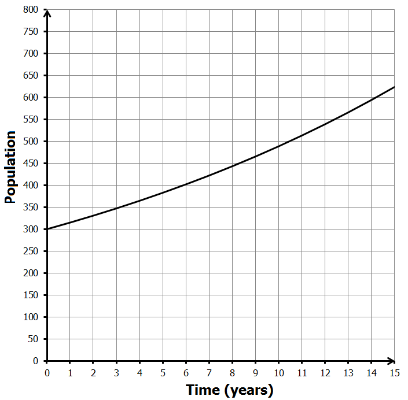
The population in a particular area, in years, is shown in the graph.

Which is the function that best models the population?

Graph showing population growth over 15 years. The population starts at around 300 and increases steadily to 650.

Pitanje 21
21.

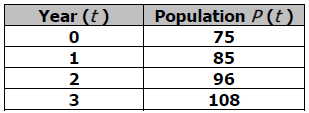
Aida is studying the population growth of rabbits in a state park. Her results are shown in the table, where P(t) represents the population after t years of study. The year 0 represents the initial population when Aida began her study.

Table showing population over years. Columns are: Year (t), Population P(t). Rows are: Year 0, Population 75; Year 1, Population 85; Year 2, Population 96; Year 3, Population 108.Which function best represents the population for any time $t$?

Pitanje 22
22.

Rate your level of understanding and identify one thing that you learned in the lesson today.