A flashlight uses a battery to produce light. Which explanation best describes the energy transformations that occur in this system?
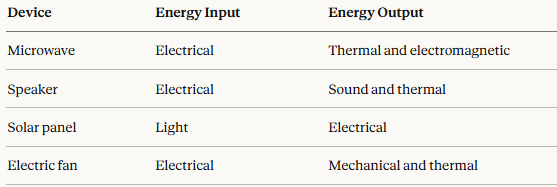
A student observes several energy transformations occurring in their home and records them:
Which device shows an energy transformation from electromagnetic energy to thermal energy?
Three students analyze energy transformations in a smartphone and create different explanations:
Student A's Explanation: "When charging: Electrical energy → Chemical energy in battery. When using phone: Chemical energy → Electrical energy → Light energy in screen."
Student B's Explanation: "When charging: Electrical energy → Chemical energy in battery (some thermal energy released). When using phone: Chemical energy → Electrical energy → Light energy in screen AND Sound energy in speaker AND Thermal energy throughout."
Student C's Explanation: "When charging: Electrical energy from outlet → Thermal energy in charger → Chemical energy in battery. When using phone: Chemical energy → Light energy and Sound energy."
Which analysis best identifies the most complete and accurate explanation of energy transformations in this system?
A teacher plans an investigation to demonstrate the three methods of thermal energy transfer. Which setup would best demonstrate conduction?
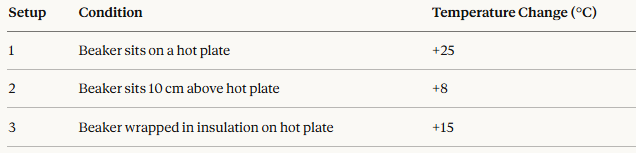
Students investigate thermal energy transfer by setting up three identical beakers of cold water. They place each beaker in different conditions and measure temperature changes over 10 minutes:
Which interpretation best explains the molecular motion and thermal energy transfer in Setup 1 compared to Setup 2?
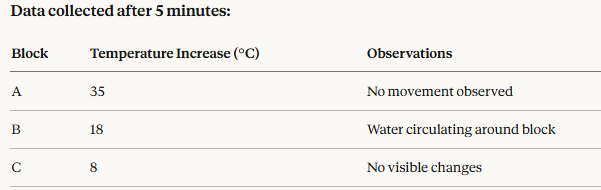
A student designs an investigation to compare all three methods of thermal energy transfer using a single heat source. They set up the following:
Materials: Heat lamp, three identical metal blocks (A, B, C), three thermometers, water in a clear container, black surface
Setup:
Block A: Placed in direct contact with the black surface under the heat lamp
Block B: Suspended in water directly under the heat lamp (not touching container)
Block C: Placed 20 cm to the side of the heat lamp with no direct path through water or solids
Which analysis best explains how molecular motion relates to the thermal energy changes observed in each block?
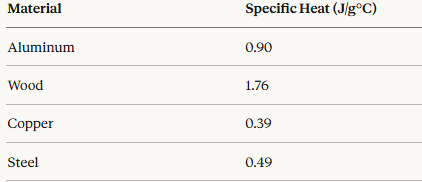
A company needs to select a material for making cooking pot handles that stay cool while the pot heats up. They test four materials and record their specific heat values:
Which material is best for pot handles and why?
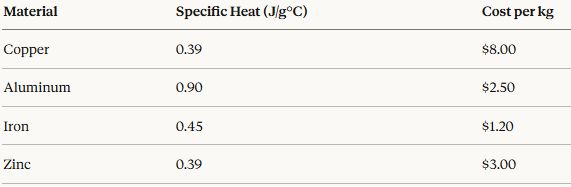
An engineer must select a material for a heat sink that will absorb excess heat from a computer processor. The material should heat up quickly to draw heat away from the processor. The specific heat data shows:
Which interpretation of this data best justifies a material selection?
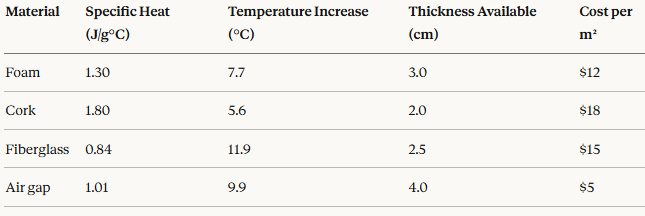
A company designs insulated containers to keep cold drinks cold during summer outdoor events. They test four materials by measuring how much the temperature increases when 100 grams of each material absorbs 1000 joules of energy from the surroundings:
Based on this data, which material choice is best justified for the insulated container and why?
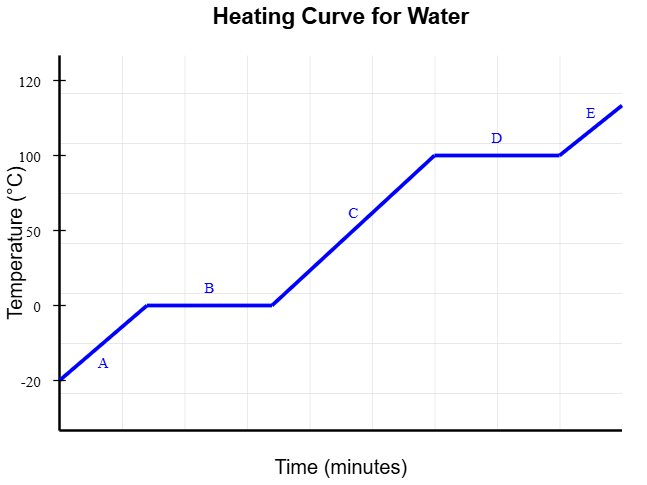
The heating curve above shows water being heated continuously. During which segment is energy being absorbed but temperature remaining constant?
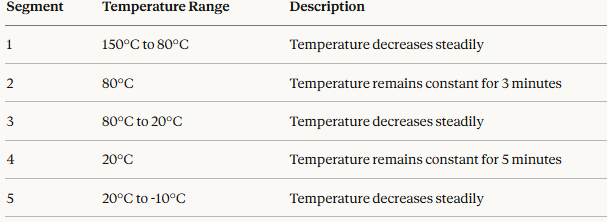
A student analyzes a cooling curve for an unknown substance and records observations:
Which interpretation best explains the flow of energy during segments 2 and 4?
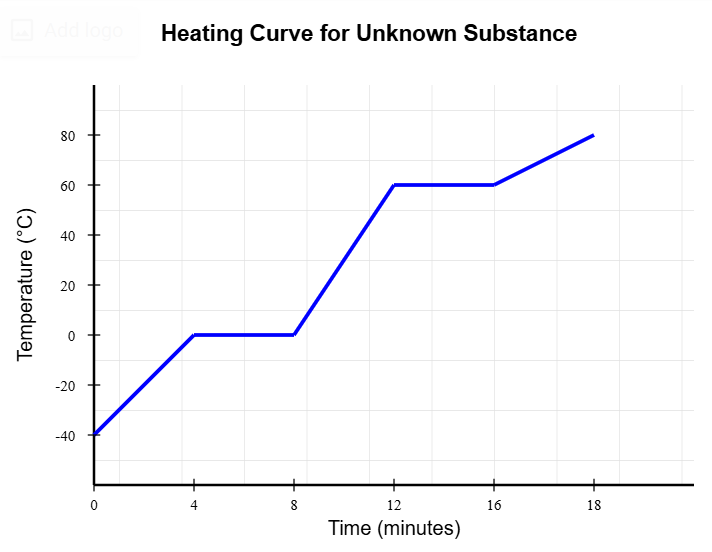
A laboratory continuously heats a 100-gram sample of an unknown substance at a constant rate and records the heating curve shown above. The substance melts at 0°C and boils at 60°C.
Energy Data:
Time 0-4 min: 8 kJ added (solid heats from -40°C to 0°C)
Time 4-8 min: 12 kJ added (melting occurs at 0°C)
Time 8-12 min: 24 kJ added (liquid heats from 0°C to 60°C)
Time 12-16 min: 15 kJ added (boiling occurs at 60°C)
Time 16-18 min: 4 kJ added (gas heats from 60°C to 80°C)
Based on the heating curve and energy data, which analysis best explains the flow of energy during phase changes compared to within a single phase?
A teacher wants students to investigate the motion of a battery-powered car traveling in a straight line. Which procedure would best allow students to create mathematical models for the car's velocity?
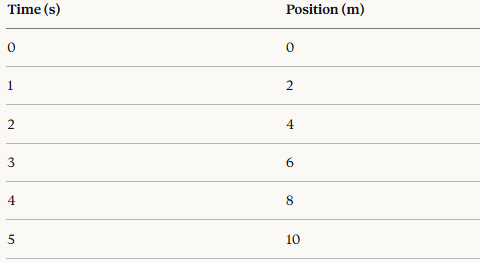
Students investigate the motion of a rolling ball by recording its position every second:
Based on this data, which mathematical model best describes the ball's motion?

A student conducts an experiment by pushing a cart across the floor. The cart moves at constant velocity until it hits a wall and stops. Which explanation uses evidence from this experiment to support Newton's First Law?
Students conduct three experiments to test Newton's Laws:
Experiment 1: Push two carts with the same force - one empty (2 kg) and one loaded (6 kg). Measure acceleration.
Result: Empty cart accelerates at 3 m/s²; loaded cart accelerates at 1 m/s²
Experiment 2: Roll a cart into a wall. Measure forces.
Result: Cart exerts 50 N on wall; wall exerts 50 N on cart
Experiment 3: Place a cart on a smooth surface and observe.
Result: Cart remains at rest until pushed
Which explanation correctly connects the experimental evidence to Newton's Laws?
Students design an investigation to test Newton's Laws by observing what happens when two students on skateboards push off from each other. They collect the following data:
Before Push:
Student A: 50 kg, at rest
Student B: 75 kg, at rest
After Push:
Student A: moves backward at 3 m/s
Student B: moves forward at 2 m/s
Additional Observation:
Students report feeling equal force during the push
Push lasted 0.5 seconds
Three students analyze this investigation and make different claims:
Claim 1: "This only demonstrates Newton's Third Law because both students exert equal forces on each other."
Claim 2: "This only demonstrates Newton's Second Law because the students have different masses and different accelerations."
Claim 3: "This demonstrates both Newton's Second and Third Laws because equal forces produce different accelerations based on mass."
Which analysis best evaluates these claims using the evidence from the investigation?
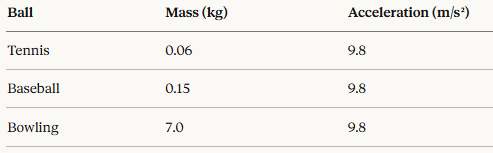
Students drop three balls of different masses from the same height and use motion sensors to collect data:
Which statement best identifies the relationship between mass and gravitational force shown in this data?
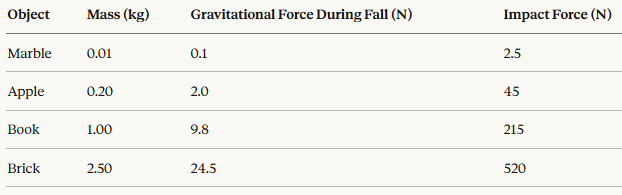
A class investigates the relationship between mass and gravitational force by dropping objects and measuring the force at impact using a force sensor. Their data shows:
Which interpretation best analyzes the relationship between mass and gravitational force for these falling objects?
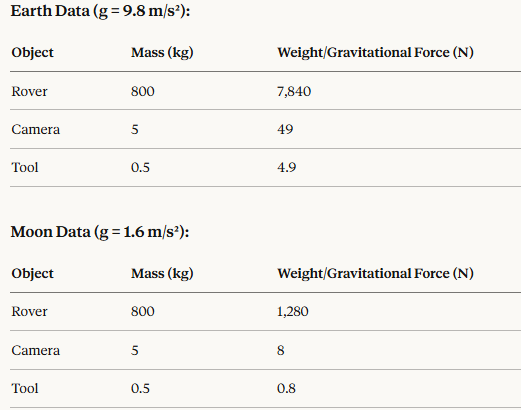
Students conduct an investigation comparing gravitational force on Earth and Moon by analyzing data from space mission records. They examine objects with different masses at each location:
Based on this data, which analysis best explains the relationship between mass, gravitational force, and location?
A student lifts a 20-newton box directly onto a shelf that is 2 meters high. Another student uses a ramp that is 4 meters long to push the same box onto the same shelf. Which statement best describes the work done in each situation?
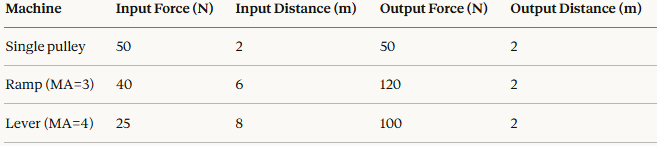
Students investigate simple machines by measuring input force, output force, input distance, and output distance for three different setups:
Which calculation correctly identifies the mechanical advantage and work relationship for the ramp?
An engineering team needs to move a 2,400 N engine from the ground to a platform 3 meters high. They consider three approaches:
Approach 1:
Direct lift (no mechanical advantage)
Required force: 2,400 N
Distance force applied: 3 m
Approach 2:
Ramp with 30° angle, length 6 meters
Required force: 1,200 N (ideal, no friction)
Distance force applied: 6 m
Approach 3:
Pulley system with mechanical advantage of 4
Required force: 600 N (ideal, no friction)
Distance rope pulled: 12 m
The team wants to minimize the force required while understanding the work-energy tradeoffs. Which analysis best uses mathematics to explain the relationships between work, mechanical advantage, and these simple machines?