Why Plastic Bags Stretch but Salt Crystals Shatter
Real-World Phenomenon
A plastic grocery bag can stretch, bend, and twist without breaking, while a grain of table salt shatters when crushed. Both materials are solids, yet they behave very differently when force is applied. Scientists explain this difference by modeling how atoms are arranged inside each material.
Solids are made of atoms arranged in specific ways. Even though plastic and salt are both solids, their atomic structures are very different, which explains why they behave differently under stress.
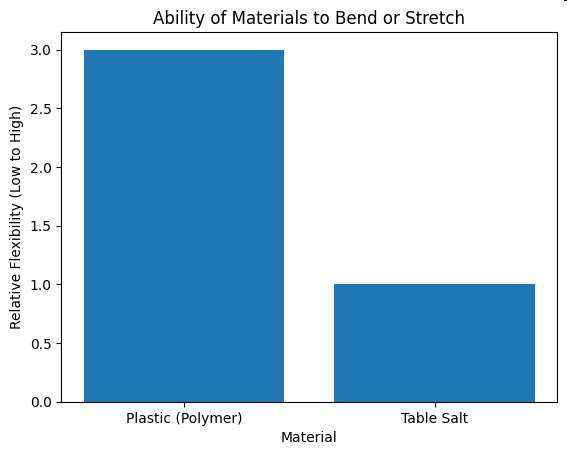
Plastic materials, such as plastic bags, are made of long molecules called polymers. These polymers are chains of repeating units, mostly made of carbon and hydrogen atoms. The chains are flexible and can slide past one another when pulled. Because the atoms are bonded in long chains rather than locked in place, the material can stretch without breaking.
Table salt, also known as sodium chloride, is not made of long molecules. Instead, it forms an extended structure called a crystal lattice. In this structure, sodium and chlorine atoms repeat in a rigid, organized pattern that extends in all directions. Each atom is strongly attracted to its neighbors, forming a stiff framework.
When force is applied to a salt crystal, the rigid lattice cannot bend or slide. Instead, the connections break suddenly, causing the crystal to crack or shatter. This is why salt grains break apart rather than stretch.
Scientists use models to represent these atomic arrangements. Polymer models show long, repeating chains, while crystal lattice models show a repeating pattern of atoms arranged in fixed positions. These models help explain how microscopic atomic structures lead to macroscopic properties, such as flexibility or brittleness.
By comparing the atomic composition and structure of plastics and salt, scientists can explain why materials that appear similar at a large scale can behave very differently.
Diagram 1.
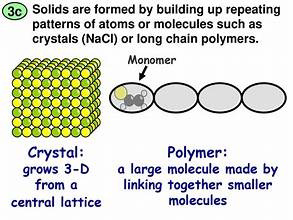 Source:
https://pp.one/
Diagram 2.
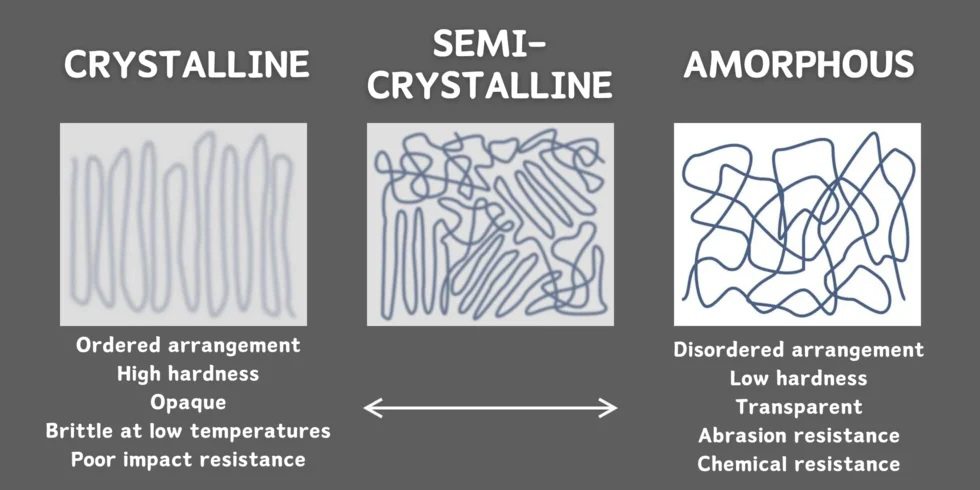 Source: https://www.lorric.com/en/Articles/Roechling/all/amorphous-vs-semi-crystalline
Table 1.
Material | Main Atom Types | Structure Type | Approximate Number of Atoms per Unit | Response to Pulling | Ability to Bend or Stretch |
|---|
Plastic (Polymer) | Carbon, Hydrogen | Molecule (Polymer Chain) | 1000 | Stretches | High |
Table Salt (Sodium Chloride) | Sodium, Chlorine | Extended Structure (Crystal Lattice) | 2 | Breaks | Low |
Graph of Information - Figure 1.
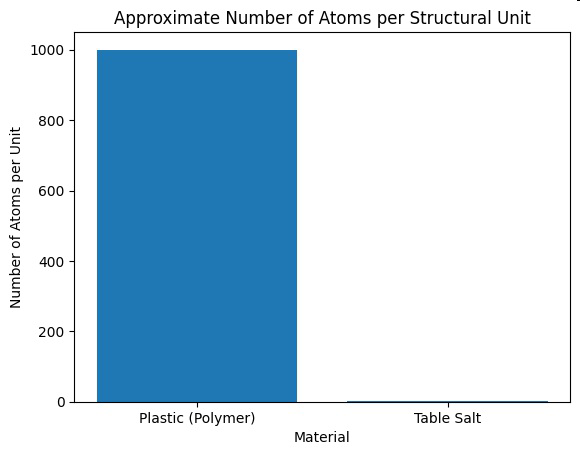
Graph of Information - Figure 2.