Why Quartz Crystals Are Hard but Sand Crumbles
Real-World Phenomenon
Quartz crystals are hard, shiny, and maintain sharp edges, while beach sand easily crumbles and shifts under pressure. Both materials are largely made of the same atoms: silicon and oxygen. Scientists explain these differences by modeling how atoms are arranged in extended structures at the atomic level.
Quartz and sand may look very different, but they share a similar chemical composition. Both are primarily made of silicon and oxygen atoms. The key difference lies not in which atoms are present, but in how those atoms are arranged.
Quartz is made of silicon dioxide, written as $SiO_2$. In quartz, each silicon atom is bonded to oxygen atoms in a repeating, three-dimensional pattern that extends throughout the crystal. This arrangement forms a strong, orderly crystal lattice. Because the structure repeats evenly in all directions, the atoms are tightly connected, making quartz hard and resistant to breaking.
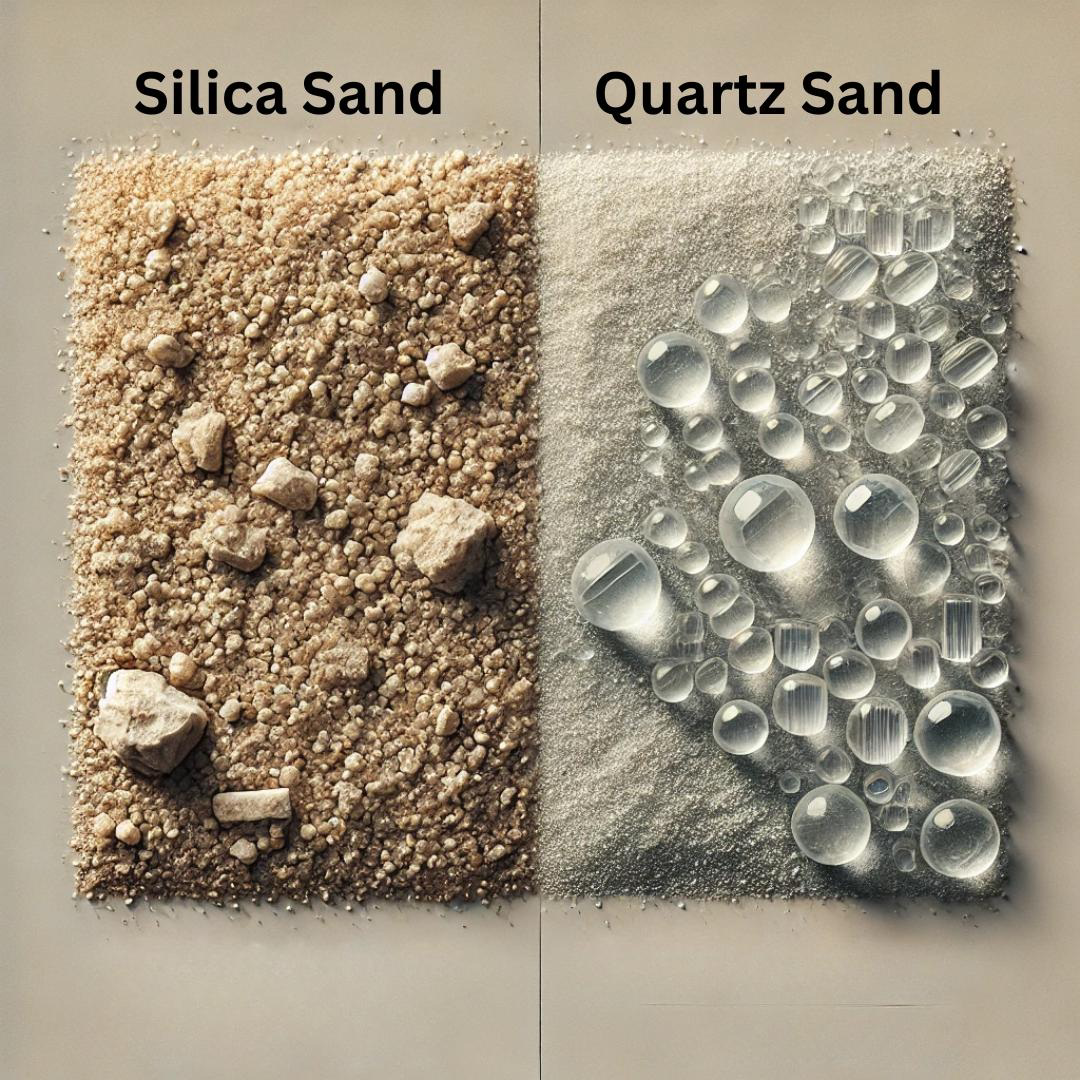
Sand grains are often fragments of quartz or other minerals that have been broken down by weathering. Although the atoms within each grain are still arranged in a crystal pattern, the grains themselves are small and irregular. Cracks, edges, and broken surfaces make sand much easier to crush or crumble compared to a large, intact crystal.
Scientists use models to represent these extended atomic structures. Lattice models show how atoms repeat in a pattern, while diagrams help explain how breaking the structure into smaller pieces changes the material’s properties. These models connect the invisible atomic arrangement to visible characteristics like hardness and durability.
By modeling how silicon and oxygen atoms form extended structures, scientists can explain why materials with the same chemical composition can have very different physical properties.
Diagram 1.
 Source:
https://silicasand.net/silica-sand/silica-sand-vs-quartz-sand-key-differences-and-applications
Diagram 2.
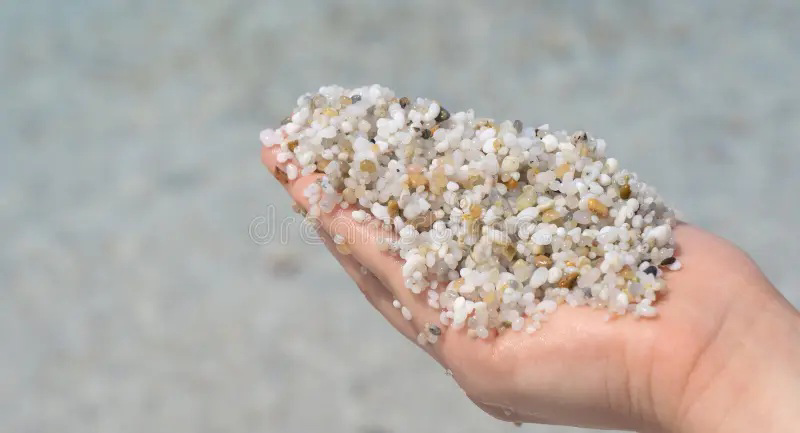 Source: https://www.dreamstime.com/hands-holding-quartz-sand-shaped-like-heart-crystal-clear-water-quartz-sand-hands-arutas
Table 1.
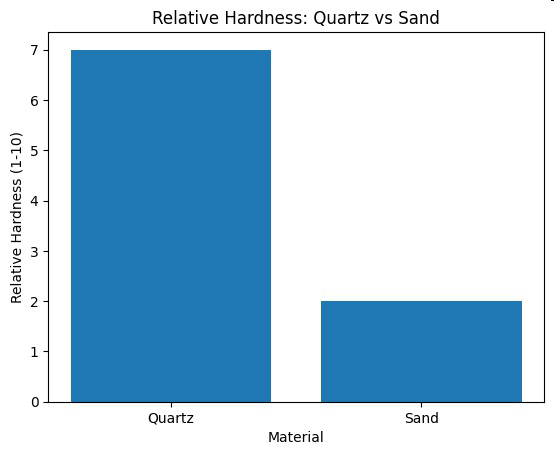
Material | Silicon Atoms per Unit | Oxygen Atoms per Unit | Total Atoms per Unit | Relative Hardness (1-10) | Structural Integrity |
|---|
Quartz (SiO$_2$, crystal) | 1 | 2 | 3 | 7 | High |
Sand (mostly SiO$_2$, fragments) | 1 | 2 | 3 | 2 | Low |
Graph of Information - Figure 1.
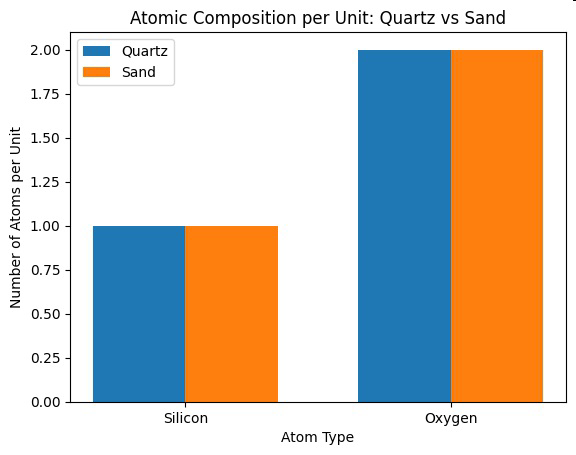
Graph of Information - Figure 2.