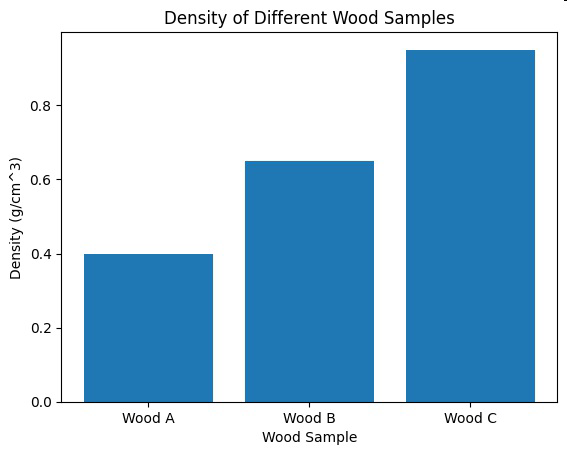
Why Some Types of Wood Float Higher Than Others
Real-World Phenomenon
When different types of wood are placed in water, some float high on the surface while others sit lower or nearly sink. Even though all the samples are wood, their behavior in water is different. Scientists can identify and compare these wood samples by measuring mass and volume and using density as evidence.
Density is a physical property that describes how much mass is packed into a given volume. It is calculated by dividing mass by volume. Because density does not change when the size or shape of a sample changes, it can be used to identify and compare materials.
Diagram 1.
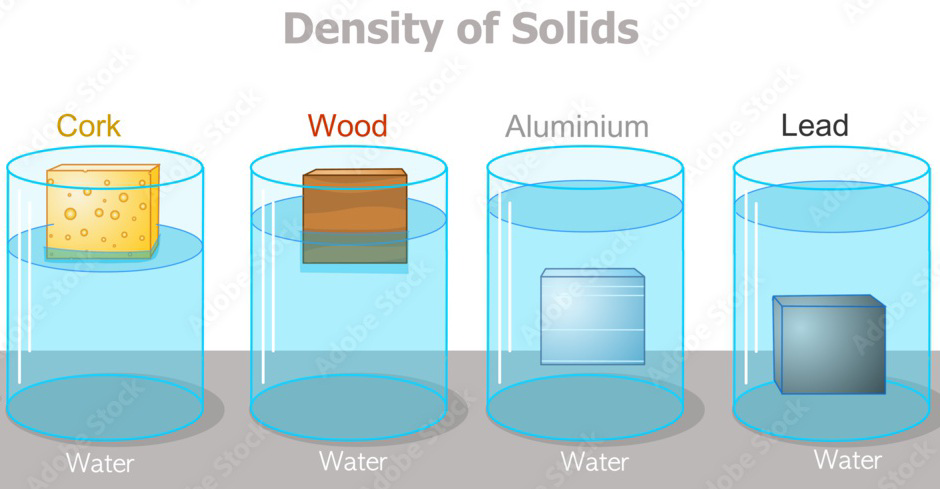 Source:
https://stock.adobe.com/in/images/density-different-solids-mass-volume-buoyancy-force-in-container
Wood comes from trees, but not all wood is the same. Different species of trees have different internal structures. Some woods have tightly packed fibers, while others contain more air spaces. These differences affect how much mass is present in a given volume of wood.
When a piece of wood is placed in water, its floating behavior depends on its density compared to the density of water. If the wood’s density is lower than water, it will float. If its density is close to water’s density, it will float lower. Wood with a higher density will sink or float just below the surface.
Scientists can measure the mass and volume of wood samples to calculate density. By comparing calculated densities, they can identify which type of wood is more dense and explain why it floats lower or higher in water. This method works even when wood samples are cut into different sizes.
Using density as evidence allows scientists to identify and compare materials based on measurable properties rather than appearance alone. Even though all the samples are wood, their different densities explain their different behaviors in water.
Diagram 2.
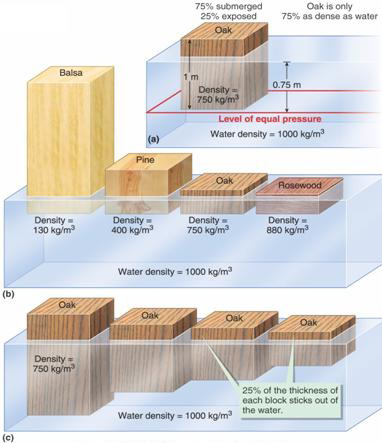 Source: https://thescienceofwood.weebly.com/activity-1-floating-wood.html
Table 1.
Wood Sample | Mass (g) | Volume (cm$^3$) | Density (g/cm$^3$) | Floating Behavior |
|---|
Wood A | 40 | 100 | 0.4 | Floats high |
Wood B | 65 | 100 | 0.65 | Floats low |
Wood C | 95 | 100 | 0.95 | Nearly sinks |
Graph of Information - Figure 1.
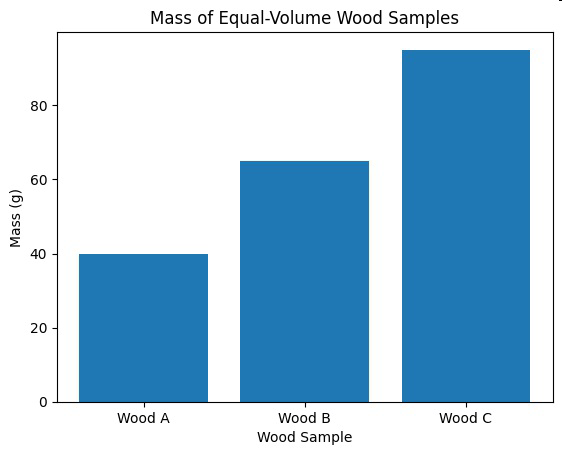
Graph of Information - Figure 2.