Analog Radio Static vs Digital Text Messages
Real-World Phenomenon
As a person moves farther away from a radio station, an analog radio signal becomes weaker and filled with static. At the same time, digital text messages sent from a phone still arrive clearly, or they resend automatically until the message is received correctly.
Information can be sent using signals that carry energy from one place to another. These signals can be analog or digital, and the way information is encoded affects how reliably it can be transmitted.
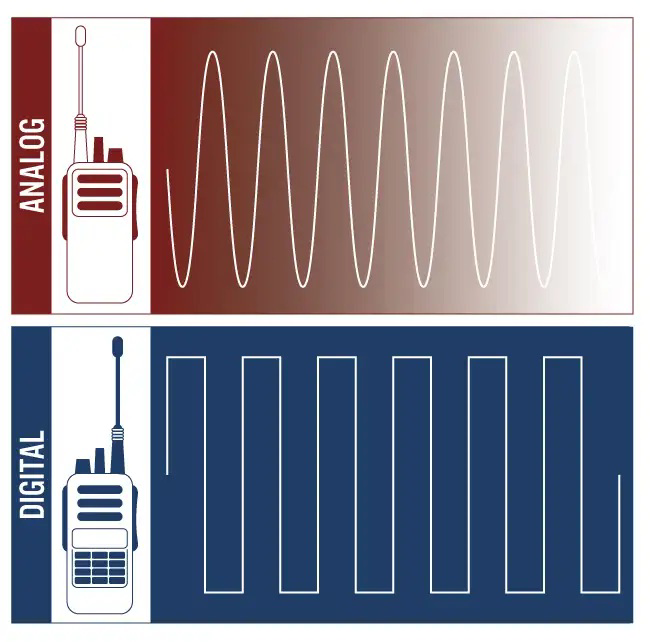
An analog radio signal represents sound as a continuous wave. As the signal travels farther from the radio station, it loses strength and is affected by interference from other signals and background noise. This interference changes the shape of the wave, causing static. As distance increases, the sound quality gradually gets worse, even though the signal is still present.
A digital signal, such as a text message, encodes information using discrete values, often represented as 0s and 1s. Each part of the message is sent as a packet of data. If a packet is affected by noise or interference, the system can detect the error and resend the packet. Because of this, digital messages usually arrive exactly the same as they were sent.
Diagram 1.
 Source: https://www.veicomm.com/blog/analog-vs-digital-radios-which-one-is-best/
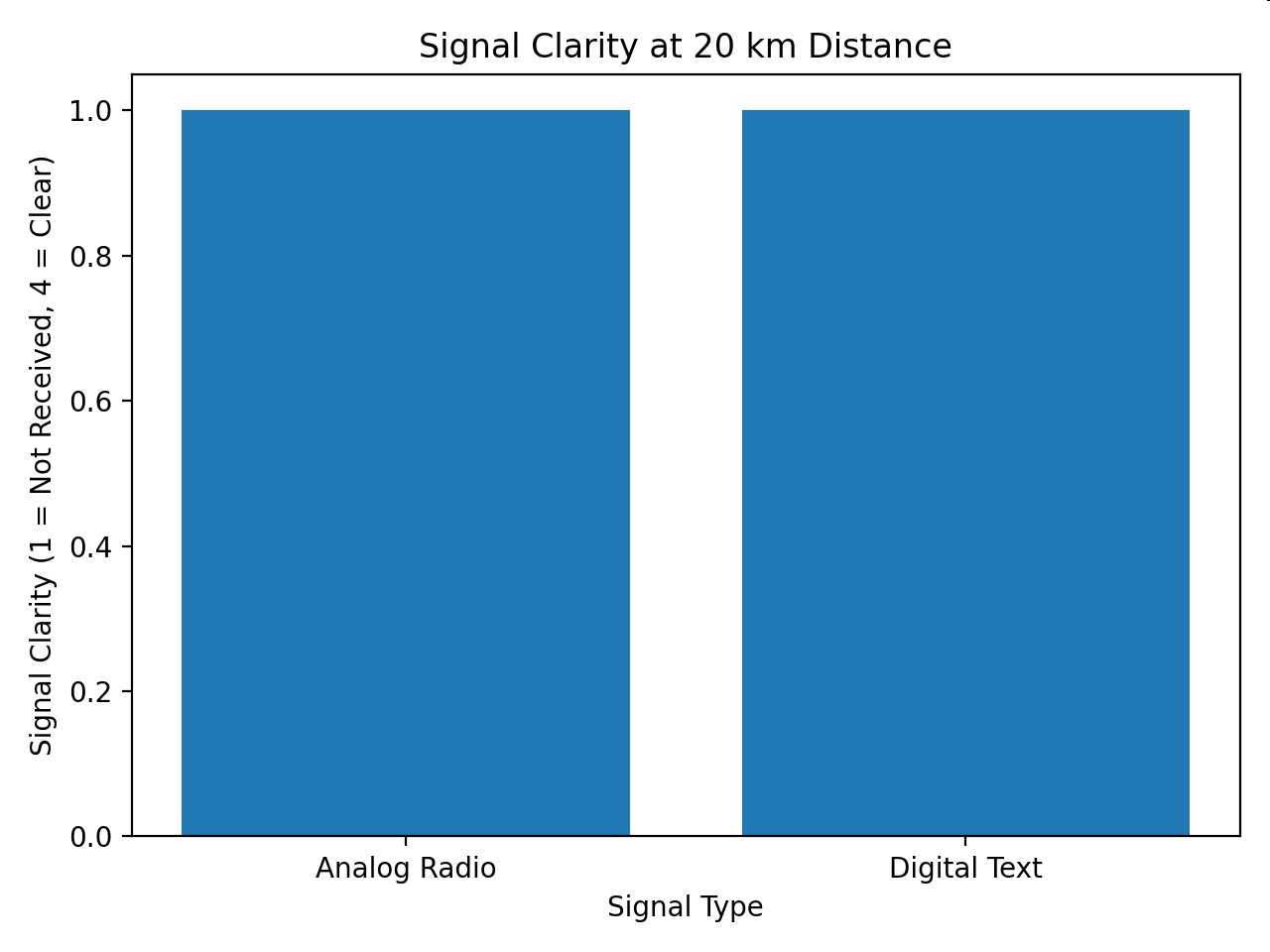
As distance increases, digital signals do not slowly become unclear. Instead, the message either arrives correctly or does not arrive at all. This makes digital communication more reliable for transmitting information accurately. Even in areas with weak signal strength, digital systems can repeat or correct data to reduce errors.
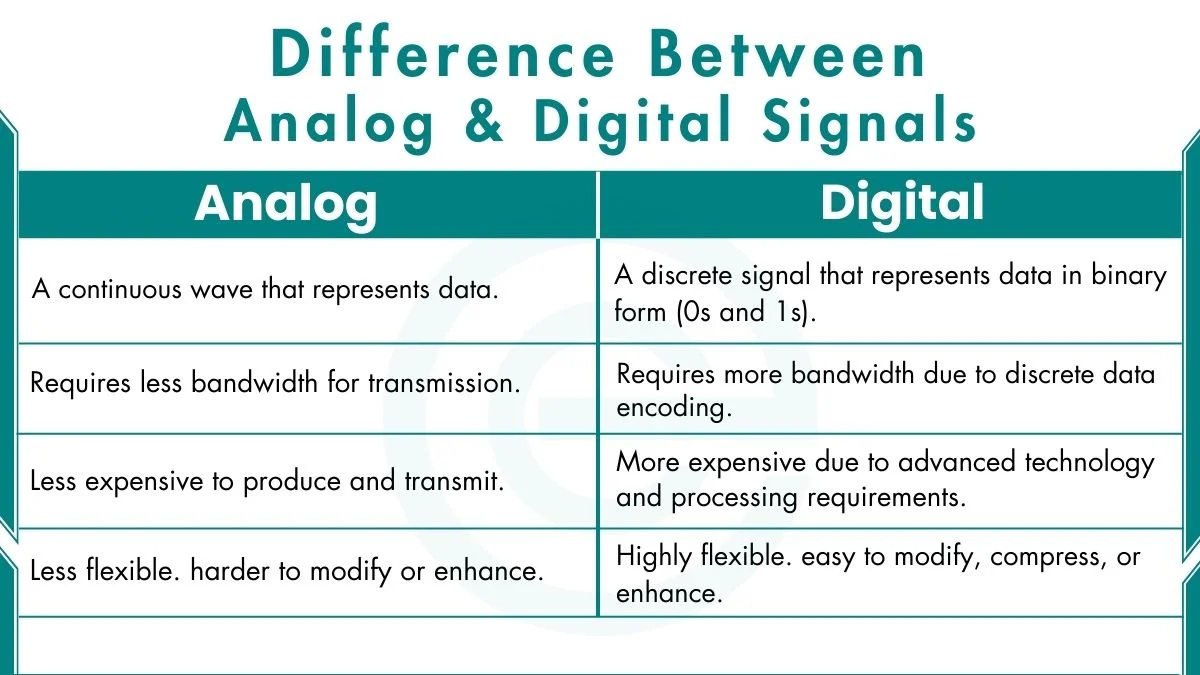
These observations show that digital signals are better at handling noise and interference than analog signals. By using error detection, discrete encoding, and automatic resending, digital signals preserve information more reliably than analog signals.
Diagram 2.
 Source: https://educatecomputer.com/difference-between-analog-and-digital-signals/
Table 1.
Distance from Transmitter (km) | Signal Type |
|---|
1 | Analog Radio |
5 | Analog Radio |
10 | Analog Radio |
15 | Analog Radio |
20 | Analog Radio |
1 | Digital Text |
5 | Digital Text |
10 | Digital Text |
15 | Digital Text |
20 | Digital Text |
Graph of Information - Figure 1.
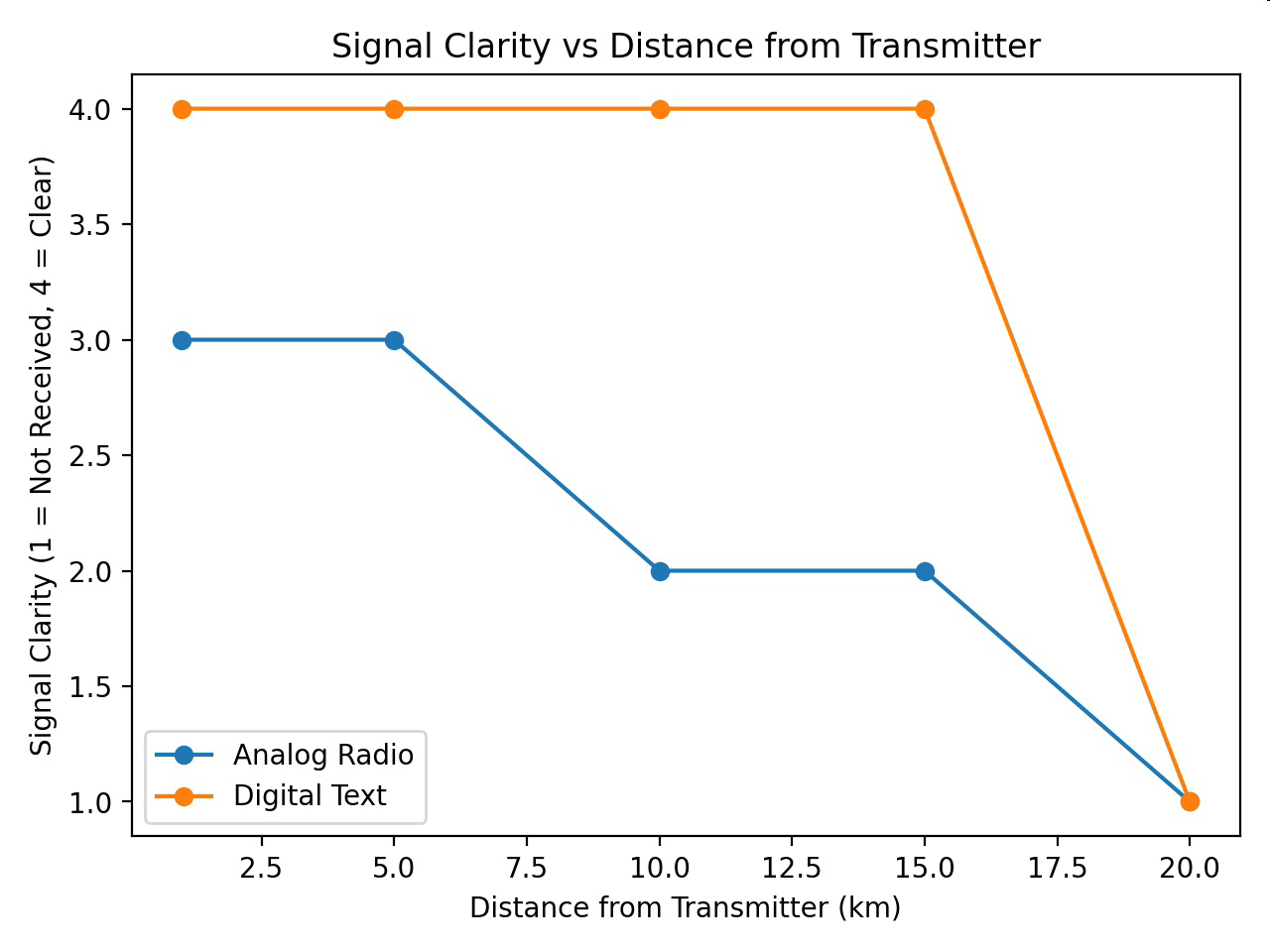
Table 2.
Signal Type | Distance from Transmitter (km) | Signal Clarity (1 to 4) |
|---|
Analog Radio | 1 | 3 |
Digital Text | 1 | 4 |
Analog Radio | 5 | 3 |
Digital Text | 5 | 4 |
Analog Radio | 10 | 2 |
Digital Text | 10 | 4 |
Analog Radio | 15 | 2 |
Digital Text | 15 | 4 |
Analog Radio | 20 | 1 |
Digital Text | 20 | 1 |
Graph of Information - Figure 2.