Vibrating Tuning Forks Creating Water Ripples
Real-World Phenomenon
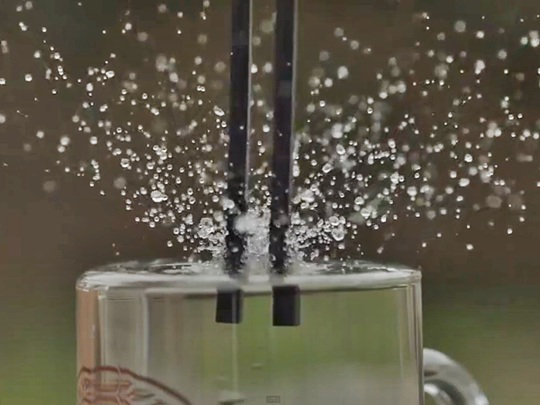
A tuning fork is tapped and then lightly touched to the surface of water. Ripples spread outward. When the tuning fork is struck harder, the ripples are taller. When a tuning fork with a higher vibration rate is used, the ripples appear closer together.
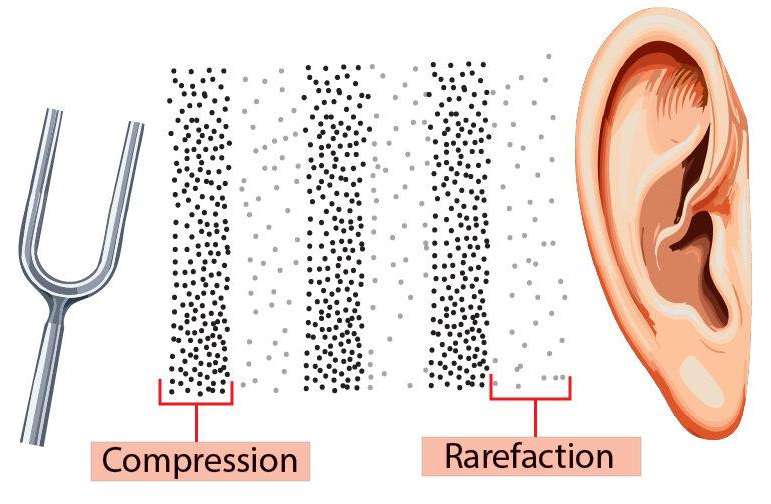
Diagram 1.
 Source:
https://scienceworksheets.co.uk/aqa-gcse-evidence-for-waves/
Waves transfer energy through a medium. When a tuning fork vibrates, it moves back and forth and transfers energy to nearby materials. If the vibrating tuning fork touches water, it transfers energy to the water and creates surface waves that move outward as ripples.
Three important wave properties are frequency, wavelength, and amplitude. Frequency is how many vibrations occur each second and is measured in hertz (Hz). A tuning fork labeled with a higher frequency vibrates more times per second. When the vibration frequency is higher, the ripples it creates are closer together. This means the wavelength, or the distance between wave crests, is shorter.
Amplitude is the height of the wave measured from the resting water level to the crest. When a tuning fork is struck harder, it vibrates with a larger amplitude. This transfers more energy to the water, producing larger ripples. Waves with larger amplitudes carry more energy because the water moves farther from its resting position.
Diagram 2.
Source:
https://hight3ch.com/mesmerizing-vibrations-from-tuning-fork-captured-in-super-slow-motion/
This phenomenon provides evidence that waves can be described using measurable quantities and mathematical relationships. Frequency and wavelength are related through the speed of the wave in the same medium, while amplitude is related to the energy carried by the wave. By observing the spacing and height of ripples, students can connect wave properties to the amount of energy being transferred.
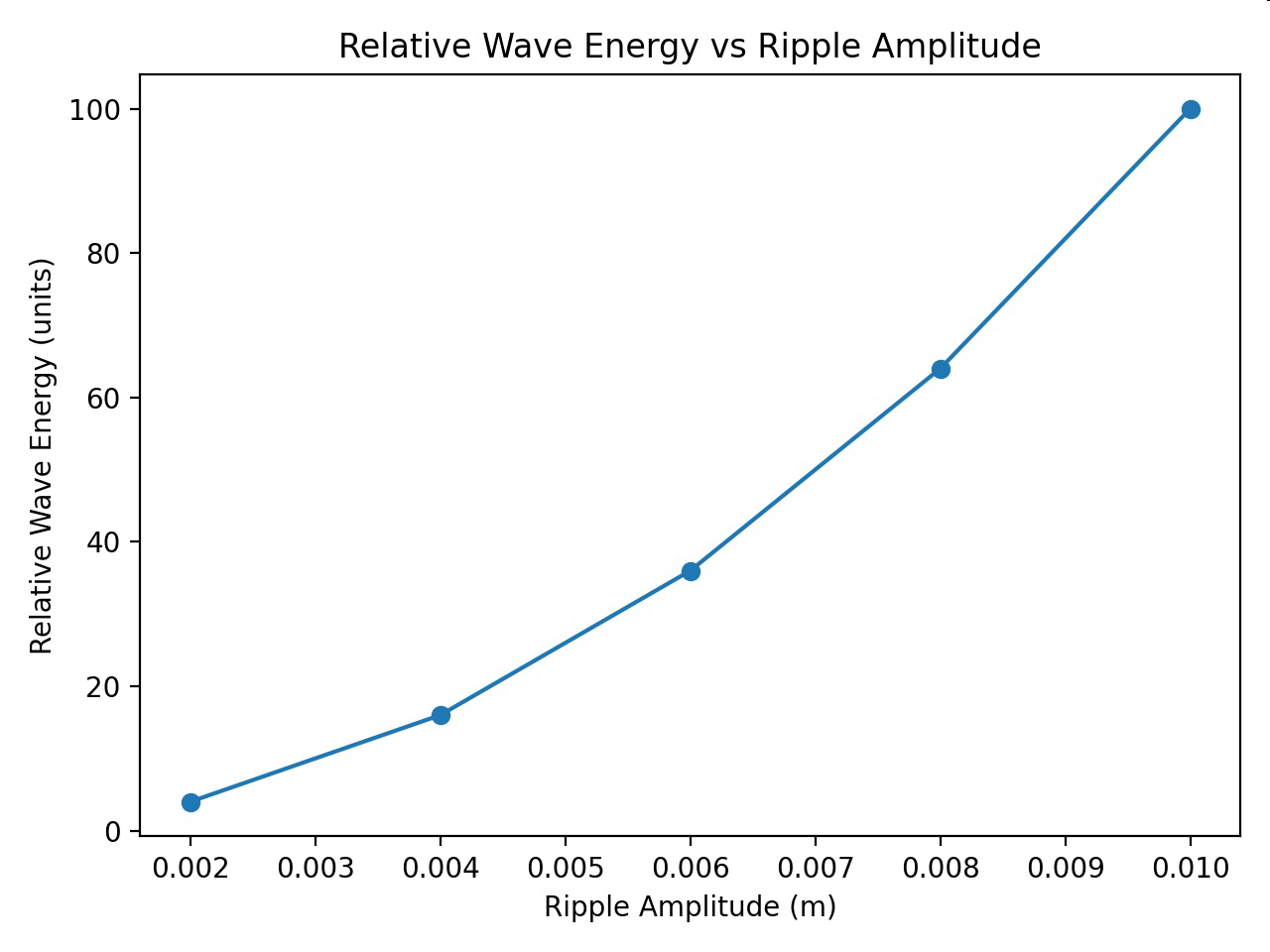
Table 1.
Tuning Fork Frequency (Hz) | Wavelength of Ripples (m) | Ripple Amplitude (m) | Relative Wave Energy (units) |
|---|
100 | 0.008 | 0.002 | 4 |
200 | 0.004 | 0.004 | 16 |
300 | 0.0027 | 0.006 | 36 |
400 | 0.002 | 0.008 | 64 |
500 | 0.0016 | 0.01 | 100 |
Graph of Information - Figure 1.
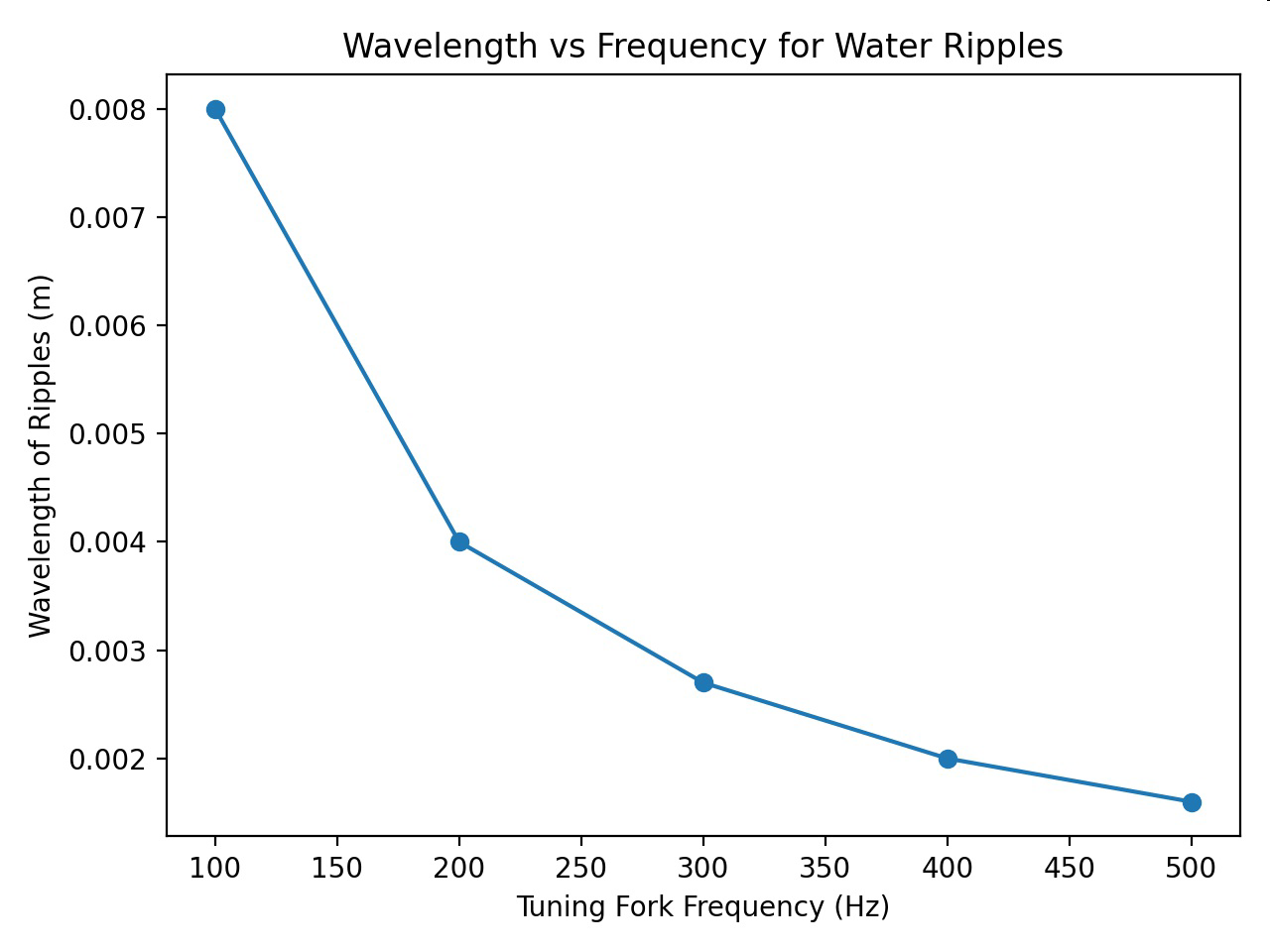
Graph of Information - Figure 2.