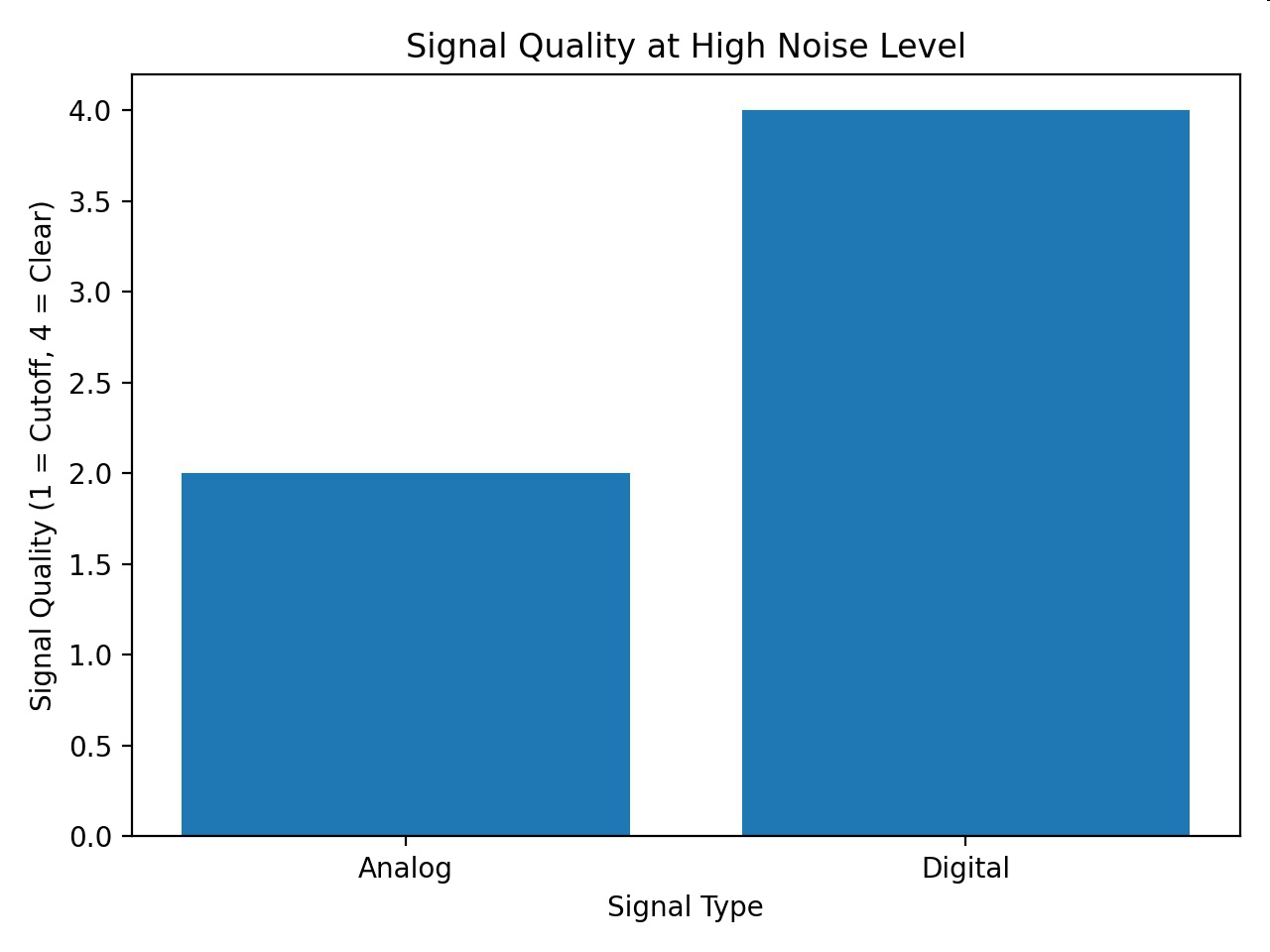
Analog vs Digital Music with Increasing Background Noise
Real-World Phenomenon
Music is played through an analog audio system and a digital audio system. As background noise increases, the analog music becomes fuzzy and distorted. The digital music stays clear until the noise becomes too strong, at which point the sound briefly cuts out or pauses.
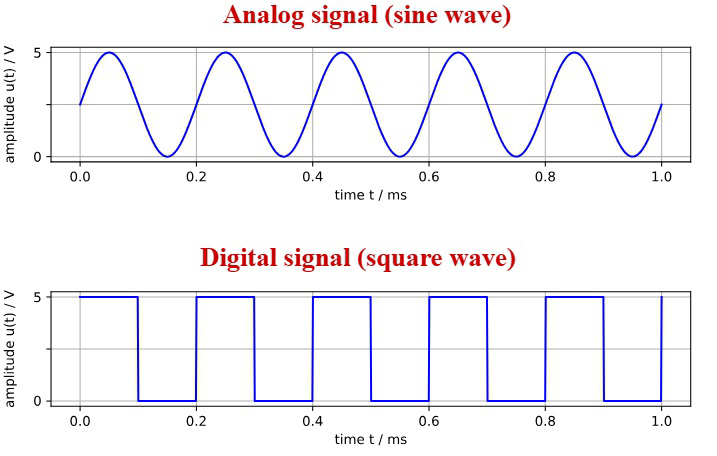
Diagram 1.
Source: https://www.weigu.lu/tutorials/microcontroller/01_numbers_codes/index.html
Information can be sent using signals. These signals can be analog or digital, and the way information is encoded affects how reliably it can be transmitted.
An analog signal changes smoothly and continuously. In an analog music system, sound is represented by a wave that closely matches the shape of the original sound waves. Because the signal is continuous, any interference or background noise slightly changes the shape of the signal. As noise increases, the signal becomes more distorted, and the music gradually sounds worse.
A digital signal represents information using discrete values, often shown as 0s and 1s. Instead of copying the exact shape of the sound wave, the system records samples of the sound and converts them into digital data. When the digital signal is transmitted, small amounts of noise do not usually change whether the signal is read as a 0 or a 1. This allows the original sound to be reconstructed accurately.
As background noise increases, digital music usually remains clear because the system can ignore small errors or correct them. However, if the noise becomes too strong, the system may not be able to read the signal correctly. When this happens, the sound may briefly cut out rather than slowly becoming distorted.
This difference shows why digitized signals are more reliable. Analog signals degrade gradually as noise increases, while digital signals resist noise and preserve the original information. Digital systems also often include error detection and correction, which helps ensure that the transmitted information matches the original.
Table 1.
Noise Level | Signal Type |
|---|
Low | Analog |
Medium | Analog |
High | Analog |
Very High | Analog |
Low | Digital |
Medium | Digital |
High | Digital |
Very High | Digital |
Graph of Information - Figure 1.
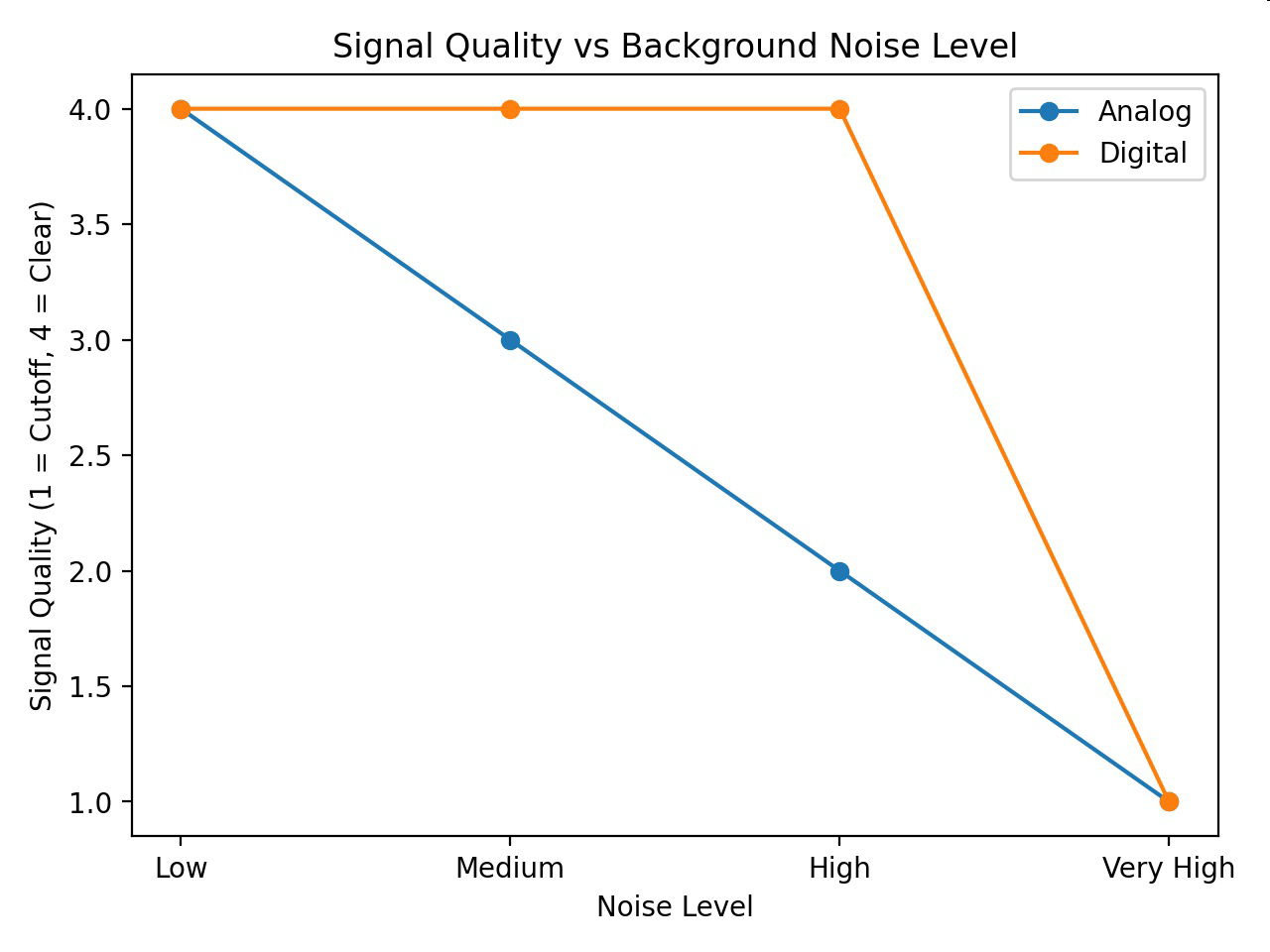
Table 2.
Signal Type | Noise Level | Signal Quality (1 to 4) |
|---|
Analog | Low | 4 |
Analog | Medium | 3 |
Analog | High | 2 |
Analog | Very High | 1 |
Digital | Low | 4 |
Digital | Medium | 4 |
Digital | High | 4 |
Digital | Very High | 1 |
Graph of Information - Figure 2.