This is a post-lab for the Blood Types Lab we will complete during class on Tue/Wed (2/10 - 2/11).
You need your "ERHT Treatment Document" to be able to answer the questions in this assignment. The first two questions will also ask you to upload clear, readable images of your completed ERHT Treatment Document.
Asemmisa {{asɛmmisaAhyɛnsode}}
1.
Insert one image of the front side of your ERHT Treatment Document to this question.
Make sure all questions are answered, and all data tables are filled in (for ALL family members).
Use the blue "+" sign to insert the image, and resize the image as needed to make sure it is large enough to be readable!
Asemmisa {{asɛmmisaAhyɛnsode}}
2.
Insert one image of the back side of your ERHT Treatment Document to this question.
Make sure your pedigree is complete, with all names, blood types, and genotypes filled in (and readable).
Use the blue "+" sign to insert the image, and resize the image as needed to make sure it is large enough to be readable!
Asemmisa {{asɛmmisaAhyɛnsode}}
3.
[MARK ALL THAT APPLY!]
Which individual(s) from this family pedigree can safely donate to John?
Asemmisa {{asɛmmisaAhyɛnsode}}
4.
[MARK ALL THAT APPLY!]
Which individual(s) from this family pedigree can safely donate to Sue?
Asemmisa {{asɛmmisaAhyɛnsode}}
5.
[MARK ALL THAT APPLY!]
One of the people who cannot donate to John is Jen.
Which of the following option(s) lists reasons WHY Jen is not able to donate to John?
Asemmisa {{asɛmmisaAhyɛnsode}}
6.
Some researchers are currently exploring the possibility of generating artificial blood in a lab. One method being explored is to take adult blood stem cells and cause them to differentiate (specialize) into red blood cells. If enough of these stem cells are maintained and scaled up, this could potentially lead to a new source of blood for transfusions, without needing to wait for donors each time!
If a researcher were interested in trying to create these lab-generated blood samples, it would be best if they focused on creating blood. This would be the best choice due to the of on the red blood cells in this blood type. This means that the in the recipient's body will not react to the transfused blood.
Asemmisa {{asɛmmisaAhyɛnsode}}
7.
Identify which possible genotype(s) each indicated person could have, by dragging and dropping genotypes to each person.
Answers can be used more than once or not at all, and people may have multiple possible genotypes!
IAIA
IAi
IBIB
IBi
IAIB
ii
Ellen
Nick
Mike
Sue
Asemmisa {{asɛmmisaAhyɛnsode}}
8.
Choose "yes" or "no" for each question below.
If this scenario had happened a bit differently, such that Sue was in need of a transfusion but John was healthy and uninjured, would it have been possible for John to donate blood to Sue?
If the opposite occurred, such that John was in need of a transfusion but Sue was healthy and uninjured, would it have been possible for Sue to donate blood to John?
Based on John and Sue's known medical information, would it be possible for them to ever have a child together that has Type O blood?
Asemmisa {{asɛmmisaAhyɛnsode}}
9.
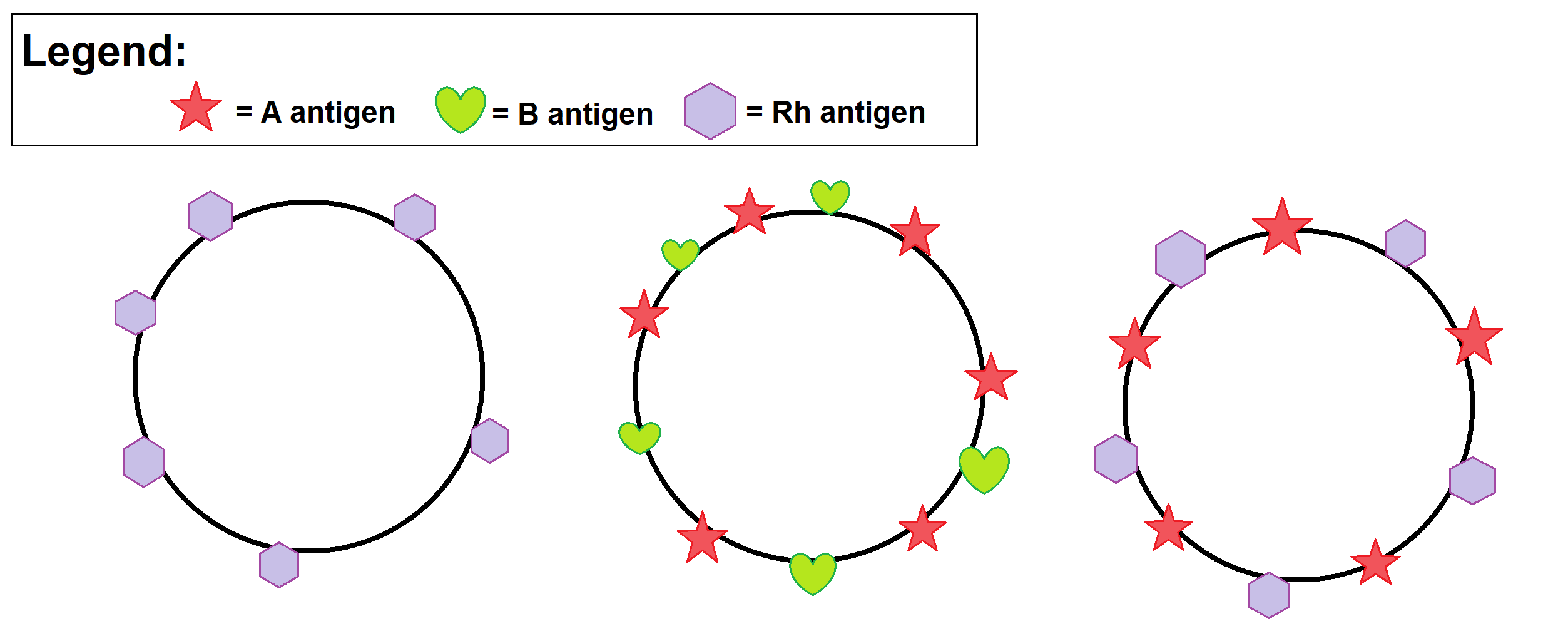
Review the image below. Then, drag and drop the correct blood type for each drawing.
Some answer choices may not be used, while others may be used more than once.
Mmuae Afoforo a Wobɛpaw:
Type B -
Type A +
Type AB +
Type O -
Type O +
Type AB -
Type B +
Type A -
Asemmisa {{asɛmmisaAhyɛnsode}}
10.
The blood type AB+ is sometimes referred to as the "universal recipient". Why is this?
Your answer must:
be 1-2 full sentences long (no more or less)
include "antigens" and "antibodies" in your specific explanation of WHY