Log in
Sign up for FREE
arrow_back
Library

Practice ACT - Math - MC5

star
star
star
star
star
Last updated about 3 hours ago
45 questions
Note from the author:
1
F
1
IES
1
N
1
IES
1
N
0
1
F
1
A
1
A
1
S
1
A
1
G
1
G
1
N
0
1
S
1
IES
1
S
1
F
1
IES
1
F
1
G
1
IES
0
1
S
1
A
1
A
1
A
1
IES
1
F
1
A
0
1
N
1
N
1
F
1
IES
1
F
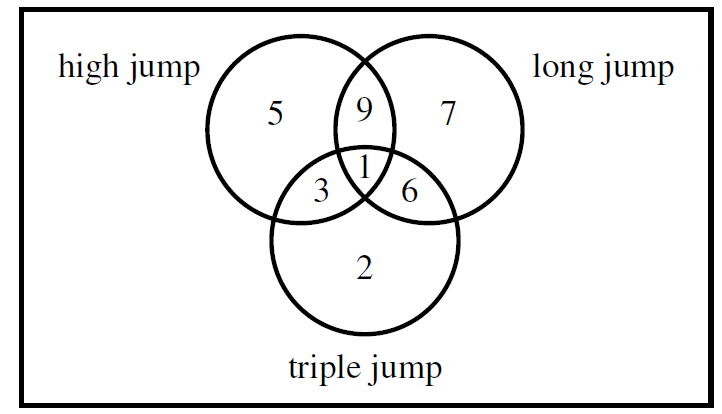
Venn diagram below shows the distribution of the number of athletes competing in each jumping event.
1
Question 1
1.

S
Question 2
2.

Question 3
3.

Question 4
4.

Question 5
5.

Question 6
6.

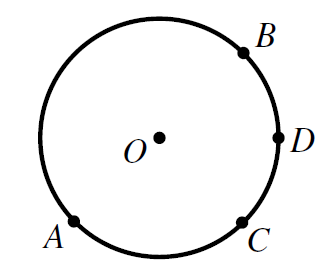
A black line drawing of a circle on a white background. The center of the circle is marked with a solid black dot and labeled with the letter O. Four additional solid black dots are located on the edge (circumference) of the circle:  Point A is in the lower-left quadrant.  Point B is in the upper-right quadrant.  Point D is on the far right edge (3 o'clock position).  Point C is in the lower-right quadrant, positioned between point D and the bottom of the circle.
1
Question 7
7.

G
Question 8
8.

Question 9
9.

Question 10
10.

Question 11
11.

Question 12
12.

Question 13
13.

Question 14
14.

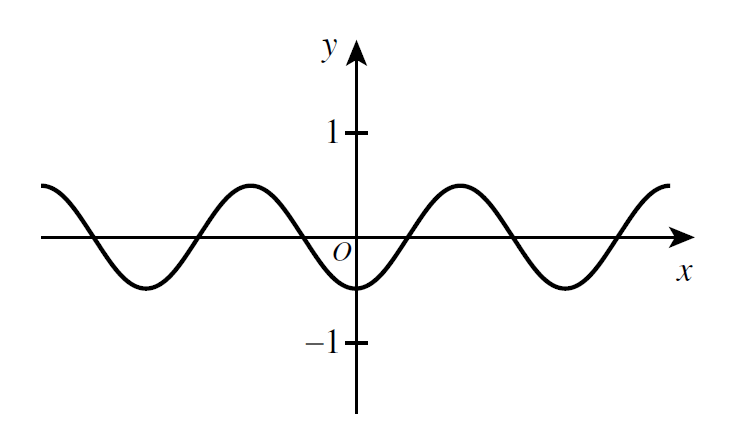
A mathematical graph on a Cartesian coordinate system with $x$ and $y$ axes.Axes: The y-axis is labeled with "1" and "-1" tick marks. The origin is labeled "O".Function: A smooth, periodic wave (sinusoidal) is plotted.Key Features: The curve crosses the y-axis at its minimum point ($0, -1$). It reaches a maximum height of $1$ and a minimum of $-1$. The wave repeats consistently across the visible x-axis, showing approximately two and a half full cycles.
1
Question 15
15.

F
Question 16
16.

Question 17
17.

Question 18
18.

Question 19
19.

Question 20
20.

Question 21
21.

Question 22
22.

Question 23
23.

Question 24
24.

Question 25
25.

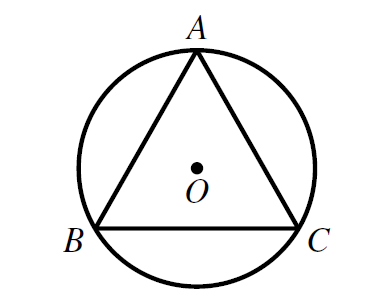
A black line drawing featuring a circle and a triangle.Circle: The circle has a center marked with a solid dot and labeled with the letter O.Triangle: An inscribed triangle is positioned inside the circle so that all three vertices touch the circle's circumference.Labels: The top vertex is labeled A, the bottom-left vertex is labeled B, and the bottom-right vertex is labeled C. The base of the triangle, segment BC, is a horizontal line.
1
Question 26
26.

G
Question 27
27.

Question 28
28.

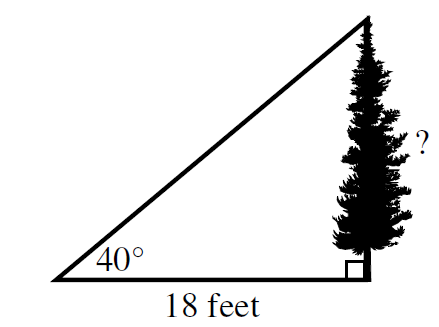
A diagram representing a real-world trigonometry problem.Geometry: A right-angled triangle is formed by a horizontal ground line, a vertical tree, and a diagonal line of sight (hypotenuse). A square symbol at the base of the tree indicates a $90$-degree angle.Measurements: The horizontal distance from the far vertex to the base of the tree is labeled "18 feet". The angle of elevation at the far vertex is labeled "40°".Objective: The vertical height of the tree is marked with a question mark (?), indicating the value to be solved.
1
Question 29
29.

G
A black horizontal line with arrows on both ends, representing a number line.Endpoints: The leftmost marked point is labeled "0" and the rightmost marked point is labeled "8".Points: There are six equal segments between 0 and 8. Five intermediate points are marked with solid dots and labeled consecutively from left to right as "A", "B", "C", "D", and "E".
1
Question 30
30.

IES
Question 31
31.

Question 32
32.

Question 33
33.

Question 34
34.

Question 35
35.

Question 36
36.

Question 37
37.

Question 38
38.

Question 39
39.

Question 40
40.

Question 41
41.

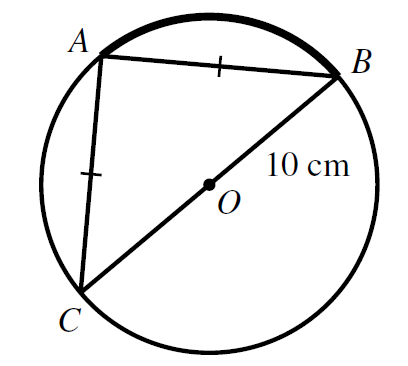
A circle with center O containing an inscribed triangle ABC.Diameter: Segment BC passes through the center point $O$ and is labeled "10 cm", identifying it as the diameter.Triangle: Triangle ABC is inscribed in the circle. Side AB and side AC each have a single tick mark, indicating they are equal in length (isosceles triangle).Arc: The arc between points A and B is highlighted with a thicker black line.
1
Question 42
42.

G
Question 43
43.

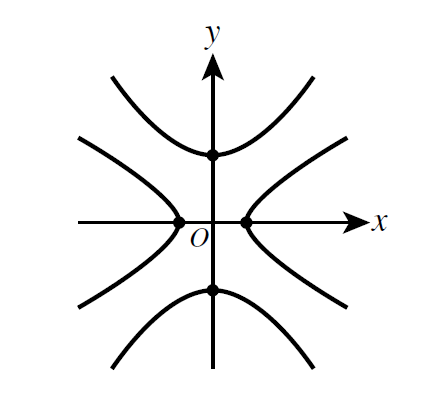
A graph showing four separate curved branches on x and y axes.Orientation: Two branches open vertically (one up, one down) and two branches open horizontally (one left, one right).Vertices: Each of the four branches has a vertex marked with a solid black dot where it is closest to the origin O.Symmetry: The curves are perfectly symmetrical across both the x-axis and the y-axis.
1
Question 44
44.

G
Question 45
45.