Log in
Sign up for FREE
arrow_back
Library

Review Benchmark 3

star
star
star
star
star
Last updated 4 months ago
54 questions
Note from the author:
1
L.8.2C.1
1
L.8.2A.4
1
L.8.4B.2
1
L.8.2A.2
1
L.8.2A.2
1
L.8.4A.2
1
L.8.2B.1
1
L.8.2B.2
1
L.8.2B.3
1
L.8.4A.2
1
L.8.4B.1
1
L.8.4A.2
1
L.8.4A.2
1
L.8.4A.2
1
L.8.2B.1
1
L.8.2A.2
1
L.8.4A.2
1
L.8.4A.1
1
L.8.2B.2
1
L.8.2B.2
1
L.8.2A.1
1
L.8.4B.2
1
L.8.4B.2
1
L.8.4B.1
1
L.8.2A.1
L.8.2A.3
…
1
L.8.2A.1
L.8.2A.3
…
1
L.8.2A.1
L.8.2A.3
…
1
L.8.2A.1
L.8.2A.3
…
1
L.8.2A.1
L.8.2A.3
…
1
L.8.2A.1
L.8.2A.3
…
1
L.8.2A.1
L.8.2A.3
…
1
L.8.2A.1
L.8.2A.3
…
1
L.8.2A.1
L.8.2A.3
…
1
L.8.2A.1
L.8.2A.3
…
1
L.8.2A.1
L.8.2A.3
…
1
L.8.2A.1
L.8.2A.3
…
This is a formative review for 8th grade science.
1
1
1
1
1
1
1
1
1
1
1
Question 11
11.

1
1
1
1
1
1
1
Question 18
18.
Question 19
19.

Question 20
20.

Question 21
21.

Question 22
22.

Question 23
23.

Question 24
24.

Question 25
25.

Question 26
26.

Question 27
27.

Question 28
28.

Question 29
29.

Question 30
30.

Question 31
31.

Question 32
32.

Question 33
33.

Question 34
34.

Question 35
35.

Question 36
36.

Question 37
37.

Question 38
38.

Question 39
39.

Question 40
40.

Question 41
41.

Question 42
42.

Question 43
43.

Question 44
44.

Question 45
45.

Question 46
46.

Question 47
47.

Question 48
48.

Question 49
49.

Question 50
50.

Question 51
51.

Question 52
52.

Question 53
53.

Question 54
54.

Question 1
1.
Question 2
2.
Question 3
3.
Question 4
4.
Question 5
5.
Question 6
6.
Question 7
7.
Question 8
8.
Question 9
9.
Question 10
10.
Question 12
12.
Question 13
13.
Question 14
14.
Question 15
15.
Question 16
16.
Question 17
17.
F
G
H
J
F
G
H
J
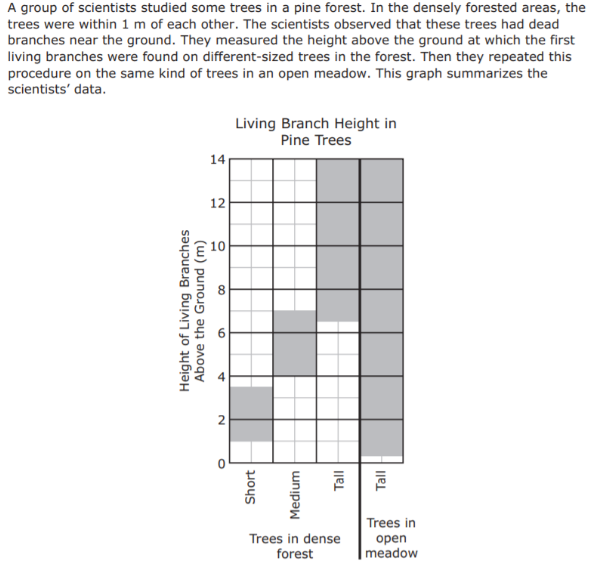
Pine trees in a dense forest can grow taller than pine trees in an open meadow.
Pine trees in a dense forest compete for sunlight with the surrounding trees.
Pine trees in a dense forest are part of a less-complex food web than pine trees in an open meadow.
Pine trees in a dense forest have more living branches than pine trees in an open meadow.
A
B
C
D
F
G
H
J
The male offspring receive the taits from the male parent, and the female offspring receive the traits from the female parent.
All the offspring will have the traits exhibited by the male parent.
Sexual reproduction does not change the genetic combinations of the offspring.
Sexual reproduction results in possible new combinations of genes in the offspring.
Hollow bones in birds
Bright, colorful feathers
Sweet-smelling, colorful flowers
Doing a complicated courtship dance
A
B
C
D
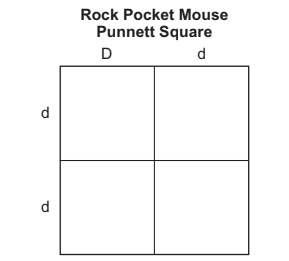
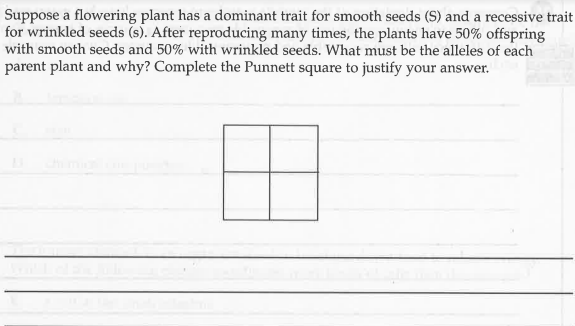
SS, Ss
SS, ss
Ss, ss
Ss, Ss
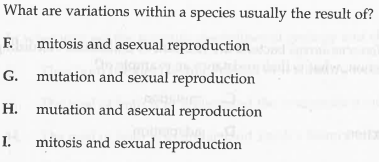
F
G
H
I
A
B
C
D
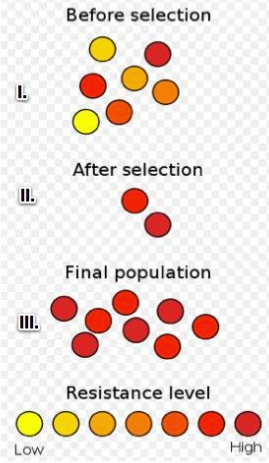
There is a change in the environment. An antibiotic is added. Some of the bacteria adapt to the new environment. They survive and reproduce.
In any population, variation exists. Some bacteria are resistant to antibiotics. Most bacteria die, but the bacteria that are resistant survive and reproduce.
Sexual reproduction of bacteria cause variation. Some bacteria survive antibiotics and some do not. Regardless, over time all of the bacteria should become extinct.
In a population of bacteria that are exposed to antibiotics, some bacteria are able to change their genetic make-up and survive. The new genotype is passed on to offspring.
homologous
analogous
vestigial
non-relatable
How does meiosis contribute to the genetic variability in offspring?
It involves duplicating chromosomes.
It creates genetically identical offspring.
It produces gametes with genetic diversity.
It repairs damaged DNA.
How does natural selection affect populations over time?
It decreases all traits equally
It creates new species instantly
It eliminates all weak traits
It increases traits that enhance survival.
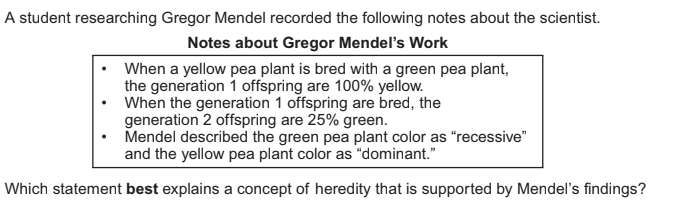
What did Gregor Mendel study to show heredity?
He focused on environmental changes
He studied pea plant traits and patterns.
He analyzed human genetics
He studied animal behavior
What are genes responsible for?
Genes are not passed to offspring
Genes influence only climate adaptation
Genes only affect physical appearance
Genes determine inherited traits of organisms.
Why do some organisms survive better in specific environments?
Only size matters for survival
All traits are equally beneficial
Genetic variations can enhance survival chances.
Survival is random and not genetic
What can affect an organism's growth?
Height is only because of environment
Both genetic and environmental factors play a role.
Growth depends on food alone
Only genetic factors matter
What occurs during meiosis?
Chromosomes double and stay the same
Homologous chromosomes segregate and recombine.
All DNA is lost during division
Cells divide without genetic change
How do traits become more common in a population?
New traits emerge every generation
Traits are randomly inherited without change
All traits disappear over time
Natural selection favors advantageous traits.
What did Mendel's experiments reveal about traits?
Traits can be dominant or recessive.
All traits are inherited equally
Traits come only from one parent
Traits are always blended together
What are chromosomes made of?
Chromosomes consist only of RNA
Chromosomes are made of DNA and proteins.
Chromosomes are liquids in cells
Chromosomes are made of carbohydrates
What explains the variation of traits in a population?
Genetic variations lead to differences in traits.
Trait variations occur solely from environmental factors.
Traits remain unchanged across generations.
Individuals in a population are genetically identical.
What is the result of successful natural selection?
All traits become perfectly suited
Elimination of all less favorable traits
Increased frequency of beneficial traits.
Creation of entirely new species
A
B
C
D
A
B
C
D
A
B
C
D
A
B
C
D
A
B
C
D
A
B
C
D
A
B
C
D
A
B
C
D
A
B
C
D
A
B
C
D
A
B
C
D
A
B
C
D
A
B
C
D
A
B
C
D
A
B
C
D
A
B
C
D