Twa kɔ nsɛm atitiriw so
Log in
Sign up for FREE
arrow_back
Laabri

Week 4.1: Texas State Reading Test

star
star
star
star
star
Last updated about 2 hours ago
41 Nsɛmmisa
Year-Long Summer
Cultural Cooking Connections & Tradition with a Twist
The Big Race
Fostering Positive Experiences
Junior Park Rangers

Click submit when finished with all questions and check your answers. You may not be able to make corrections at this time.

Year-Long Summer

1 In the high branches of an oak tree in a beautiful little nest lived Robin. Squirrel and Robin were great friends and spent their summer together.

2 Soon the days grew shorter and the air grew colder. Squirrel knew this meant she needed to start preparing for the cold winter. She worked hard adding more foliage to her nest. She spent days gathering nuts and seeds. Squirrel couldn't wait for hibernation, since she loved sleeping in her cozy hollow all winter and relaxing after the busy bustle of autumn.

3 Robin, on the other hand, could not stand the idea of hibernating. Even so, she worked alongside Squirrel, padding her nest and storing food.

4 "I wish summer would last all year," cried Robin.

5 "Why?" replied Squirrel. "Winter is a wonderful season."

6 "I dread winter," complained Robin. "It is freezing, and all the animals are asleep. I don't have anyone to keep me company."

7 "Why don't you sleep like the rest of us?" asked Squirrel.

8 "I can't sleep," replied Robin, "because once the light of morning reaches my nest, I wake up."

9 "You should winter in the hollow this year," replied Squirrel. "The light never reaches me."

10 So, Squirrel helped Robin move into the hollow. Soon autumn turned to winter and, just like winters in the past, Squirrel quickly feel asleep. The first night was restful for Robin, but in the morning she could sense the rising sun. Even though the hollow was dark, she awoke at dawn as usual.

11 "This will never do," she said to herself.

12 She thought about waking up Squirrel, but Squirrel looked so happy sleeping snugly in her corner of the hollow. Robin tried to go back to sleep, but sleep would not come. She wanted to sing her morning song, but she didn't want to wake up Squirrel. She started pacing around the hollow, trying desperately to think of a way to sleep.

13 Squirrel was not slumbering as soundly as usual. She loved her long nap, but she could hear Robin pacing to and fro and humming her morning song. Squirrel became annoyed.

14 "What are you doing?" asked Squirrel.

15 "Oh, I'm sorry, did I wake up?" asked Robin. "I just can't stay asleep. When the morning comes, I must get up. I don't think I can stay in the hollow all winter."

16 Squirrel and Robin tried to think of a solution. At first Robin considered going back to her nest, but all her leaves and twigs were in the hollow and snow blanketed the ground outside. Rebuilding it would be tedious, frigid chore. Then Squirrel suggested that Robin feast on some of the nuts and seeds they had stored in the hollow. "Eating a lot always makes me tired," Squirrel said with a yawn.

17 Robin tried to stuff herself with delicious food stores, but she could only eat a little bit at a time. "It's useless!" Robin cried. "I want to live where it is never winter!"

18 "That's it!" exclaimed Squirrel, "Your wings are strong. You can fly to where it's warm."

19 "But you are my friend. I can't leave you!" Robin gasped.

20 "I'll be sleeping all winter - you should fly south where it is warm, and in the spring, you can fly back here. I'll be awake by the time you get back, and we can have all summer together."

21 Robin considered Squirrel's idea, and thoughts of warmth filler her like rays from the sun. If she went south for winter, she could have summer year round, while Squirrel could hibernate in peace. "This is a wonderful idea," she said. "I will leave at once."
1
1
1
1
1
1
1
1
1
1
1
1
2
1
1
1
1
1
1
1
1

Andy wrote this paper about running in a challenging race. Read Andy's paper and look for revisions he needs to make. Then answer the questions that follow.

The Big Race

(1) My older brother Alex is on his middle school cross-country team. (2) I'm trying to earn a position on our neighborhood soccer team. (3) We live in a small neighborhood that includes only about 30 houses. (4)Alex challenged me to train for a run in a race with him to help build my endurance. (5) It was a 5K race, which is 3.1 miles. (6) I wasn't sure I would ever be able to run that far. (7) But I really look up to my older brother, so I agreed.

(8) "You're" almost there! (9) You can do this, Andy!" Alex said as he jogged a few paces in front of me. (10) We were training for the race, just as we had been doing for months. (11) On this day, I was working on finishing three miles without stopping. (12) I gathered all the energy I had left and finally crossed the finish line. (13) I gave him a weak smile and learned over with my hands on my knees, trying to catch my breath.

(14) At this point, the race was just a week away, and I was beginning to feel nervous. (15) I wasn't sure I was ready. (16) We had been running all around our neighborhood and had slowly build it up to more and more miles each day. (17) Today, had been our first attempt at three miles. (18) I'd made it, but would I be able to do it on race day? (19) I really don't know.

(20) That week flew by, and the next thing I knew, it was the morning of the race. (21) I woke up early and ate a big breakfast with my brother. (22) My dad drove us to the race site, and we got in line to register. (23) My stomach was beginning to twist up in knots.

(24) Before long, all the runners were lined up, and all the runners were waiting for the signal to start. (25) Suddenly, I felt Alex's hand on my shoulder. (26) "Andy, I know you can do this!" he said." (27) "I'll be right there with you the whole time!"

(28) His words of encouragement felt like a jolt of energy. (29) "Go!" the announcer called, and we were off. (30) After about 20 minutes of running on level ground, we reached our first hill, but Alex was right there to motivate me. (31) "Keep going, Andy!" he said. (32) "After this, it's downhill the rest of the way."

(33) About 20 minutes later, I finished the race. (34) My brother was by my side. (35) We looked at each other and smiled broadly. (36) Then we quickly high-fived. (37) We had finished a 5K! (38) And now I knew I was finally ready to try out for the soccer team!

1
1
1
1
1
1

Fostering Positive Experiences

1 For many people, nothing compares to owning a pet. Animals give friendship and assistance to humans. They can even provide therapy. However, there is another way than ownership to care for animals. Serving as a foster family for an animal brings many benefits of pet ownership in a shorter time. It may be challenging, but the joys and educational value of fostering can be worth the effort.

2 Fostering offers the chance to meet, train, and play with animals. The time frame can last weeks or months. The focus is on quality time. Fostering lets us find out what animals like or dislike. How do they play? Which kind of treats do they want? Foster families have fun answering these questions. The animals can learn tricks. They can also learn good pet behaviors. The foster family learns about the animal’s qualities.

3 Another good thing is that these future pets spend less time in animal shelters. Sometimes these places do not have the space or funds to make animals comfortable. Studies show that fostering helps pets to feel less stressed. A welcoming home for a few days can make a big difference for these furry friends. Fostering helps animals put their best paw forward when meeting adoptive families.

4 Pets can be expensive. Bills for food, grooming, and veterinarian visits add up. Fostering a pet is a cheaper way to do one’s part to help animals. That is because some of the costs are paid or discounted by animal rescue organizations.

5 Some people may not want to take care of an animal for only a short time. Others may not be ready to let go of the bond they have made with their foster animal when it is adopted. These are reasonable concerns. Still, these challenges can be part of learning about how to help animals find happy homes and better lives.

6 Fostering animals is a way of volunteering. It plays a part in improving how we treat animals. Rescue groups and shelters rely on foster families to help the animals in their care. These organizations give support to those caring for the pets. The animals are paired with families that will be a good fit. Foster opportunities are available in cities and towns all across Texas. When fostering works, more animals find happy homes. Another result is that fewer people go to irresponsible pet breeders and sellers to find a pet.

7 Fostering a dog or cat may not be for everyone. One thing is for certain, though. It can be good for pets and people. It includes some work but also a lot of fun. For future pet owners, fostering an animal can help with choosing the best pet for them. Caring for these fuzzy friends for a short time can have long-lasting benefits for the animals. It is also good for the people who take care of them and for the community as a whole.

2
Asemmisa {{asɛmmisaAhyɛnsode}}
28.

Read the information in paragraphs 1 and 2.

Which sentences emphasize that responsibilities are part of fostering a pet?

Select only TWO correct answers.

1
1
2
1
1
1
1
1
1
1
1
1
1
Asemmisa {{asɛmmisaAhyɛnsode}}
1.

Which idea should be included in a summary of the story?

Asemmisa {{asɛmmisaAhyɛnsode}}
2.

What does the third-person point of view in the story help the reader understand about Robin and Squirrel?

Asemmisa {{asɛmmisaAhyɛnsode}}
3.

What do paragraphs 9 and 10 show about Squirrel?

Asemmisa {{asɛmmisaAhyɛnsode}}
4.

Based on the events that take place at the end of the story, what will Robin most likely do next?

Asemmisa {{asɛmmisaAhyɛnsode}}
5.

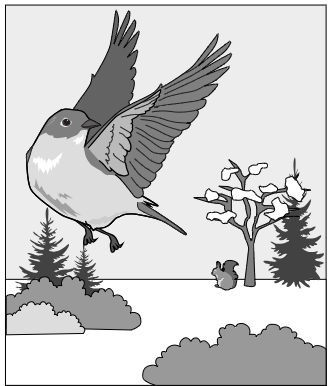
What is the most likely reason the author includes the illustration?

Asemmisa {{asɛmmisaAhyɛnsode}}
6.

Which detail shows that "Year-Long Summer" is a fable?

Asemmisa {{asɛmmisaAhyɛnsode}}
7.

Why did Robin not want to hibernate?

Passage 1:

Cultural Cooking Connections

1 Many people can think of foods that taste like home. For many, food is at the center of their family and culture. Foods connect people with their neighbors, even their ancestors. Making a meal the way it was made in the past is a meaningful experience to many.

2 For chef Enrique Olvera, preparing food is very important. As a kid, Olvera spent time in his grandmother's bakeshop in Mexico City. He has fond memories of working with his grandmother to turn masa1 into handmade tortillas. Food author Samin Nosrat says making bread with your hands is a mindful experience. She mentions turning the dough, feeling the wetness. "That kind of stuff, to me, is what makes us human."

3 Olvera is not along in his respect for tradition. The mortar and pestle is common around the world. The took has been around for thousands of years. You place ingredients in a bowl and grind them with a tiny club. And it is used in high-end restaurants such as Osteria Mozza in Los Angeles. Chefs claim that simple tools like mortar and pestle blend flavors in ways modern technology can't. But beyond flavor balance, chef Nancy Silverton places the importance on feelings. She says, "I just feel like I tasted the care, you know?"

4 Olvera remembers his grandmother's belief that salsa from a blender tastes like electricity. For salsa, Olvera first softens the vegetable over heat. Then he smashed the vegetables using a heavy bowl made from volcanic rock. Olvera has plenty of formal chef training. But making Mexican food involves different teachings. In his grandmother's shop, Olvera learned lessons of care.

5 Cooking and relationships go hand in hand. Laruen Sklba lives in Colorado but her family is in Wisconsin. When she couldn't travel for Thanksgiving, she dug out her great-grandmother's recipe to whip up a family favorite of her own. "I had no idea if I was actually doing it right, but then it turned out great," Sklba says. Using an old recipe didn't just give Sklba a great mean. It also connected her to her family.

1Masa is a dough made from ground corn and water.

Asemmisa {{asɛmmisaAhyɛnsode}}
8.

Read the dictionary entry.

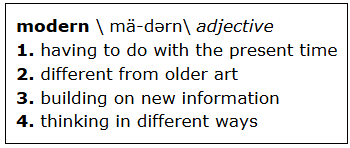
Which definition best matches the meaning modern in paragraph 3 of the article "Cultural Cooking Connections?"

Asemmisa {{asɛmmisaAhyɛnsode}}
9.

Which sentence from paragraph 2 in the article "Cultural Cooking Connections" shows that cooking is a skill that families share with one another?

2 For chef Enrique Olvera, preparing food is very important. As a kid, Olvera spent time in his grandmother's bakeshop in Mexico City. He has fond memories of working with his grandmother to turn masa into handmade tortillas. Food author Samin Nosrat says making bread with your hands is a mindful experience. She mentions turning the dough, feeling the wetness. "That kind of stuff, to me, is what makes us human."

Asemmisa {{asɛmmisaAhyɛnsode}}
10.

What is the most likely reasons the author chose to include the details about the cooking tools in the article "Cultural Cooking Connections?"

Asemmisa {{asɛmmisaAhyɛnsode}}
11.

Based on the information in the selection "Tradition with a Twist," what can the reader conclude about Sedjro Ahouansou and Valerie Vinakpon?

Asemmisa {{asɛmmisaAhyɛnsode}}
12.

What is the central idea of the selection "Tradition with a Twist?"

Asemmisa {{asɛmmisaAhyɛnsode}}
13.

What is most likely the author's purpose for presenting the information in paragraphs 1 and 2 of the selection "Tradition with a Twist" in a cause-and-effect structure?

Select TWO correct answers.

Asemmisa {{asɛmmisaAhyɛnsode}}
14.

What is the message the author expresses in the selection "Tradition with a Twist?"

Asemmisa {{asɛmmisaAhyɛnsode}}
15.

How is chef Enrique Olvera in the article "Cultural Cooking Connections" SIMILAR to the chefs in the selection "Traditions with a Twist?"

Asemmisa {{asɛmmisaAhyɛnsode}}
16.

What is a belief people have about using traditional recipes in the selection "Tradition with a Twist" that is NOT described in the article "Cultural Cooking Connections?"

Asemmisa {{asɛmmisaAhyɛnsode}}
17.

Which ideas about cooking is developed in BOTH the article "Cultural Cooking Connections" and the selection "Traditions with a Twist?"

Asemmisa {{asɛmmisaAhyɛnsode}}
18.

Based on passage 1: Why do some chefs use tools like a mortar and pestle?

Asemmisa {{asɛmmisaAhyɛnsode}}
19.

Based on Passage 2: How has the internet changed cooking?

Asemmisa {{asɛmmisaAhyɛnsode}}
20.

Based on Passage 2: Why are some people surprised by new versions of traditional dishes?

Asemmisa {{asɛmmisaAhyɛnsode}}
21.

How are the passages different?

Asemmisa {{asɛmmisaAhyɛnsode}}
22.

How did Andy feel about running the race?

Asemmisa {{asɛmmisaAhyɛnsode}}
23.

What did Alex say to encourage Andy during the race?

Asemmisa {{asɛmmisaAhyɛnsode}}
24.

Andy has included a sentence that does not belong in the first paragraph (sentence 1 - 7). Which sentence should he remove?

Asemmisa {{asɛmmisaAhyɛnsode}}
25.

Andy wants to add this sentence to the second paragraph (sentences 8 - 13).

"Well done!" Alex cheered.

Where should this sentence be added?

Asemmisa {{asɛmmisaAhyɛnsode}}
26.

How should sentence 24 be revised so that is does not repeat information?

Asemmisa {{asɛmmisaAhyɛnsode}}
27.

Andy wants to combine the ideas in sentences 33 and 34. Which sentence below combines these ideas in a clear and effective way?

1 For many people, nothing compares to owning a pet. Animals give friendship and assistance to humans. They can even provide therapy. However, there is another way than ownership to care for animals. Serving as a foster family for an animal brings many benefits of pet ownership in a shorter time. It may be challenging, but the joys and educational value of fostering can be worth the effort.

2 Fostering offers the chance to meet, train, and play with animals. The time frame can last weeks or months. The focus is on quality time. Fostering lets us find out what animals like or dislike. How do they play? Which kind of treats do they want? Foster families have fun answering these questions. The animals can learn tricks. They can also learn good pet behaviors. The foster family learns about the animal’s qualities.

Asemmisa {{asɛmmisaAhyɛnsode}}
29.

This question has two parts. First, answer Part A. Then, answer Part B.

Part A

Which statement expresses an idea about society found in the article?

Asemmisa {{asɛmmisaAhyɛnsode}}
30.

Part B

Which sentence from the article best supports the answer to Part A?

Asemmisa {{asɛmmisaAhyɛnsode}}
31.

What are the most likely reasons that the author includes paragraph 6? Select TWO correct answers.

Asemmisa {{asɛmmisaAhyɛnsode}}
32.

What is one benefit of fostering animals?

Asemmisa {{asɛmmisaAhyɛnsode}}
33.

Why do shelters need foster families?

Asemmisa {{asɛmmisaAhyɛnsode}}
34.

What could be a challenge of fostering?

Junior Park Rangers

1 It’s a warm, sunny day at Garner State Park in Texas. A group of children crouch down near a dusty trail. The children are studying a strange set of footprints on the ground. One girl points at the toe markings. Meanwhile, a boy studies an animal-tracking guide. “I think they belong to a turkey!” the boy announces. The other children agree. They make a note in their journals. “We’re one step closer to our Junior Ranger badges!” the girl grins. These children are participating in the Texas State Parks Junior Ranger Program. This program offers a fun way for children to discover and explore in Texas state parks.

Junior Rangers across Texas

2 In May 2013 the Texas State Parks Junior Ranger Program began. Thanks to the program, there are many Junior Rangers across the state of Texas today. This means that many children have learned how to take care of parks. This is good news for Texas state parks because there are nearly 100 parks in the state.

3 No matter where you live in Texas, chances are there is a state park close to you. There are park locations among mountains and canyons, in the desert, and along the seashore. Each park is rich with different animals, birds, rocks, flowers, and plants. No two parks are alike. Each park offers a unique experience for young explorers.

Becoming a Junior Ranger

4 It is easy to become a Junior Ranger. The program is completely free and is available to children aged 6 through 12. Children interested in becoming a Junior Ranger need the Junior Ranger Activity Journal. This journal is available at every state park. The journal describes the park and its history. Children can also read about the jobs of park rangers in the journal. It contains safety rules as well as information about how to keep the park beautiful.

5 In order to become a Junior Ranger, you must complete some of the activities in the journal. The number of activities is determined by your age. For example, if you are 8 to 10 years old, you may work on your choice of seven activities. You may choose to interview a ranger, explore a trail, complete a game, or answer questions about the park. If you are younger, you may complete fewer activities. If you are older, more activities are required to earn your badge.
6 No matter your age, when you have finished your activities, a park ranger will review the completed activities in your journal. (You may take the journal home as a souvenir!) Then, you will take the Junior Ranger pledge and promise to care for the park. You will also receive an official Junior Ranger badge. Each park has a different badge, so you can collect as many as you want!

Helpful Tools for Junior Rangers

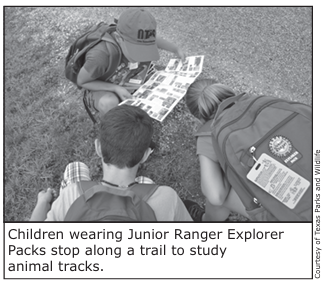
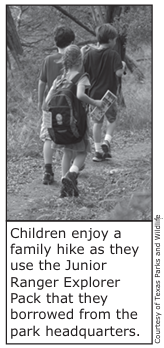
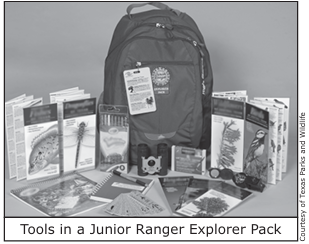
7 Each time you visit a new Texas state park, visit the park headquarters. It is often located near the park’s main entrance. This is where you can pick up a Junior Ranger Activity Journal. Some state parks offer Junior Ranger Explorer Packs. Children may borrow the backpack from the park headquarters.

8 The Junior Ranger Explorer Packs contain helpful items for a young explorer. The backpacks include binoculars, a magnifying glass, an animal-tracking key, a pencil, crayons, watercolors, and a sketchbook. The binoculars are especially useful for viewing animals from a distance. The animal-tracking key shows what different animal tracks look like. The key helps explorers figure out which animals have traveled on a path by looking at their footprints. The backpack also includes guides to birds, flowers, rocks, plants, and trees. The guides help children learn more about what can be seen at the state park.

Spoken Like a Real Junior Ranger

9 What’s it like to earn a Junior Ranger badge? “It’s fun!” says Molly Miser, who earned a badge at Stephen F. Austin Park. Ranger Bryan Hein, who awarded her the badge, agrees. “It’s a great opportunity for our young ones to learn the culture and natural resources of our parks,” he says.

Asemmisa {{asɛmmisaAhyɛnsode}}
35.

What is the central idea of the selection?

Asemmisa {{asɛmmisaAhyɛnsode}}
36.

In which section would the reader find information about having a park ranger review the Junior Ranger Activity Journal after the activities in the journal have been completed?

Asemmisa {{asɛmmisaAhyɛnsode}}
37.

Which sentence best states a message in the selection?

Asemmisa {{asɛmmisaAhyɛnsode}}
38.

In paragraphs 4 through 6, what key idea about the Junior Ranger Activity Journal is best supported?

Asemmisa {{asɛmmisaAhyɛnsode}}
39.

What is the most likely reason the author includes the anecdote in paragraph 1?

Asemmisa {{asɛmmisaAhyɛnsode}}
40.

Which sentence best explains why children should visit as many parks as they can?

Asemmisa {{asɛmmisaAhyɛnsode}}
41.

What does the Junior Ranger Activity Journal include?