By Heidi Poelman
1 Imagine that you are swimming in the ocean and come upon a shark as long as a school bus. Pretty scary, right?
2 Well, if it were a whale shark, you would be in luck. The whale shark is the largest fish in the ocean, but it isn't aggressive. In fact, its 300 rows of teeth are too small to hurt humans. When a whale shark eats, it doesn't rip or tear. It drifts or swims with its mouth wide open, filtering some of the ocean's smallest creatures out of the water.
3 Scientists have learned a lot about whale shark, but much of the animals' lives is a mystery.
4 The shark makes an entire meal out of tiny prey. To do it, the fish filters a lot of water. In a recent study, scientists learned that in one hour a midsize whale shark can pass more than 157,895 gallons - enough to fill 13 tanker trucks - through the filters in its throat and out of its gills. In the process, it eats about six pounds of plankton and small fish....
5 That's some of what scientists know. They have to answer many more questions to help whale sharks survive in the changing oceans. Where do the fish go when they disappear for weeks at a time? Why do they dive so deep?...
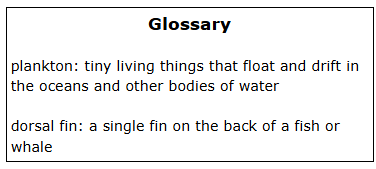
6 An electronic tracking tag allows scientists to trace a whale shark's journey through the ocean. Scientists use a small pole spear to attach the tag to the shark's dorsal fin. No one knows if the sharks can feel the point of the spear. "Ninety-nine percent of the time, the shark shows no response," says Dr. Robert Hueter at Mote Marine Laboratory in Florida. He's a leader of the research group.
7 Tracking tag contain devices that keep a record of where each shark travels, how deep it swims, and any changes in water temperature. When the shark surfaces, the tag sends the information to a satellite in orbit around Earth. The satellite transmits the information back to Earth. "We basically get e-mails of the data," says Dr. Hueter. "It gives a record of what the animal has been doing."
8 Using a tracking tag, Dr. Hueter recorded a whale shark that dived to a depth of 6,325 feet, or about 1.2 miles - the world record for whale sharks so far.
9 No one knows why the sharks dive so deep. The reason may be because sharks don't have swim bladders like most other fish. A swim bladder is a gas-filled sac that lets a fish rise, sink, or stay one depth. Without a swim bladder, sharks sink toward the ocean floor to rest. This tendency to sink adds to the whale shark mystery. "If a whale shark dies in the ocean, it sinks," explains Dr. Hueter. "So it's very difficult to learn what happened to it."
10 No one know where whale sharks breed or give birth. In 2007, Dr. Hueter tagged what he believes was a pregnant whale shark. Over the next 150 days, the shark traveled nearly 5,000 miles from the Yucatan Peninsula to a point about halfway between South America and Africa. Dr. Hueter thinks this may be one place where whale sharks go to give birth, but he'll need more data to find out.
11 For now, scientists keep searching for answers. As Dr. Hueter puts it, "The more we learn about whale sharks' travel and their favorite hangouts, the better we can understand and conserve them."
by Known your World Extra
1 Captains have picked their teams. Gym teachers have passed out the hard rubber balls. Now it it time to play the game that some students love and other students dread.
2 Of course, we're talking about the game of dodgeball.
3 Students have played dodgeball in gym for many years. Few people used to think twice about it. Now, dodgeball has come under fire.
4 The National Association for Sport and Physical Education does not support dodgeball. The group thinks the game should not be played in physical education (PE) classes.
5 In recent years, some schools have banned dodgeball because it is too risky....
6 Dodgeball has its critics. It also has its fans. Many students think it is fun. Some teachers think it is good exercise for students.
7 Dodgeball has caused trouble in PE classes for many years. Schools should ban the game once and for all.
8 Gym classes are meant to improve the health of students. Dodgeball is a slow game. Most players only step away from thrown balls. Some players hide behind larger players. That does little to help students get fit. Students should play more active games such as basketball and soccer.
9 .... When thrown hard, the rubber balls can sting. The balls can cause bruises and bad scrapes. Students should not play a game in which something is hurled at their bodies on purpose.
10 Dodgeball pits the strong against the weak....
11 One role of schools is to keep students sage. Playing dodgeball can strike fear into some students.
12 Dodgeball is a mean and risky game. It has no place in schools.
13 Dodgeball is part of most gym classes. Students have enjoyed playing the game for many years. There is no reason to ban it now.
14 Dodgeball is good for students. It helps them improve physical skills. It also teaches students about teamwork.
15 Studies show that young people are not as fit as they should be. But active games like dodgeball help student work up a sweat.
16 In dodgeball, players make short sprints. They run form thrown balls. Students also run to get loose balls. Throwing the balls helps students build strong arms.
17 Some people say that dodgeball is risky. All PE games and sports have risks. Dodgeball is no different. Still, it has become safter. Many schools make students wear eye gear and use soft foam balls.
18 Teachers make sure that students play dodgeball fairly...Rough players are often taken out of games.
19 Dodgeball is a fun game that is a good activity for students. Schools should continue to let students play dodgeball.
Read the sentences from Passage 1:
"In recent years, some schools have banned dodgeball because it is too risky." (paragraph 5)
"Dodgeball is a mean and risky game." (paragraph 12)
Which sentence from the passage helps the reader understand the meaning of the word risky as it is used in these sentences?
Read the following sentence from Passage 1.
"Now it is time to play the game that some students loves and other students dread." (paragraph 1)
What is the meaning of dread as it is used in this sentence?
Read the following paragraph from Passage 1.
9 ... When thrown hard, the rubber balls can sting. The balls can cause bruises and bad scrapes. Students should not play a game in which something is hurled at their bodies on purpose."
Which phrase from the paragraph helps the reader understand the meaning of the word hurled?
Which two sentences should be included in a summary of Passage 1?
*please select 2 answer choices
What is the main idea of Passage 2?
Which detail from Passage 2 explains why dodgeball can be a dangerous game?
According to Passage 2, what happened as a result of Heather Lindaman's injury?
Drag the sentences below to show whether each idea about why schools should allow dodgeball is found in Passage 1 or Passage 2
Dodgeball builds concentration.
Dodgeball develops hand-eye coordination.
Dodgeball teaches the importance of teamwork.
Passage 1
Passage 2
Why do some schools ban dodgeball?
How do teachers make dodgeball safer?
What do critics say about the impact of dodgeball?
What do supporters of dodgeball believe?
What does the National Association for Sport and Physical Education believe?
What is the main argument against banning dodgeball?
Read this sentence from the passage.
"It drifts or swims with its mouth open wide, filtering some of the ocean's smallest creatures out of the water." (paragraph 2)
What is the meaning of filtering as it is used in this sentence?
Read the phrase from paragraph 3.
"much of the animals' lives is a mystery."
Select two sentences from the passage that support the author's statement.
Please make sure you choose 2 answers for this question.
Read the sentence from the passage.
"The satellite transmits the information back to Earth." (paragraph 7)
Select two words or phrases from paragraph 7 that help the reader understand what the word transmits means.
Please make sure you choose 2 answers for this question.
How is information presented in this passage?
Drag the statement to the correct section of the passage where each piece of information can be found.
What information is still unknown
Basic information about whale sharks
The way scientists get information
Filling Up on Little Bits
How to Track a Shark
Deep Divers
What is the main idea of the passage?
Which sentence supports your answer for the main idea of this passage (your answer from the previous question)?
retold by Pat Betteley
In this play, based on a folktale from Northern Australia, Elder is telling a story to his granddaughter, Alinta.
1 ELDER: Ah, but the fire is warm, young one. And I have a story to tell.
2 ALINTA: A story? What about, grandfather?
3 ELDER: It is about fire... A bird Woman lived in a nearby tree. Everyday she looked down at Crocodile Man. One day she flew down to him.
4 BIRD WOMAN: There are people by the river who want to cook their food. Would you share your firesticks with them?
5 CROCODILE MAN: They can eat their food raw, just like you do!...I am the boss of Fire. I control Fire! Nobody will have firesticks but me!
6 BIRD WOMAN: You are unkind. Creatures must help each other. If I had Fire, I would share it with others. Even with a mean, cranky Crocodile!
7 ELDER: As time passed, Bird Woman watched Crocodile Man from her tree. She went about her business-catching food, eating it raw, and shivering with cold at night. But she was always watching and waiting. Finally, the moment for which she had waited arrived. Crocodile Man opened his mouth and yawned the longest, sleepiest, biggest yawn anyone had ever seen.
8 BIRD WOMAN: This is my chance.
9 ELDER: Bird Woman flew down and snatched the firesticks from the Sleeping Crocodile.
...
10 BIRD WOMAN: Now I can give Fire to the people.
11 ELDER: And Bird Woman proudly flew around the countryside, putting Fire into the heart of every tree. That is why, to this day, people can make Fire using dry sticks and wood from a tree.
12 ALINTA: To keep them warm at night.
13 ELDER: Yes, and to cook their food with, and to light their way in the dark. But that is not the end of the story. Next, the Bird Woman did a dance, placed the firesticks into her tail, and became a beautiful Rainbow Bird. Then she flew straight to the Crocodile Man.
14 BIRD WOMAN: Your life will always be down in the wet and muck. I will fly high and stay dry in the fresh air. If you try to come up here, you might die!
15 ALINTA: So that is why the Crocodile lives down in the swamp.
16 ELDER: Yes. And even though Fire is gone, he still opens his mouth wide and growls, "I am the boss!"
17 ALINTA (drowsily): And Rainbow Bird?
18 ELDER: If you are lucky, you can still see her flying through the sky, taking fire to the tree in a blaze of rainbow bright feathers. Alinta, are you awake? (Alinta has fallen asleep by the fire.)
Why did Crocodile Man refuse to share firesticks?
What explanation does Rainbow Bird give about nature?
Read this sentence from Passage 1.
"And Bird Woman proudly flew around the countryside, putting Fire into the heart of every tree." (paragraph 11).
What does the phrase putting Fire into the heart of every tree mean?
In paragraph 24, what does the phrase "endure the fatigue no longer" show about the boy?
In Passage 2, why is fire so important?
Read this sentence from Passage 2.
"Then she flew down and searched with her sharp little eyes until she found a tiny live coal." (paragraph 27)
What does the phrase sharp little eyes tell the reader about the robin?
Which two ideas should be included in a summary of Passage 2?
Please choose 2 answers for this question.
This question has 2 parts. First answer this question, then answer the next question.
Part A:
Based on her actions in Passage 2, which phrase describes the robin?
Part B
Select two details that support your answer from Part A (the previous question).
Please choose 2 answers for this question.
Which statement describes how Passage 1 and Passage 2 are different?
Draw the statements below to show which ideas can be found in Passage 1, which can be found in Passage 2, and which can be found in both passages.
an explanation of how the whole ground is lit up
an explanation of how people can make fires
an explanation of how the hero beats the enemy
Passage 1
Both passages
Passage 2
Read this sentence from Passage 2.
"Her little breast was scorched red, but she did not stop until a fine red flame blazed up from the ashes." (paragraph 28)
What is the the meaning of scorched?
What is a common theme in BOTH passages?
How are Bird Woman and the robin similar?
by Suzanne Zimbler
1 In July 2017, families in Marion County, Florida, got some surprising news. "Traditional homework as we know it will disappear, at least for elementary students," Heidi Maier said in a voice message to parents. Maier is the school superintendent. "Instead, we want students reading," she said.
2 More than 20,000 students attend the county's 31 elementary schools. Dara Mehr is one of them. She is in the fifth grade. Last year, Dara had two or three hours of homework a night. "I would have 12 math questions and six or seven pages of work to do for reading," she told TIME for kids.
3 Now Dara's only homework is to read for 30 minute. She and her younger sister, Neveah, enjoy having more time for other activities. But their mom, Kayla Mehr, misses last year's homework. "Sometimes, getting the kids to sit down and read for 30 minutes is a challenge," she says.
4 A number of schools around the country are trying out a no-homework policy. School leaders say the new policy is based on research. Studies have shown that homework does not boost grades or test scores in elementary school.
5 Paula Fass is a professor at the University of California, Berkeley. She says there has been disagreement over homework "ever since schooling became a requirement."
6 Support for homework has gone up and down through the years (see "Homework History"). "In the 1900s, a lot of parents thought that homework just occupied children's time [when] they could be doing chores," say Fass. Today, many still question the role that homework should have in kids' lives.
...
Early 1900s: A number of school districts pass anti-homework rules. The goal? To cut down on students' having to memorize information, known as rote learning.
1957: The Soviet Union launches Sputnik, a satellite. The space race is on. Homework in science and math increases.
1966: The National Education Association suggests "limited amounts" of homework in upper elementary school.
1983: President Ronald Reagan's Education Department says schools need to improve. There is pressure to get tough.
1990s: Global competition is on the rise. Support for homework in the U.S. is strong. Students get more homework than they had in the past.
Select two details that should be included in a summary of Passage 1.
Please choose 2 answers for this question.
Passage 1 quotes Dara Mehr, a students, and Paula Fass, a professor. How is Dara's perspective about homework different from Paula's?
Using information from Passage 1, why did people want less homework in the 1900s? Choose two options.
Select 2 answers for this question.
Read these sentences from Passage 2.
"Research shows that homework pays off. Students who put effort into their homework are better at managing their time." (paragraph 9)
What does the phrase "pay off" suggest?
How is Passage 2 organized?
Read these sentences from Passage 2.
"Homework helps you practice how to plan your time and manage distractions. It teaches you to keep trying when learning becomes difficult." (paragraph 8)
What does the word distractions refer to?
How is the No! section in Passage 2 written?
Draw the boxes to show which idea appears in Passage 1, Passage 2, or both passages.
Only one box per category.
Some families have disagreements about homework.
Some teachers think that homework should include only reading.
Some doctors and researchers think that more homework leads to less time for exercise.
Passage 1
Both Passages
Passage 2