Choose the answer that best completes the sentence below.
Different animals have adapted to life in the rainforest in different ways, camouflaging themselves.

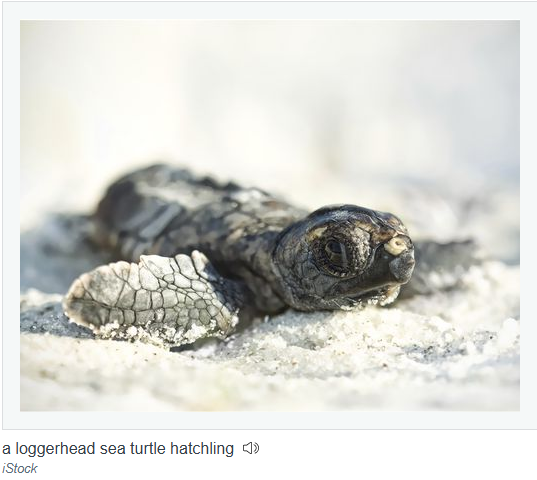
When you were a baby, you needed lots of care. Someone was always nearby to feed you, change your diaper, and make sure you were comfortable. Sea turtles, though, are a different story. Sea turtles hatch from eggs their mothers buried in a hole on a beach. They have to dig their way out of the hole, follow their instincts to get to the ocean, and start swimming. On the way, they risk getting lost and being eaten by other animals. Not all of them make it to the water.
When baby sea turtles do make it to the ocean, they swim, eat, and grow. Scientists have studied where they go. Sea turtles born on Florida beaches may travel hundreds or thousands of miles, to other warm, tropical waters. After they mature, they return to the same beach where they were born to lay eggs. Then, their babies start the process again.
Sea turtles breathe air but can stay underwater for hours. They eat jellyfish, fish, crabs, seagrass, and many other things. Along the coasts of the United States, there are five types of sea turtles: loggerhead, green, leatherback, Kemp’s ridley, and hawksbill.
The loggerhead, named for the large size of its head, is one of the most common species of sea turtle seen in the United States. Loggerheads use their powerful jaws to eat horseshoe crabs, clams, mussels, and other shellfish.
Green turtles are another type of sea turtle. They were once hunted by the thousands and sent to England to make soup. Green turtles eat mostly seagrass and algae.
Leatherbacks are the largest of all sea turtles, averaging six feet long and weighing up to 1,500 pounds—or about the same as a fully grown cow. These animals get this big by eating almost nothing but jellyfish!
The Kemp’s ridley is the rarest, smallest sea turtle in the world and also one of the most endangered. They weigh just 85 to 100 pounds and are about two feet long. They eat crabs, clams, mussels, shrimp, fish, and jellyfish.
The hawksbill sea turtle eats sponges, anemones, squid, and shrimp, and is known for its beautiful shell. This made hawksbills a target for people who wanted to make jewelry and other ornaments from turtle shells. Thankfully, it is now against the law in the United States to hunt sea turtles.
Endangered animals are protected by laws to prevent them from becoming extinct. When an animal becomes extinct, no more of that animal remains on the earth. Scientists and conservationists are trying to save sea turtles, which are endangered, but they still have a lot of questions about them. For example, scientists are still trying to understand how adult turtles return to the beach where they hatched to lay eggs.
Scientists who study sea turtles were concerned about the decline in the number of turtles. They knew part of the problem was that baby turtles face many risks from when they first hatch to when they make it to the ocean. People were driving vehicles on beaches and destroying turtle nests. Lights from nearby homes and businesses would confuse the babies when they tried to find the water. Scientists realized part of the solution would be to help baby turtles get to the ocean safely.
Communities and organizations are now working together to protect nesting areas and help baby turtles. They ask people to turn off outdoor lights near the beach from May through October when the mother turtles lay their eggs and the baby turtles hatch. They also help homeowners install special turtle-safe lighting. This lighting doesn’t bother baby sea turtles as they emerge from their nests or mother sea turtles when they come onto beaches to lay eggs.
Groups of researchers tag some turtles and track them with satellites to follow their travels and movements. You can follow some of the tagged loggerhead turtles at the website of the Archie Carr National Wildlife Refuge. All of this cooperation is paying off. Over the past five years, more turtles have been observed coming home to nest. Just as important, scientists have counted more baby sea turtles hatching from their nests and finding their way to the ocean!
Tick. Tick. Tick. Holding an antenna above my head, I was trying to find a clear radio signal.
Beep. Beep. Beep. I was getting closer.
Ping! Ping! Ping! That was it! "I’m getting a radio signal up and to the right," I told my team.
Up the hill we went until we find our target—a gray koala named Abby nestled in a tree. Abby lived in a forest on St. Bees Island, 19 miles off the northeastern coast of Australia.
It was 2006, and I was one of eight volunteers visiting this tropical island. We joined a research team whose members had been hoping to find ways to protect koalas throughout Australia.
Koalas are pictured everywhere in Australia—on cleaning products, on boxes of chocolate, on sports team jerseys. Yet the animals are found only in isolated pockets up and down the east coast.
Koalas were once found throughout the entire range, but farmers cut down many of the forests where koalas lived. Hunters also killed the animals for their fur. By the early 1900s, "koalas were basically shot out of south Australia," says ecologist Bill Ellis. An ecologist is a scientist who studies the relationships among living things and their environments. Bill Ellis was also the team leader of the research team I joined in 2006.
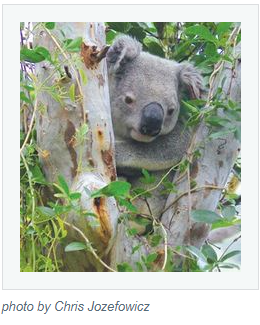
"Here she is!" yelled Jane Stanfield, one of the volunteers, when she spotted Abby. Abby was perched in a blue gum, a type of eucalyptus (yoo-kuh-LIP-tuhss) tree. The koalas on St. Bees live and sleep in the trees. Koalas eat a steady diet of eucalyptus leaves—their main source of food.
Although koalas can walk on the ground, they are better suited for life in the canopy, the high cover of branches and leaves in a forest. Whenever we found one of the furry leaf eaters, we collected information about the trees in the area. We measured how tall and how fat the trees were. Then, we put tags on their trunks so that we would know they had been recorded.

A few days after tracking Abby, our team encountered more koalas, including one named Yellow. Yellow had a baby, called a joey, in her pouch.
We planned to capture the two and give them a quick checkup. My teammates used a long aluminum pole to shake the tree branches on which Yellow sat. "We’re going to bring her straight down," Ellis said.
Yellow tumbled into a plastic sheet we held under the tree, and we gently prodded her into the sack. Ellis measured and checked both mom and baby to ensure that they were healthy.
By 2006, what had Ellis’s research taught him? Compared with koalas in other areas, the St. Bees koala population seemed to be healthy. Yet Ellis wondered whether the koalas on St. Bees could be headed for hard times. The island was overrun with wild goats. Ellis thought the goats could have been eating the small blue gum trees.
Without those trees, koalas would run out of food in the future. Ellis hopes more research will help him understand how to protect the blue gums—and the koalas that depend on them.
They are marsupials (mahr-SOO-pee-uhlz). A marsupial is an animal that typically has a pouch in which to carry its young.
They spend most of their time in eucalyptus trees.
A koala eats about 2½ pounds of eucalyptus leaves each day. Koalas eat so many leaves that they often smell like eucalyptus cough drops.
Eucalyptus leaves are not very nutritious. As a result, koalas spend up to 18 hours a day sleeping. That helps them store up energy.
Bill Ellis shook the branches of a tree where a koala named Yellow was resting.
As volunteers held a plastic sheet to catch Yellow, Ellis gently pushed her into a sack.
Volunteers held Yellow in the sack as they adjusted a radio collar around her neck. The radio collar helped scientists track her. They also placed a colored tag in her ear to help tell her apart from other koalas on St. Bees Island.

"I started thinking of them as a family almost immediately," filmmaker Martyn Colbeck told WR News. He was talking about wild elephants, not his next-door neighbors. For more than 15 years, Colbeck has filmed a family of African elephants in Amboseli National Reserve in eastern Africa.
Colbeck's film about the family, Unforgettable Elephants, aired April 1, 2007, on the PBS television show Nature. The film came after studies found that elephants can recognize their reflection in a mirror. That is something only humans, chimpanzees, and dolphins were thought to be able to do. "These animals are smart," Colbeck says. His documentary shows just how intelligent African elephants—the world's largest land animals—are.
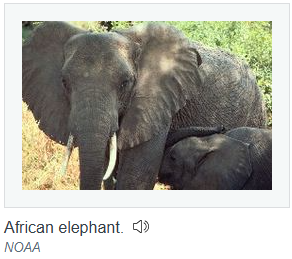
Colbeck's film follows an elephant family led by a 62-year-old female elephant named Echo. In the wild, African elephants live in herds. They roam long distances to find food. The oldest female elephant, called the matriarch, leads the herd. Adult male elephants live separately from the females and the young calves.
Echo guides her family to fresh water and food while staying alert for danger. The young elephants are the most vulnerable, or at risk of being harmed. Colbeck witnessed that danger when he saw another elephant family attempt to kidnap Echo's calf, Ebony. Echo gathered the other adult female elephants in her family to come to the rescue. "Together they plowed into the kidnappers to recover Ebony," Colbeck explained. "It showed forethought and teamwork."
During his years of filmmaking, Colbeck observed other signs of elephant intelligence. Elephants communicate with each other through low rumbling sounds that people often cannot hear. Family members also make distinct sounds that other members can recognize.
Like humans, elephants have their own rituals, or customs. After an elephant dies, the other family members cover the body with sticks and leaves and linger near the site for days. The animals often return to the site years later.
Amboseli National Reserve covers about 150 square miles in southern Kenya, near the Tanzania border. The Kenyan government protects the nature reserve's elephants from poaching, or illegal hunting. Elephants have been hunted throughout history for the ivory in their tusks. Humans have used ivory to make jewelry and other objects. Today, elephants are an endangered species.
Since strict anti-poaching laws were put into effect in 1968, the number of elephants in Amboseli has risen from 500 to more than 1,200. When Colbeck began filming Echo's family in 1990, the family had only 14 members. Today it has 30 members.
Although the elephants still face some danger from the local Maasai people, the creatures have become remarkably comfortable around human visitors. That makes Amboseli an ideal place for scientists to study elephant behavior.
"The elephants are totally relaxed about having vehicles in amongst the herd," says Colbeck. "Nevertheless, it is still very important to respect the animals and not disturb them. That respect develops into a trust, and in that way we have been able to document some extraordinary moments in their lives." That trust has not only allowed Colbeck to film Echo's family, but it has also made him feel like one of the family.
The elephant families in Amboseli National Reserve are organized alphabetically. Echo's family is the "E" family, so every member of the family is given a name starting with E. Here's how Echo fits in with some of her relatives.
Grandmother
Echo (age 62): Echo is one of the oldest elephants in Amboseli. She is the leader of her family. You can tell that she is old by the length of her tusks. They are almost touching! Wild African elephants live an average of 60 years.
Children
Erin (died at age 34): She was Echo's eldest daughter. Erin died from a spear injury after she wandered too close to a watering hole protected by the local Masai people.
Eliot (age 22): As a young calf, Eliot would run up and rest her head on researchers' vehicles. Now that she has grown up, Eliot keeps her distance from people.
Ely (age 17): When he was born, Ely couldn't walk. The family waited to move until he stood on his own. Now he lives alone. He left the herd at age 12.
Grandchildren
Edwina (age 25): Edwina is Echo's first known grandchild.
Eleanor (age 22): Eleanor helped care for Email after Erin died.
Email (age 6): Email's mother, Erin, died when he was 2. Now the rest of the family takes care of him.
Great-grandchildren
Europa (age 12): Europa is Echo's first known great-grandchild.
Elaine (age 8): Elaine is Echo's second great-granddaughter.
Elmo (age 8): Elmo is Echo's only surviving great-grandson.
What animals does filmmaker Martyn Colbeck film?
How does the author describe the leader of an elephant herd?
Read the following sentences from the text.
“Elephants communicate with each other through low rumbling sounds that people often cannot hear. Family members also make distinct sounds that other members can recognize. Like humans, elephants have their own rituals, or customs. After an elephant dies, the other family members cover the body with sticks and leaves and linger near the site for days.”
What can you conclude about elephants based on this information?
What is one way that elephants are being protected by the Kenyan government?
What is the main idea of this text?
How does Echo help her family?
Why are elephants comfortable around humans in Amboseli?
Where can you find more animal species than anywhere else in the world? It’s not a zoo or the circus. It’s a very special type of ecosystem called a rainforest, and most rainforests can be found in tropical climates in the Southern Hemisphere.
Why are rainforests only found in certain parts of the globe? Let’s start with geography. A “hemisphere” is a half of the earth, so the Northern Hemisphere is the northern half and the Southern Hemisphere is the southern half of Earth. They are divided by a line called the equator. The Northern Hemisphere starts just above the equator and ends at the Arctic Circle. The Southern Hemisphere starts just below the equator and ends at the South Pole in Antarctica.
The two most common climates in the Southern Hemisphere, temperate and tropical, both have lots of precipitation. The difference is that temperate climates have warm summers and cold winters, while tropical climates are warm all year long.
Because there’s lots of rain and the temperature stays at about 75-85 degrees Fahrenheit year round, rainforests in tropical climates have optimal conditions for many animal species. Rainforest animals don't have to worry about freezing during the winter or finding shade in the summer. Plus, because it rains almost every day, animals rarely have to search for water. This makes tropical rainforests a suitable home for many species.
In addition to their tropical climates, another reason why rainforests are home to so many different types of animals is because they are some of the oldest ecosystems on Earth. Scientists think that some rainforests have been around since dinosaurs roamed the earth at least 100 million years ago.
One of the rainforests in the world is the Amazon rainforest in Brazil. Jaguars, toucans, parrots, and tarantulas all call it home. Yet this is only a small sample of rainforest animals. Many other rare and often endangered animals can be found in rainforests, like the okapi. This beautiful creature has striped hindquarters and front legs like a zebra. Okapis also have tall perky ears, like a giraffe, and they mostly live in the Ituri rainforest of Central Africa. In fact, there are so many different types of animals in tropical rainforests that we haven’t been able to name all the species yet.
Rainforests are also home to some animals you might want to avoid, like flying snakes (although their name is actually a misnomer since they can only glide and not gain altitude) and spiders that eat birds. Other rainforest animals, like the coral snake and the poison arrow frog, produce a natural poison that protects them from harm. Get too close, and they could easily harm you with poison. Many of these species are endemic to tropical rainforests, meaning that rainforests are the only place they live on Earth.
Some species have had to adapt to their surroundings in the rainforest in order to survive. For example, toucans and parrots both have very large, strong beaks. These powerful beaks make it easy for them to crack open the tough shells of nuts that grow on many rainforest trees. Birds with small beaks, like robins and sparrows living in the Northern Hemisphere, probably would not be able to survive in the rainforest without being able to crack open hard nuts.
Another way animals adapt to life in the rainforest is by camouflaging themselves to hide from predators. An insect called the "walking stick" lives in the palm tree, and it blends in so well with it that it’s practically unnoticeable unless it moves. When some butterflies close their wings, they look identical to leaves, which masks them from predators.
Despite the biodiversity in the rainforests of the Southern Hemisphere, many species are quickly becoming extinct, as people cut down trees and destroy natural habitats. Other threats to species of the rainforest include illegally trading monkeys to sell them as pets and killing jaguars for their highly-valued skins. Pollution from mining has killed many types of fish as well.
Because of the unique tropical climate in rainforests of the Southern Hemisphere, the animals within these ecosystems most likely cannot survive elsewhere if their habitats are destroyed. It’s crucial to take care of our planet, especially the rainforests, so that these animals can continue to thrive.
In which ecosystem can you find more animal species than anywhere else in the world?
What does the author describe in the passage?
Tropical rainforests have optimal conditions for many animal species. What evidence from the text supports this conclusion?
Why do rainforests have some of the most diverse plant and animal life on earth?
What is this passage mainly about?
Read the following sentences:
“Where can you find more animal species than anywhere else in the world? It’s not a zoo or the circus. It’s a very special type of ecosystem called a rainforest, and most can be found in tropical climates in the Southern Hemisphere. […] Despite the biodiversity in the rainforests of the Southern Hemisphere, many species are quickly becoming extinct, as people cut down trees and destroy natural habitats.”
What does biodiversity mean?
Where are sea turtles born?
What does the author list and describe in the section “All Kinds of Sea Turtles?”
Read these sentences from the text.
“Scientists and conservationists are trying to save sea turtles, which are endangered, but they still have a lot of questions about them. For example, scientists are still trying to understand how adult turtles return to the beach where they hatched to lay eggs.”
What can you conclude based on this information?
What is one solution that many people are working on together to save the sea turtles?
What is the main idea of this text?
What is one way communities protect turtles?
Based on the text, what is one cause of koalas being found only in isolated pockets up and down Australia's east coast?
Read these sentences from the text.
By 2006, what had Ellis’s research taught him? Compared with koalas in other areas, the St. Bees koala population seemed to be healthy. Yet Ellis wondered whether the koalas on St. Bees could be headed for hard times. The island was overrun with wild goats. Ellis thought the goats could have been eating the small blue gum trees.
What can you conclude based on this evidence?
Based on the text, what will Australia's koala population look like in the near future?
What is this text mostly about?
Read these sentences from the text.
The koalas on St. Bees live and sleep in the trees. Koalas eat a steady diet of eucalyptus leaves—their main source of food.
As used in these sentences, what does the word “steady” mean?
Choose the answer that best completes the sentence.
Volunteers put a colored tag in Yellow’s ear, they could tell her apart from other koalas.