Twa kɔ nsɛm atitiriw so
Log in
Sign up for FREE
arrow_back
Laabri

Week 3.8: Earth and Space

star
star
star
star
star
Last updated about 2 hours ago
38 Nsɛmmisa
Our Changing Earth: Plate Tectonics and Large-Scale System Interactions
The Whys of Weather: The Colors of the Rainbow
Engineering and Natural Gas
Sunrise, Sunset...or Not?
Lunar Eclipses and Solar Eclipses

Make sure you have answered all the questions, click submit when finished with all questions and check your answers. You may not be able to make corrections at this time.

1
1
1
1
1
1
1
Asemmisa {{asɛmmisaAhyɛnsode}}
7.

Choose the answer that best completes the sentence below.

While the earth’s plates move very slowly, some changes in the earth happen very quickly, the moon looks reddish during a lunar eclipse.

1

Our Changing Earth: Plate Tectonics and Large-Scale System Interactions

David and Charlie were setting off on a hiking trip with their uncle Max.

They had packed all of the essential items they would need for their day of hiking. Inside their backpacks were sandwiches, water, sunscreen, bug spray, a long sleeve shirt for the cold, and sunglasses for the sun.

Before they started on their trip, they gathered around a picnic table with their uncle. He showed them what was inside his own backpack. His bag was heavier. He had all the same things David and Charlie had in their bags, except he also had a first aid kit, extra water bottles, a flashlight and a bunch of folded papers.

“What is with all the papers, Uncle Max?” asked David. “Are you going to be doing some homework at the top of the mountain?”

Uncle Max and the boys laughed.

“No,” said Uncle Max, spreading out the folded papers. “These are all maps. They will show us where we are headed.”

“Why don’t you just look up the map on your phone?” asked Charlie.

“Well, we can do that too,” said Uncle Max. “But just in case the phone battery dies or we lose service, we will have these maps on paper. Plus a few of these maps show specific trails for the park that may not be listed on your phone.” Uncle Max opened one of the maps even wider and pointed to a spot with his finger. “This is where we are,” he said. “See all of the trees around us? And this is the trail we are going to take up the mountain and then back.” Uncle Max pointed at a mountain to the right. Sure enough, it was on the map in the same spot.

The boys adjusted their bags, tied their shoes tight, and started off down the trail following behind Uncle Max.

“How do the people who make the maps know where everything is?” asked Charlie.

“Well, there is something called cartography,” said Uncle Max. “Cartography is the study and making of maps. Cartographers use science and exploration to establish where certain parts of the earth are.”

Uncle Max and the boys hiked around a bunch of trees and followed a path over a small river.

“Do maps tell you about what is under the water too?” asked David.

“Some of them do,” said Uncle Max. “Not all maps show all bodies of water. But bigger bodies of water like oceans and lakes are often mapped out. If you are exploring in the ocean and you want to find a coral reef or a sunken ship, then that would be included on a map.”

The three walked for another hour. As they went, they looked at all the trees and plants. They also saw a deer and a few frogs.

After a few more minutes, the boys stopped and had some water, while Uncle Max showed them where they were on the map. They were almost at the bottom of the mountain—they could see it right up in front of them.

“In school we learned that the earth’s surface moves,” said David, as they started walking again. “Because the earth is made up of plates.”

“Plates?” asked Charlie. “Like the plates we use to eat lunch?”

Uncle Max laughed. “Sort of,” he said. “More like puzzle pieces that fit together. And yes, they do move, but usually they move very slowly. If you look at maps that scientists have created of what the earth looked like many, many years ago, you can see that countries and islands on the earth were in different places. Land masses broke apart and floated.”

“So then maps change,” said Charlie.

“Yes, they have to be updated to reflect any changes,” said Uncle Max. “Not that those changes happen very fast.”

“Earthquakes happen fast, though,” said David.

“Definitely,” said Uncle Max. “Very fast. An earthquake is the result of a sudden release of energy in the earth’s crust that creates something called seismic waves. That is why the machine used to measure an earthquake is called a seismometer. This machine helps scientists figure out what is going on in the earth and helps predict any future earthquakes, since they sometimes come in patterns.”

“That’s scary,” said Charlie.

“It is. But that shows you how powerful the earth’s movements can be,” said Uncle Max.

The three hikers reached the mountain.

David looked up. “We are going all the way up there?” he asked. He was tired from his first hike and was not looking forward to heading up the mountain.

Uncle Max laughed. “How about we have our sandwiches down here instead?” he suggested. “Then we can go back and swim in the lake.”

The boys agreed. So Uncle Max laid a blanket on a big flat rock, and the three had their sandwiches in the sun. Then they took a photo in front of the mountain, so they could show their mom. Maybe next time they came back, they could use the map to climb the mountain.

Asemmisa {{asɛmmisaAhyɛnsode}}
1.

What is the name of the study and creation of maps?

Asemmisa {{asɛmmisaAhyɛnsode}}
2.

In the passage, Uncle Max describes a number of things to the boys. How does he describe earthquakes?

Asemmisa {{asɛmmisaAhyɛnsode}}
3.

The movement of the earth’s plates has changed the way that the earth looks over many years. What evidence from the text supports this conclusion?

Asemmisa {{asɛmmisaAhyɛnsode}}
4.

Based on the information Uncle Max explains, what can be concluded about the impact of the movement of the earth’s plates?

Asemmisa {{asɛmmisaAhyɛnsode}}
5.

What is the main idea of this story?

Asemmisa {{asɛmmisaAhyɛnsode}}
6.

Uncle Max compares the earth’s plates to puzzle pieces. Why does Mr. Max compare the earth’s plates to puzzle pieces?

Asemmisa {{asɛmmisaAhyɛnsode}}
8.

According to the legend, what were the colors fighting over?

Asemmisa {{asɛmmisaAhyɛnsode}}
9.

In this legend, what is the cause of rainbows?

Asemmisa {{asɛmmisaAhyɛnsode}}
10.

Read this paragraph from the text.

Green spoke first. “Look around you. See the grass and the trees. I am the color of Earth. Without me, no animal could live. Look at the farms in the countryside. Look at the forests. I am more places on Earth than any of you.”

Based on this evidence, what does Green mean by saying, “Without me, no animals could live”?

Asemmisa {{asɛmmisaAhyɛnsode}}
11.

Based on this legend, how might some Native people of North America view colors?

Asemmisa {{asɛmmisaAhyɛnsode}}
12.

What is this text mostly about?

Asemmisa {{asɛmmisaAhyɛnsode}}
13.

Read these sentences from the text.

The colors kept quarreling. They all started speaking at once. Rain heard the noise and became angry. He made lightning crash from the sky. All the colors huddled together in fear. Rain scolded the colors: “What are you fighting about? . . .”

As used in these sentences, what does the word “quarreling” mean?

Asemmisa {{asɛmmisaAhyɛnsode}}
14.

Choose the answer that best completes the sentence.

Rain made all of the colors form a rainbow

Asemmisa {{asɛmmisaAhyɛnsode}}
16.

Where is natural gas found?

Asemmisa {{asɛmmisaAhyɛnsode}}
17.

What does the author describe in the passage?

Asemmisa {{asɛmmisaAhyɛnsode}}
18.


Read the following sentences:

“Matt designs these pipes for PG&E, figuring out where the pipes need to be so that the gas gets where it needs to go… This means that Matt figures out how many gas pipes are needed, how big they need to be, and how much gas needs to go through them.”

Based on this evidence, what conclusion can be made?

Asemmisa {{asɛmmisaAhyɛnsode}}
19.

Based on the text, what does Matt need to do when designing the natural gas pipes for PG&E?

Asemmisa {{asɛmmisaAhyɛnsode}}
20.

What is this passage mostly about?

Asemmisa {{asɛmmisaAhyɛnsode}}
21.

Read the following sentences: “Matt says that he can't ‘have every piece of information [he] need[s] to solve a problem.’ This means that Matt and other engineers have to assume some things.”

What does “assume” mean?

Asemmisa {{asɛmmisaAhyɛnsode}}
22.

Choose the answer that best completes the sentence below.

Natural gas is used for many domestic and commercial purposes,

Asemmisa {{asɛmmisaAhyɛnsode}}
24.

Midnight sun in northern Alaska is an effect described in the passage. What is its cause?

Asemmisa {{asɛmmisaAhyɛnsode}}
25.

Read the following sentences:

“During part of the spring and summer in Earth’s Northern Hemisphere, the Northern Hemisphere is tilted towards the sun so much that the sun in northern Alaska, which is located in the Arctic Circle, never goes below the horizon. . . . During parts of the fall and winter in Earth’s Northern Hemisphere, the Northern Hemisphere is tilted in such a way that the sun doesn’t come over the horizon in northern Alaska for a little over two months."

What conclusion about the impact of the tilt of the earth does this information support?

Asemmisa {{asɛmmisaAhyɛnsode}}
26.

Based on the text, how does the Northern Hemisphere tilt during the Northern Hemisphere's winter months?

Asemmisa {{asɛmmisaAhyɛnsode}}
27.

What is this passage mostly about?

Asemmisa {{asɛmmisaAhyɛnsode}}
28.

Read the following sentences: “During some of the spring and summer in Earth’s Northern Hemisphere, the Northern Hemisphere is tilted towards the sun so much that the sun in northern Alaska, which is located in the Arctic Circle, never goes below the horizon. In Barrow, Alaska, the sun doesn’t set for almost three months! This phenomenon is called the midnight sun, when the sun has not set at midnight.”

What does the word “phenomenon” mean above?

Asemmisa {{asɛmmisaAhyɛnsode}}
29.

Choose the answer that best completes the sentence below.

The midnight sun is when the sun never sets;

Lunar Eclipses and Solar Eclipses

An eclipse happens when a planet or a moon gets in the way of the sun’s light. Here on Earth, we can experience two kinds of eclipses: solar eclipses and lunar eclipses.

What’s the difference?

Solar Eclipse

A solar eclipse happens when the moon gets in the way of the sun’s light and casts its shadow on Earth. That means during the day, the moon moves over the sun and it gets dark. Isn’t it strange that it gets dark in the middle of the day?

This total eclipse happens about every year and a half somewhere on Earth. A partial eclipse, when the moon doesn’t completely cover the sun, happens at least twice a year somewhere on Earth.
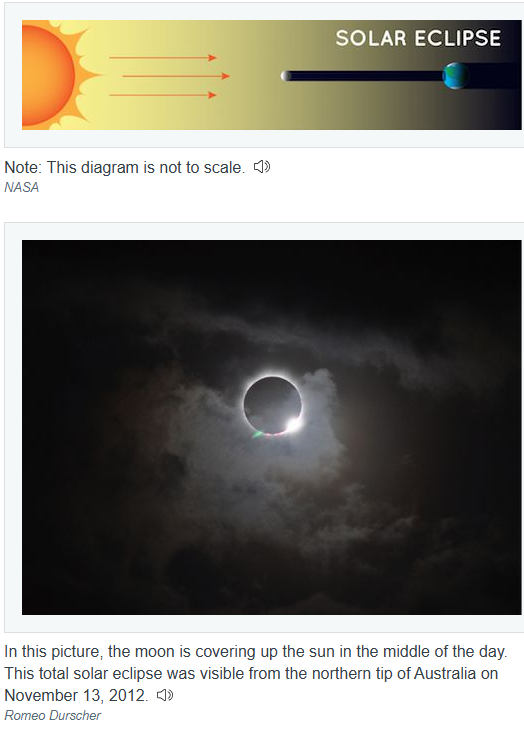
But not everyone experiences every solar eclipse. Getting a chance to see a total solar eclipse is rare. The moon’s shadow on Earth isn’t very big, so only a small portion of places on Earth will see it. You have to be on the sunny side of the planet when it happens. You also have to be in the path of the moon’s shadow.

On average, the same spot on Earth only gets to see a solar eclipse for a few minutes about every 375 years!
Lunar Eclipse

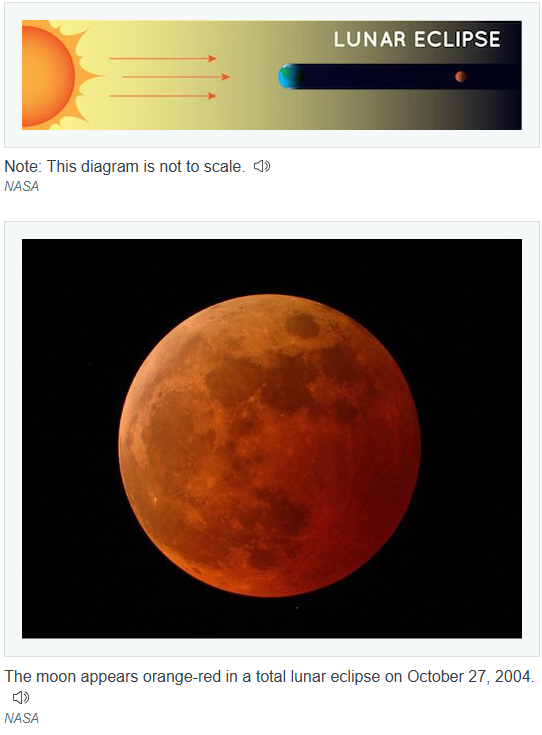
During a lunar eclipse, Earth gets in the way of the sun’s light hitting the moon. That means that during the night, a full moon fades away as Earth’s shadow covers it up.

The moon can also look reddish because Earth’s atmosphere absorbs the other colors while it bends some sunlight toward the moon. Sunlight bending through the atmosphere and absorbing other colors is also why sunsets are orange and red.

During a total lunar eclipse, the moon is shining from all the sunrises and sunsets occurring on Earth!
Why don’t we have a lunar eclipse every month?

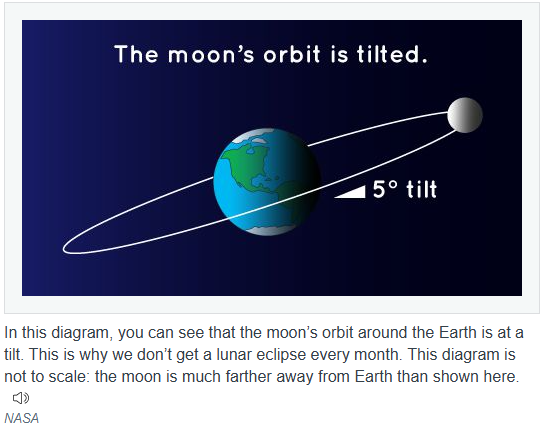
You might be wondering why we don’t have a lunar eclipse every month as the moon orbits Earth. It’s true that the moon goes around Earth every month, but it doesn’t always get in Earth’s shadow. The moon’s path around Earth is tilted compared to Earth’s orbit around the sun. The moon can be behind Earth but still get hit by light from the sun.
Because they don’t happen every month, a lunar eclipse is a special event. Unlike solar eclipses, lots of people get to see each lunar eclipse. If you live on the nighttime half of Earth when the eclipse happens, you’ll be able to see it.

Remembering the Difference

It’s easy to get these two types of eclipses mixed up. An easy way to remember the difference is in the name. The name tells you what gets darker when the eclipse happens. In a solar eclipse, the sun gets darker. In a lunar eclipse, the moon gets darker.

Asemmisa {{asɛmmisaAhyɛnsode}}
31.

What is an eclipse?

Asemmisa {{asɛmmisaAhyɛnsode}}
32.

The text compares and contrasts solar and lunar eclipses. What is one difference between them?

Asemmisa {{asɛmmisaAhyɛnsode}}
33.

The text states, “During a lunar eclipse, Earth gets in the way of the sun’s light hitting the moon. That means that during the night, a full moon fades away as Earth’s shadow covers it up.” What conclusion can you draw based on this evidence?

Asemmisa {{asɛmmisaAhyɛnsode}}
34.

What is one thing that must happen in order for either a solar or a lunar eclipse to occur?

Asemmisa {{asɛmmisaAhyɛnsode}}
35.

What is the main idea of this passage?

Asemmisa {{asɛmmisaAhyɛnsode}}
36.

Please read these sentences from the text. "Getting a chance to see a total eclipse is rare. The moon's shadow on Earth isn't very big, so only a small portion of places on Earth will see it."

Based on these sentences, what does the word rare mean?

Asemmisa {{asɛmmisaAhyɛnsode}}
38.

Which section would you find information about the moon's orbit around Earth?