Excerpt from The Great Pyramid: Egypt’s Tomb for All Time
by Jeanette Leardi
 In the sun’s blazing heat, a group of Egyptians arrived at a desert along the banks of the Nile River. They had traveled hundreds of miles by boat. They were scared, but excited. Never before had they left their tiny villages.
 As the Egyptians stepped off the boat, they saw 20,000 workers. Many were cutting giant blocks of limestone. Others were pulling huge stones up the slanted sides of a building. All had come at the command of their king, Khufu (KOO-foo). They were doing the most important work of their lives. They were building Khufu’s tomb—the Great Pyramid.
Who Were the Pharaohs?
 Who was the king who could order such a mighty task? He was an ancient Egyptian ruler, called a pharaoh. Yet to the Egyptian people, their king was not just a powerful man. He was the sky god Horus (HOR-us), who had come down to Earth.
 The pharaoh was all-powerful. Many Egyptians used crops or animals to pay taxes. They also paid by working for the ruler. They built his palaces —and his tomb.
A Towering Tomb
 Like other pharaohs before him, Khufu ordered workers to build him a tomb. It would hold his body and his treasures. So he wanted the building to be strong enough to last forever. Yet Khufu wanted something more. He wanted his tomb to be the tallest one ever built—and it was. Khufu’s pyramid stood 481 feet (147 m) tall.
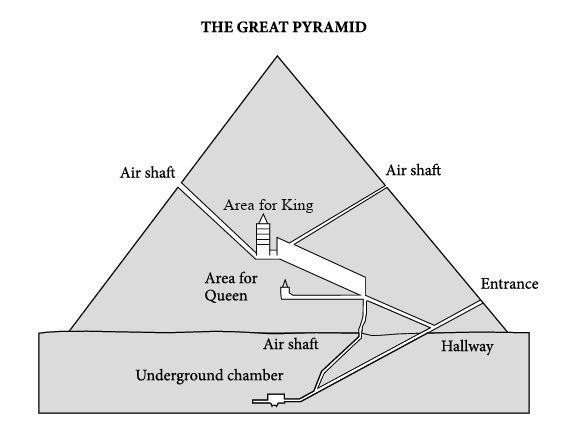
 Building the Great Pyramid took lots of planning. The tomb would need tightly closed rooms to keep out robbers. It would also need air shafts. These airways may have been built to help Khufu’s spirit travel to the heavens.
 How Did They Do It?
 Once it was decided where the pyramid’s walls would lie, the building could begin. Workers cut huge stones from rock quarries. They did this using simple hand tools. Some stones were sent to Giza by boat on the Nile River. Others were dragged to the site using ropes and wooden sleds.
 No one knows how the workers got the stones to the top of the pyramid. Most stones weighed about 2.5 tons (2.3 metric tons). The builders may have used one big ramp. Or they may have built a ramp that wrapped around the pyramid. In all, it took more than two million stones to complete the pyramid.
Who Built the Great Pyramid?
 Workers came to Giza from every part of Egypt to help build Khufu’s tomb. About 5,000 skilled workers stayed there throughout the year. Many were artists and stonecutters. About 20,000 others worked for three to four months each year. They did the hard tasks of dragging the stones.
 We are almost at the end of the market where the cat-rescue people always set up on Sunday, and I hope she’s in the mood not to resist some more.
  “I think a pet would make a very appropriate half-birthday present,” I say to my mother. We pull our bags up our arms a little so we can hold hands, and I lead her past the flower stands to the cats. They are my number three favorite thing about the farmers’ market. They are already above the popcorn I always get when we’re done shopping, and they would move right up to number one, past the samples, if I ever got to take a kitten home.
  “A pet is a very big responsibility, Abigail Iris,” she says. “We can look, but half birthday or not, you know we can’t bring a cat home. We’ve been over this before.”
  “I know,” I say, but I don’t know for sure. . . .
  “My mother would like to hold the big fat gray one,” I say to the cat-rescue lady in charge today, picking out the fattest, laziest-looking cat. The cat lady puts down the book she’s reading and reaches into a cage and hands my mother the cat I picked for her. . . .
  Now that my mother is all set up, I peek in another cage. All I see in there is a big stuffed teddy bear, and I’m thinking the cat-rescue lady might need to wear better glasses when she goes out to do her rescuing.
  “He likes to hide behind it, especially when he’s sleeping,” she says.
  And then I see what she’s talking about, two white paws and a little black tail curled up around the back side of the teddy bear.
 “He’s about three months old, we think,” the cat lady says to me. “Someone found him in the Albertson’s parking lot behind the trash bin. Isn’t he cute?”
  I peek behind the teddy bear and see him, a black kitty. Of course he’s cute, I’m thinking. Is there anything cuter? But I don’t say a word because sometimes it’s better to play it cool when you really want something, as my brother Eddie always tells me. He’s a teenager, and although I don’t prefer to admit it, he knows more things about the world than I do. . . .
  “Can I hold him?” I ask.
  “Well, I don’t know,” she says, smiling. “You have to be very gentle.” . . .
  She reaches in and picks up the kitten for me. I see a bright orange spot on his nose, and I think right away that this kitten must be named Spot even though it’s a dog’s name, and I hope he won’t mind. She hands him to me, and I try my hardest to hold Spot gently without letting him wiggle out of my arms. He crawls up on my chest and buries his nose with the orange spot on it into my neck, and then he’s very still, and I can feel his heart beating. . . .
  “He likes you,” the cat lady says. “See, he’s not even trying to get away.”
  My mother is handing the fat gray cat back to the cat lady and telling me it’s time to go. “What a baby,” she says about my kitten.
  “Can we keep him, Mom, please, please, please?” I say, not being cool at all now. “A kitten is like half a cat and that would be the present I would most prefer in the whole world for my half birthday.”
  “He’s very sweet,” my mother says.
  I’m waiting for her to say but, but I don’t hear it right away, so I speak quickly before she can get it out. “He likes me,” I say. “He’s not even trying to get away. I would take care of him. I would feed him and change his litter box and buy him little toys with my allowance.” . . .
  “Maybe we’ll bring up the idea to your dad tonight,” she says to me as we pick up our bags and walk back toward the popcorn man. “See what he thinks about a cat now that you all are older. Maybe it’s time.”
 Last year, Americans spent more than $22 billion on chocolate. But the tasty treat comes at a far greater cost than this. . . .
  Chocolate comes mainly from the Cocoa Belt, a narrow strip of land along the equator. It is also where much of the world’s tropical rainforest is located. In the Cocoa Belt, it is hot, humid, and rainy. Conditions are perfect for growing cacao.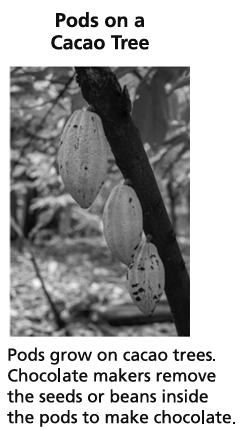
 But in recent years, climate change has affected the weather in the Cocoa Belt. As a result, cacao trees produce fewer pods. Each pod has fewer beans. The cocoa they make is of lower quality. You need more of it to make chocolate taste, well, chocolatey. Climate change has also led to the spread of disease and pests that harm trees.
  In 2013, researchers studied the changing conditions in the Cocoa Belt. They said that by 2050, it will be harder to grow cacao in 90% of places where it is now planted.
  But Christian Bunn, of the International Center for Tropical Agriculture, says chocolate won’t disappear anytime soon. Plans to protect it are already taking shape.
  One solution to the problem is cross-breeding. Scientists are combining two breeds of cacao trees to develop new trees that stand up to drought and disease. Some even produce more cacao.
  Weather stations will also help. Groups are building them in Africa. Around 70% of cacao is grown there. Information from the stations will help farmers know when to plant and fertilize trees. “Years back, farmers would follow farming rules that go with the seasons,” Bunn told TFK (Time For Kids). “Those rules don’t always apply anymore.”
  An app called CocoaLink also helps. Released in 2011 by the World Cocoa Foundation (WCF), it sends tips to farmers in Ghana.
  These fixes could help farmers grow more cacao on less land. That could help end the push to clear rainforest. That’s good for chocolate, and a sweet deal for the planet. “Everything has an impact,” WCF’s Ethan Budiansky told TFK. “We have to be smarter about our food, going into the future.”
  Where does chocolate come from? To answer that question, we’ll walk you through the making of a candy bar.
  But first, let’s talk about two words we’re using throughout this story: cocoa and cacao.
  The powder used to make chocolate is called cocoa. The seed pods that are ground up to create that powder are called cacao. It’s also the word used for the trees that grow the pods. They’re called cacao trees.
  1. Cacao is grown on trees. Cacao pods grow on a cacao tree, usually somewhere in the Cocoa Belt. When the pods are ripe, they’re picked by a farmer.
 2. The beans are separated from the pods. Most cacao is farmed by small producers in remote parts of the world. Machines can damage cacao trees. Most of the work is done by hand.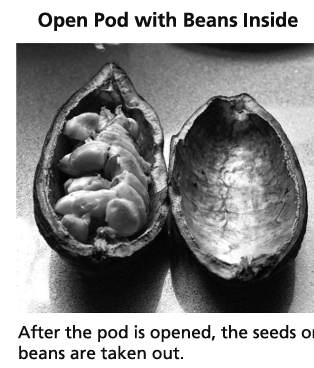
 3. The beans are fermented. Now the beans undergo a chemical process called fermentation. This brings out their chocolatey flavor.
 4. The beans are dried. Often, farmers simply spread the beans on large trays. They dry in the sun. Once dry, the beans are packed into bags and shipped to chocolate manufacturers.
 5. Chocolate is made. In manufacturing facilities, cocoa beans are roasted, heated, melted, and blended with sugar and milk. This takes away their naturally bitter flavor. Then the liquid chocolate is poured into molds and prepared for sale.
  6. Enjoy! This is the moment you’ve been waiting for. Take a bite!
 Ants are very social bugs. They live and work together in large colonies. Ant colonies are highly organized communities. Each ant helps the community survive.
 The biggest ant colonies have millions of members. Ants have to build a home that’s big enough for everyone. Often, the place with the most space is under the ground. Ant homes look simple from the outside, but there’s more to them than meets the eye.
  Ant homes are called nests. You may hear people call them “anthills.” That’s because the outside of a nest can look like a hill of dirt. The dirt comes from all the digging ants must do to build their nest.
  Many ant nests are under the ground. Some kinds of ants build nests in trees. Ant nests can also be found under rocks and piles of leaves. Tiny ants can make nests inside acorns! No matter where it is, an ant nest has one job to do: to house the colony.
  Let’s go inside an ant nest that’s been built under the ground. The opening in the anthill is called the entrance. Ants use this as a doorway to get in and out of their home.
  The inside of an ant nest is an organized network of tunnels and chambers. The tunnels are like hallways ants use to travel to different areas inside their nest. The tunnels empty into chambers. Chambers are much like the different rooms in a house.
 Ants are some of nature’s greatest builders. It takes a lot of skill to plan such an organized home. They build their home by biting and digging.
  Ants have two pairs of jaws. One pair helps them bite and carry. They bite off tiny bits of soil and carry them out of the nest. Over days and weeks, this creates a network of tunnels and chambers. Ants learn how to travel around their nest by following scent trails left by other ants. . . .
  Ant nests give ants somewhere to live, store food, and grow their colony. They have one more important job—keeping ants safe.
  Ants are food for many animals, such as anteaters. Anteaters use their sharp claws to tear apart nests. Then they use their long tongue to scoop up ants. An anteater’s tongue may be long enough to reach 2 feet (0.6 m) inside the nest. Ants keep their queen, her eggs, and their food supplies safe by building those chambers deeper than predators can reach.
 Ants protect their nest by attacking predators. All ants can bite, and some can sting. Some ants even spray chemicals to fight their enemies.
 Sleep has puzzled people for a long time. Why do we lie down and zone out for hours every night? Isn’t sleep just a giant waste of time? Could we learn to do without it?
  Now scientists are beginning to answer some of those questions. They’ve discovered that brains and bodies don’t just shut down at night. Quite the contrary! At night, your body repairs itself and grows strong. Your brain is busy making memories and learning. Sleep is so useful that all animals do it. And without it, waking life would be impossible.
  After lying down, most people take about 20 minutes to fall asleep. In the twilight zone between asleep and awake, your brain begins to drift. It muffles signals from the muscles and senses, ignoring information from the outside world. That can give you the odd sensation of falling. You aren’t really—you’re just falling asleep. . . .
  As you slip into sleep, your heart slows down and you breathe more slowly. Your eyes shut, and your brain ignores ordinary sounds. That’s why when you’re sound asleep, you don’t hear small noises or other things that might wake you up. The part of the brain that keeps you aware of time passing also switches off, so in the morning it feels like the night takes no time at all.
  But your brain does not shut down at night. In fact, it gets quite active. It’s got important jobs to do.
 You might think sleep is just . . . sleep. But in fact, you do several different kinds of sleeping, cycling through them several times through the night.
  First is a light sleep. After about half an hour, your brain sinks into a deep sleep. During deep sleep, long, slow waves of electrical impulses move through the brain. These slow waves move all the important things you learned and did today from short-term memory into long-term memory. At the same time, you forget unimportant details like putting on your socks. That frees up space to learn new things tomorrow.
  After about 20 minutes or so of slow-wave sleep, your sleeping brain shifts gears. It starts to look more awake—though it isn’t. In the next stage of sleep, your muscles go completely slack. Your body doesn’t move at all. But your eyes dart back and forth behind closed eyelids. This motion gives this kind of sleep its name—REM, for “rapid eye movement.”
  During REM sleep, the brain is making connections. It links new experiences to old memories. It also bundles together actions you’ve been practicing, such as the motions of riding a bike, into a new, single muscle memory: ride bike. All this connecting triggers dreams—which can get pretty weird.
  You cycle through stages of light, deep, and REM sleep every 90 minutes, over and over, all night long. At the beginning of the night, you do more slow-wave sleeping, while the brain cleans house. Toward morning, you get more REM sleep, as it builds new knowledge. that’s when the most vivid dreams happen.
  Why do we dream? Scientists aren’t completely sure, but they have some ideas.
 Dreams might be a side-effect of memory making. While you sleep, your brain sorts through everything that happened during the day. It tries to link new experiences to old memories that are similar in some way. As it connects things, the “story-making” part of your brain turns them into a story, and you get a dream. . . .
  When it’s sorting through the day’s memories, your brain pays special attention to anything that made you feel extra happy or scared or excited. In dreams, the brain can try out solutions to problems that are bothering you. Finding even a weird dream solution can make you feel more in control the next day.
  Dreams can even help you learn. In one test, volunteers learned how to play a new game. That night, some of them were awakened whenever they entered REM sleep. The others were awakened the same number of times, but only during non-REM sleep. The next day, the people who got their REM sleep did much better at the game. The players who started out being worst at the game had the most dreams about it—and they improved the most.
  So if you want to do well on that test, don’t stay up all night studying. Instead, get a good night’s sleep. That’s when your brain learns best.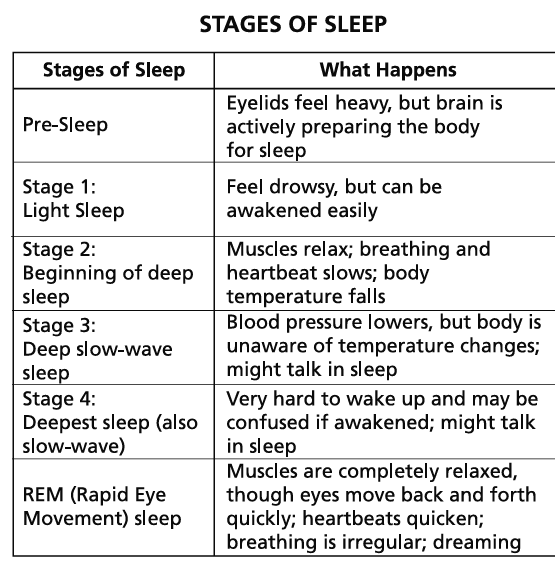
 I rode my bike up into the hills behind our house. The day was getting hot, and my T-shirt stuck to my back as I churned hard on the pedals. The sun was turning the Sangre de Cristo Mountains a rosy gold color.
  My throat dried up, my leg muscles ached with fatigue, and my lungs felt like they were about to burst. Even so, I enjoyed making the steep but quick (ten-minute) climb to Miss Sabines’ house. I was heading to a place that had always given me comfort for my troubles.
  Miss Sabines is 70 years old, but to me she seems like a sister, an hermana. She has long silver hair in a braid down her back. All the other older women I know have either short hair or chin-length hair, but Miss Sabines has never cut hers. She enjoys braiding my hair, for she says its long, thick, wavy strands remind her of her own. My face is like hers, too. We both have round, chubby cheeks and big eyes like brown buttons. Now that Miss Sabines is older, her eyes have a ring of bluish white around the brown part, but they’re shaped just like mine.
  Miss Sabines and I have more in common than just our looks. We’re both smart, but we also daydream too much. It’s a big contrast from my sister Susana, who is very practical and hardly ever daydreams.
 Speaking of daydreams, I often fantasize about living in a house like Miss Sabines’. My family’s house is bigger and fancier than Miss Sabines’, but I’d trade a mansion for her little casa any day. It has a big garden, with beautiful desert plants and herbs growing everywhere, and a courtyard that has tiles painted bright colors, with sculptures, pinwheels, wind chimes, and lawn ornaments scattered throughout. There’s a cat, who sleeps under a lemon tree in the corner of the garden, along with a parrot, Tío, meaning “Uncle,” who sits on a perch by the kitchen door.
  When I got to Miss Sabines’ house, I took off my bike helmet and threw my bike down on the sandy strip outside her gate. I rattled her courtyard fence and called, “Are you there?”
  “Rosita, is that you? What a nice surprise! Hold on a moment; I’m in the garden.” The pleasant voice came floating across the courtyard walls, putting me instantly at ease. In a moment, Miss Sabines appeared at her rickety, rusty front gate. She had on a straw hat to shade her face, but as she approached, she took it off and grinned. I helped her unhook the tricky latch on the gate and immediately gave her a big hug.
  “My, what did I do to deserve this?” Miss Sabines laughed, pulling away from the hug. She peered intently into my eyes. “You look troubled. What do you have to tell me?” she asked. . . .
  I expected Miss Sabines to feel sorry for me and understand my problems, but instead she laughed. The laugh started in her belly, echoed in her chest, and came out her mouth like a low, happy rumble. At first I was confused; I thought maybe she hadn’t understood me, but then she explained.
  “Ah, pequeño pájaro,” she said. “Little bird, you remind me so much of myself!” . . .
  We passed the rest of the afternoon puttering around the house. Miss Sabines showed me some of her new plantings, we played with her pets, and I leafed through a collection of photographs by Ansel Adams, whom Miss Sabines calls a “poet of Southwestern landscapes.” All of a sudden (or so it seemed), the June sun sank below the garden wall.
 “Oh, no!” I gasped, looking at my watch. It read 5:55 P.M. “We’re having a party tonight, and I’ve been gone for hours!”
  “Well, then, you’d better get home, muchacha!” Miss Sabines said.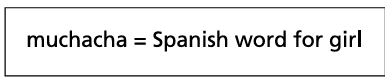
 I latched the gate, put on my bike helmet, and got on my bike. “Thank you for the talk, Miss Sabines!” I waved. “You’ll always be my hermana across time!”
  Miss Sabines waved back. “I’m always available for advice,” she called out as I sped off down the hill.