Learning ObjectivesStudents will be able to:
| National Standards for Personal Financial Education Investing
|
Learning ObjectivesStudents will be able to:
| National Standards for Personal Financial Education Investing
|
Imagine you’re buying a dozen donuts for you and your friends. Would you buy all 12 in the same flavor? Or would you buy a box that has a variety of flavors? Why?
In your own words, describe how investing in a fund is a more diversified approach than investing in a single stock or bond.
What question(s) about funds do you have now that you’ve seen the variety of fund options available to you?
Who manages the fund when Passive Investing?
Who manages the fund when Active Investing?
Between Passive Investing and Active Investing; which has the lower risk?
Do you think you would want to invest in a passively managed fund or an actively managed one? Why?
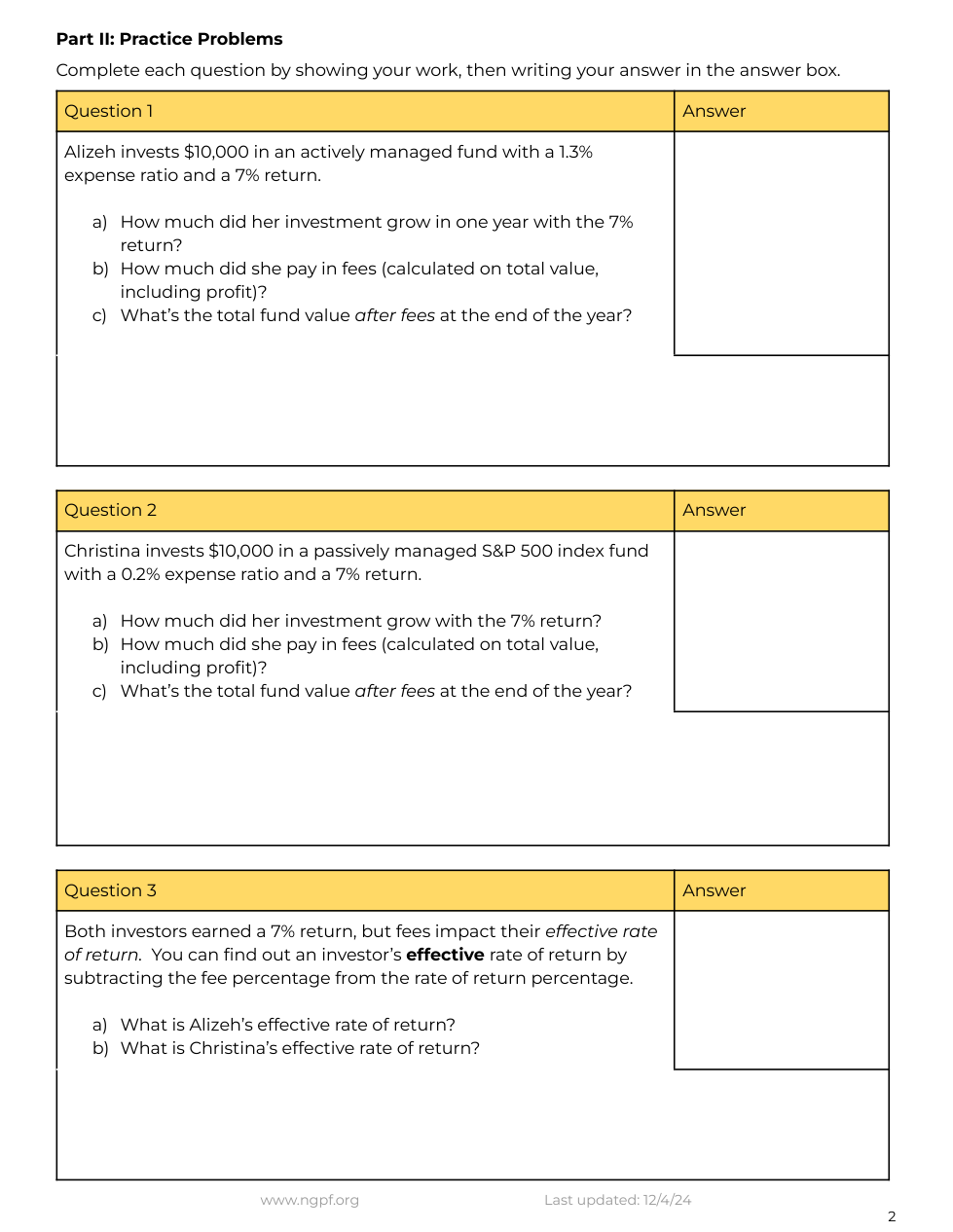
Alizeh invests $10,000 in an actively managed fund with a 1.3% expense ratio and a 7% return.
a. How much did her investment grow in one year with the 7% return?
b. How much did she pay in fees (calculated on total value, including profit)?
c. What’s the total fund value after fees at the end of the year?
Christina invests $10,000 in a passively managed S&P 500 index fund with a 0.2% expense ratio and a 7% return.
a. How much did her investment grow with the 7% return?
b. How much did she pay in fees (calculated on total value, including profit)?
c. What’s the total fund value after fees at the end of the year?
Both investors earned a 7% return, but fees impact their effective rate of return. You can find out an investor’s effective rate of return by subtracting the fee percentage from the rate of return percentage.
a. What is Alizeh’s effective rate of return?
b. What is Christina’s effective rate of return?
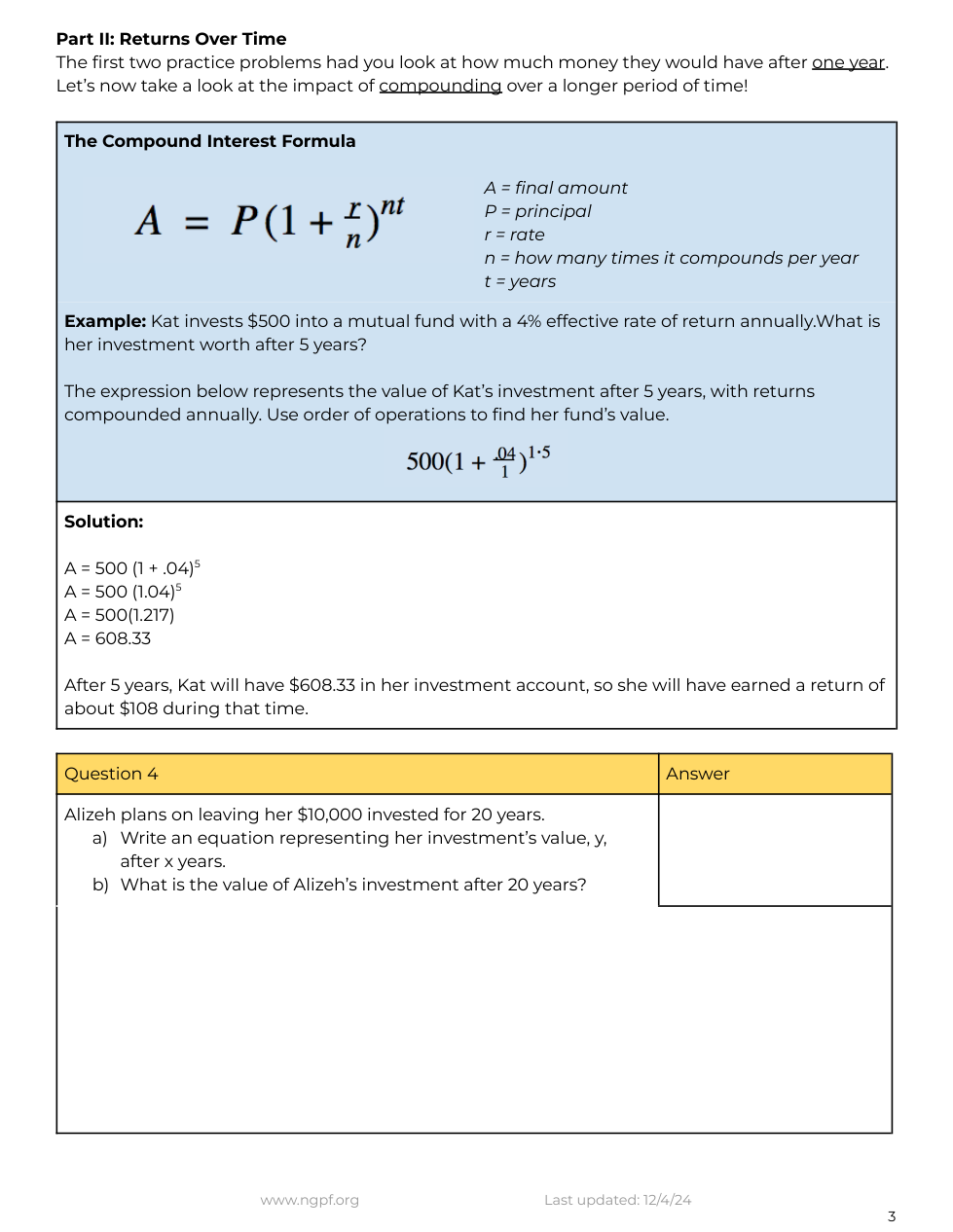
Alizeh plans on leaving her $10,000 invested for 20 years.
a. Write an equation representing her investment’s value, y, after x years.
b. What is the value of Alizeh’s investment after 20 years?
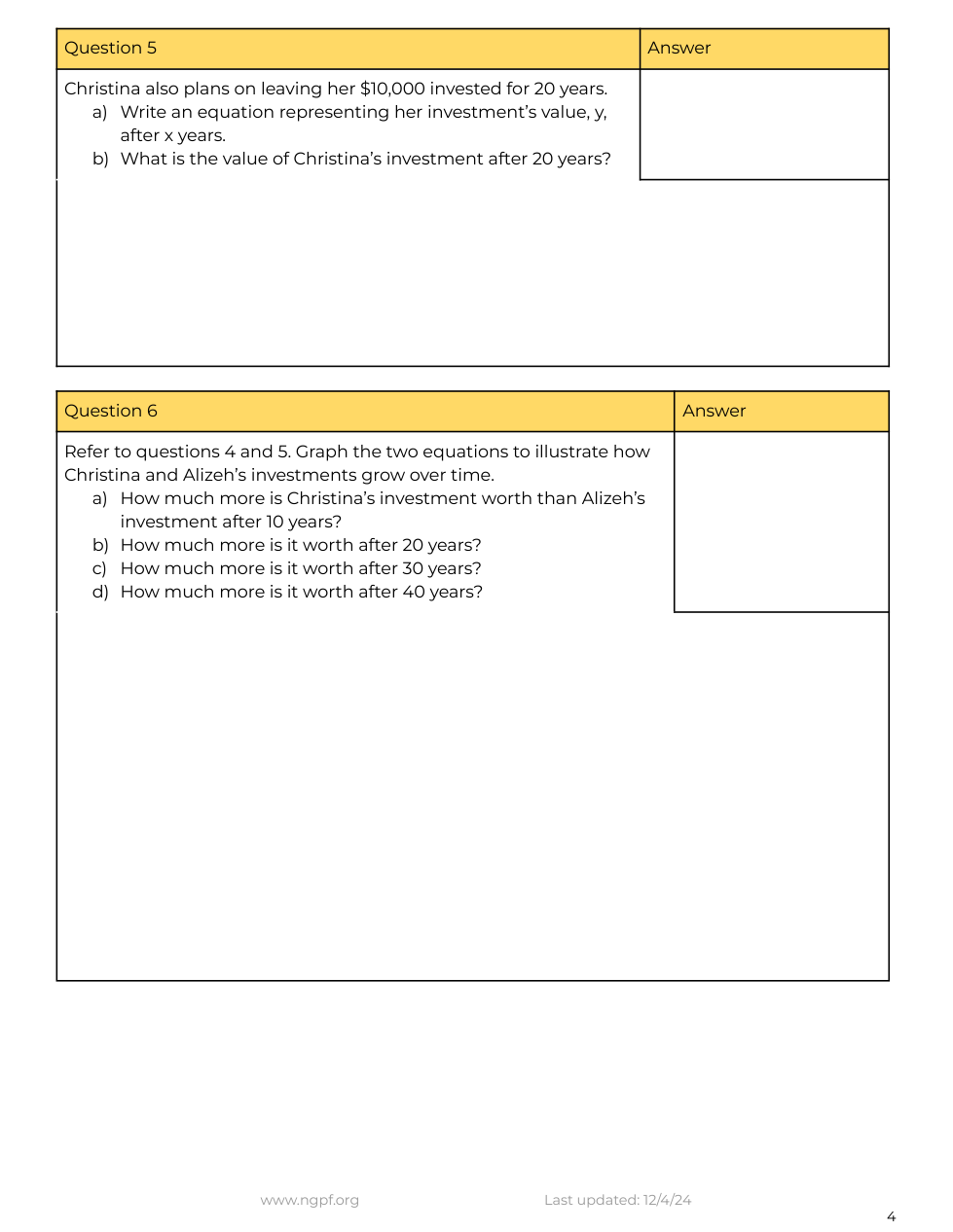
Christina also plans on leaving her $10,000 invested for 20 years.
Write an equation representing her investment’s value, y, after x years.
What is the value of Christina’s investment after 20 years?
OPTIONAL: Refer to questions 11 and 12. Graph the two equations to illustrate how Christina and Alizeh’s investments grow over time.
How much more is Christina’s investment worth than Alizeh’s investment after 10 years?
How much more is it worth after 20 years?
How much more is it worth after 30 years?
How much more is it worth after 40 years?
OPTIONAL: Refer to the graph in Question 13 to answer the following questions.
Challenge: Use math to calculate the exact answer.
How many years did it take for Alizeh’s investment to double in value?
How many years did it take Christina’s investment to double in value?
OPTIONAL: Challenge: How much would Alizeh need to invest now, with her current rate of return, to match the value of Christina’s investment after 30 years?
Part III: Reflection Q9
Q10
OPTIONAL: Q11
Q12
When talking about investing, what does it mean when someone refers to a fund?
The goal of an actively managed fund is to outperform the market. What does this mean?
All of the following are true about a passively managed fund EXCEPT…