Arctic Glaciers
Key Points
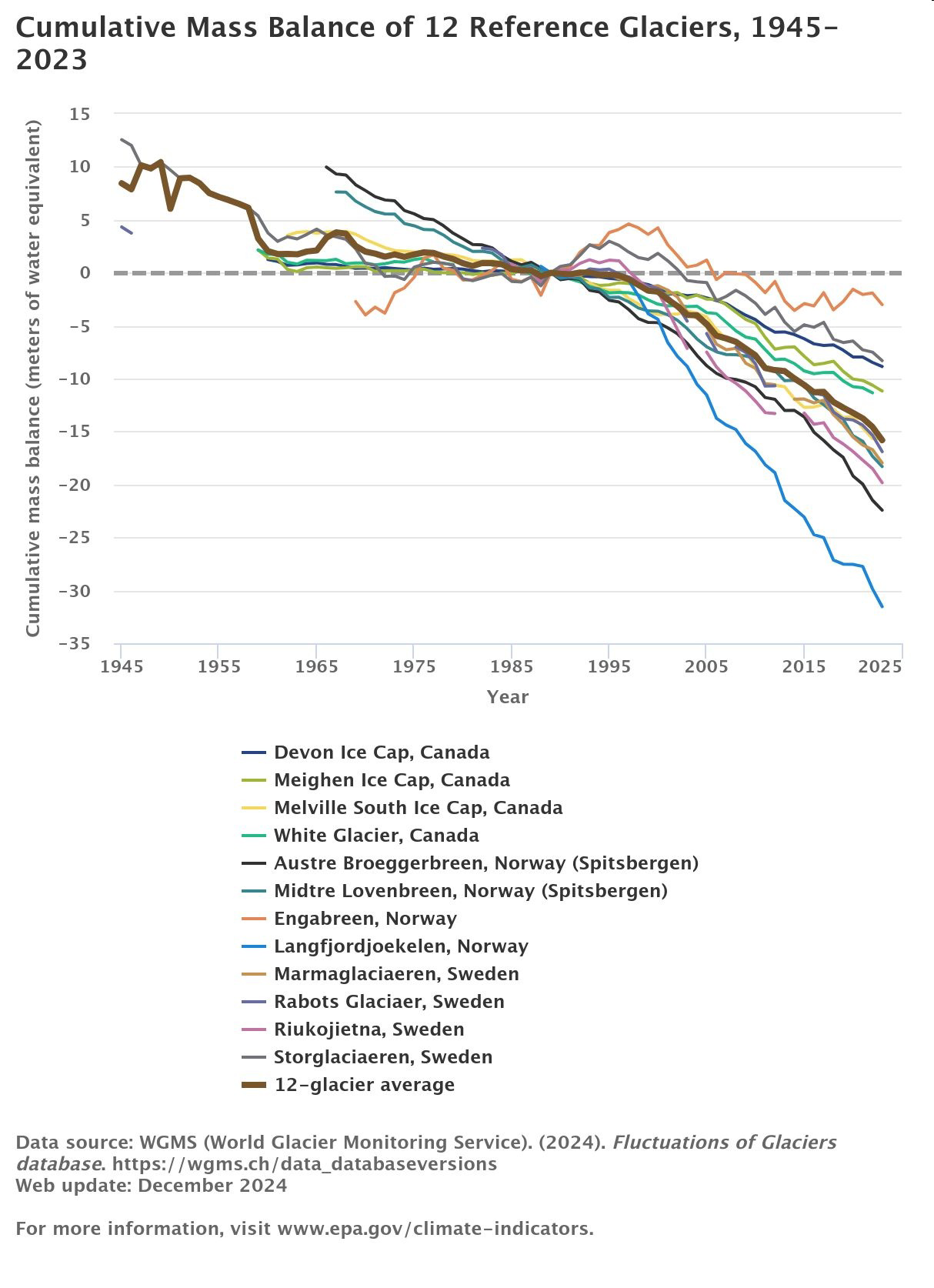
Since 1945, the 12 Arctic glaciers in Figure 1 have experienced a decline in mass balance overall. One exception to this pattern is Engabreen, near the subpolar zone along the coast of Norway, which gained mass for much of the period of measurement and has about the same mass now that it did in its earliest measurements. Engabreen is more strongly influenced by precipitation than glaciers elsewhere in the Arctic, which may partly explain this change in pattern. This trend is anomalous and does not reflect the significant global loss of land ice as measured and catalogued from numerous glaciers elsewhere in the Arctic and around the world in the 20th century.
The loss of land-based ice in the Arctic has accelerated in recent decades. The Arctic is the largest contributing source of land ice to global sea level rise.
Background
Rapid changes are occurring across the Arctic, where air temperatures are warming three times as fast as the global average temperature. The loss of land-based ice in the Arctic has accelerated in recent decades, and since at least 1972, the Arctic has been the dominant source of global sea-level rise. Greenland is the largest contributor to global sea-level rise from Arctic land ice, followed by small glaciers. If increases in greenhouse gas concentrations continue at current rates, it is expected that many of the smallest glaciers across the Arctic would disappear entirely by mid-century. As the Glaciers indicator explains, glaciers are important as an indicator of climate change and provide visible evidence of changes in temperature and precipitation.
Retreating glaciers and thawing permafrost in the Arctic are creating local and regional hazards that disrupt lives and livelihoods, infrastructure, sustainable development, and national security.
Graph of Information - Figure 1.
This figure shows the cumulative change in mass balance of a set of 12 glaciers located at a latitude of 66°N or higher with data beginning in 1945. Each time series has been adjusted to make 1989 a common zero point because this was the first year for which mass balance data are available for all 12 glaciers. Negative values indicate a net loss of ice and snow compared with the base year of 1989. For consistency, measurements are in meters of water equivalent, which reflects the mass loss of the glacier by representing changes in the glacier’s average thickness.