Tides
How to Read a Tide Table
Step 1 Look Up Daily Tide Information for Your Location
There are different ways to get information about daily tides for your particular area or location.
A. NOAA's online tool, Tide Predictions
B. Buy a tide table booklet for your specific area.
C. Look for tide tables in local newspapers or ranger stations.
Step 2 Look Up the Dates You'll Be Out
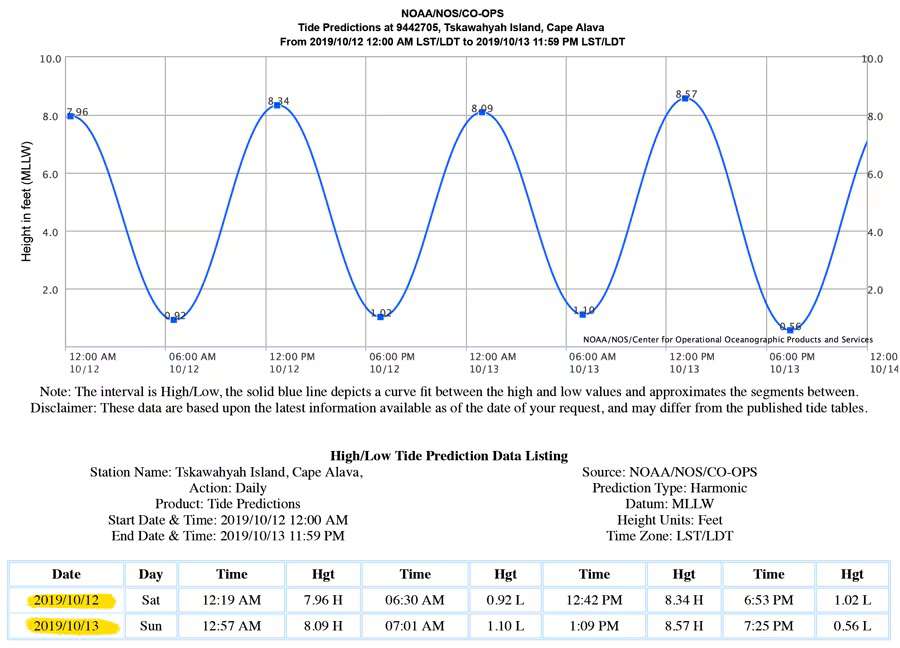
For example, let's say you wanted to do a backpacking trip along the coast of Washington state in mid-October and you need to know when high and low tides are. You may want to know whether you can hike or camp along the beach or whether you can pass a rocky point at certain times of the day.
Step 3 Make a Note of the Times of High and Low Tides
Make a note of the times and heights of high tides and low tides, and the height difference in between.
In this example at Cape Alava, Washington, there are two high tides on Oct. 12: the first high tide at 12:19 a.m. and another that is even higher tide at 12:42 p.m. The first high tide of 7.96 feet means that the water level is 7.96 feet as measured above the average of the lowest low tides. There are two low tides, one that is 0.92 feet at 6:30 a.m. and another of 1.02 feet at 6:53 p.m.