High and Low Temperatures
Key Points
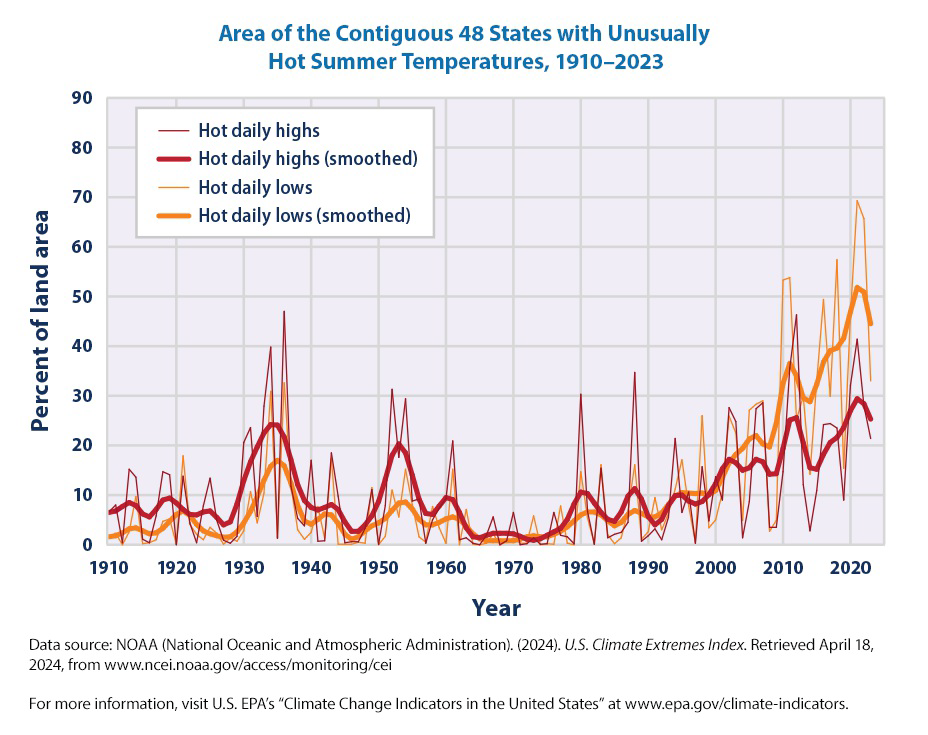
Nationwide, unusually hot summer days (highs) have become more common over the last few decades (see Figure 1). The occurrence of unusually hot summer nights (lows) has increased at an even faster rate. This trend indicates less "cooling off" at night.
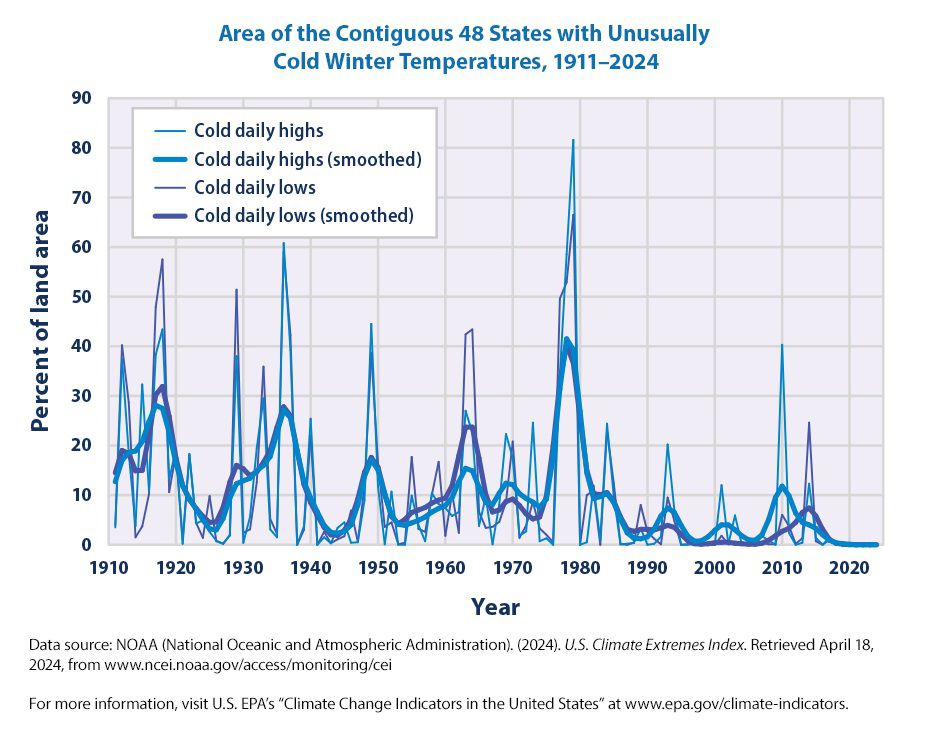
The 20th century had many winters with widespread patterns of unusually low temperatures, including a particularly large spike in the late 1970s (see Figure 2). Since the 1980s, though, unusually cold winter temperatures have become less common - particularly very cold nights (lows).
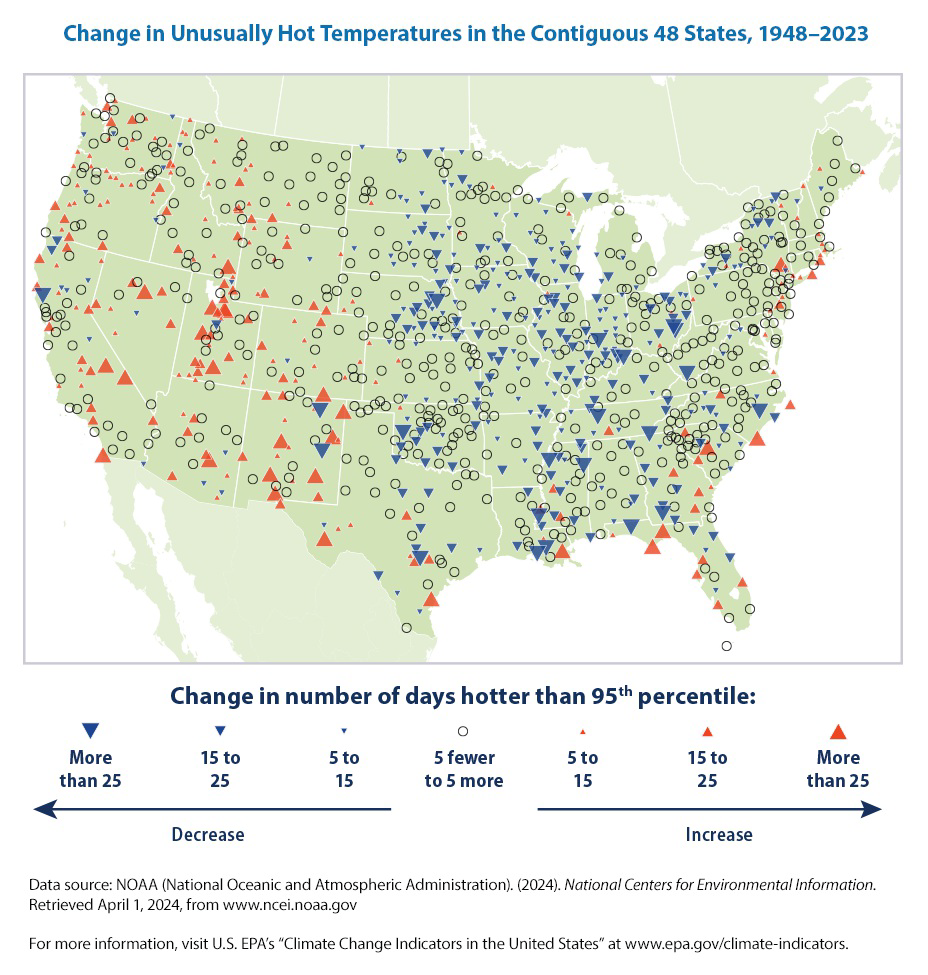
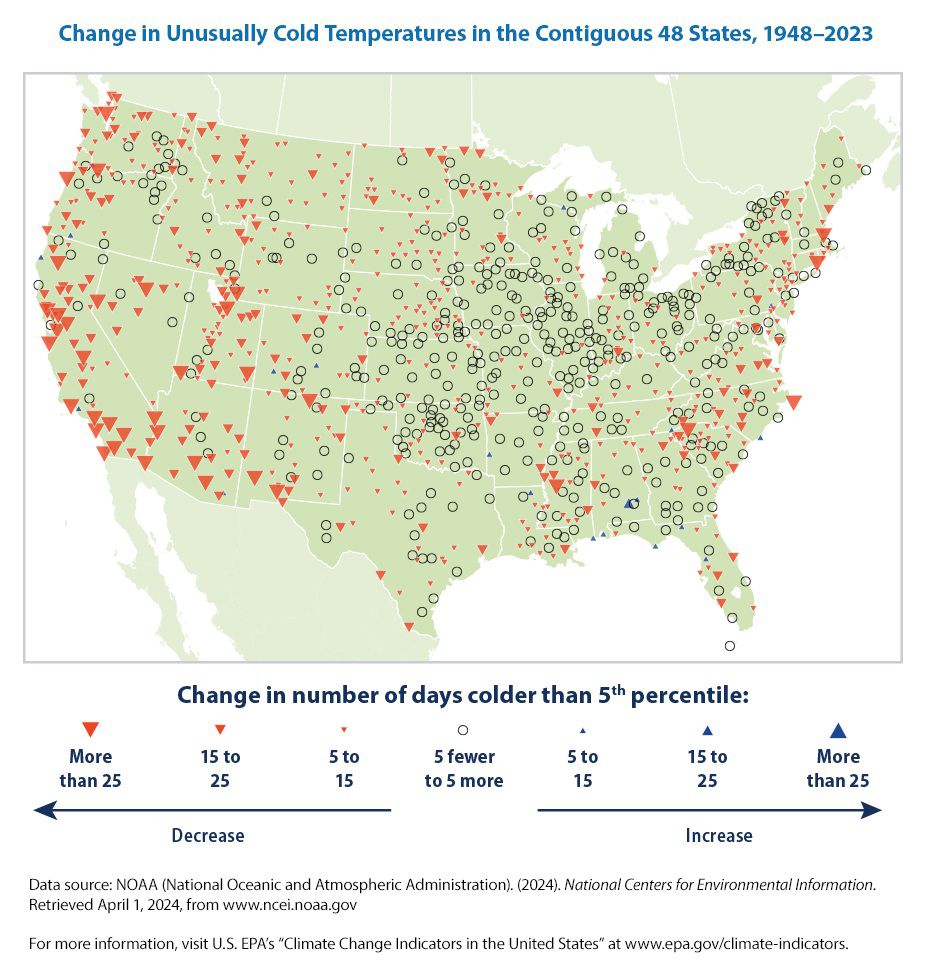
The two maps show where changes in the number of days with unusually hot (above the 95th percentile) and cold (below the 5th percentile) days have occurred since 1948. Based on this way of looking at hot days, unusually high temperatures have increased in the western United States and in several areas along the Gulf and Atlantic coasts but decreased in much of the middle of the country (see Figure 3). The number of unusually cold days has generally decreased throughout the country, particularly in the western United States (see Figure 4).
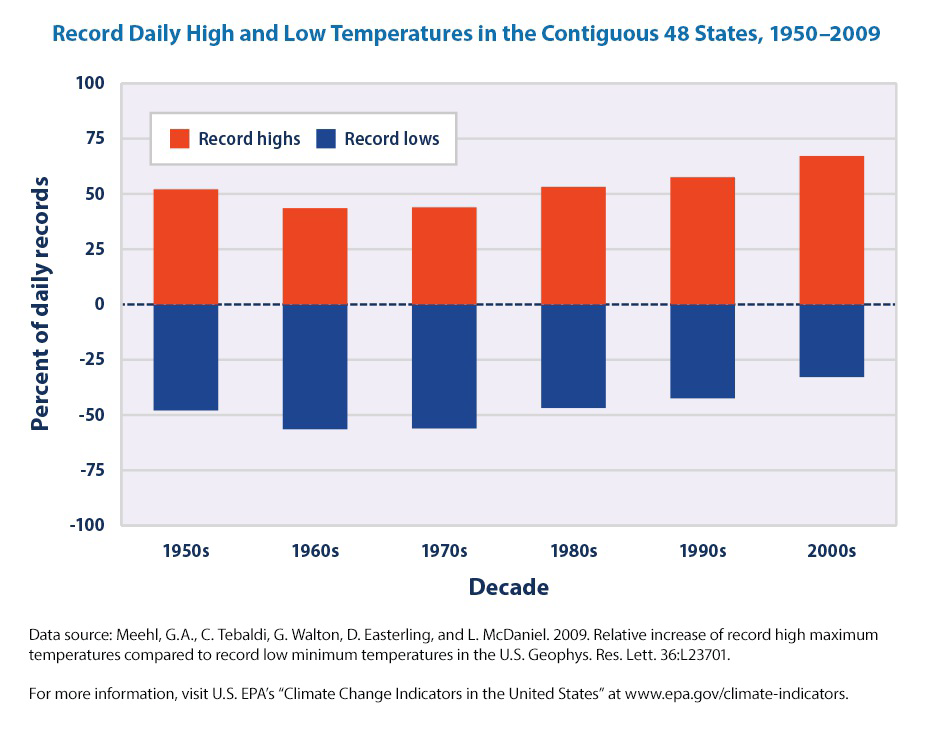
If the climate were completely stable, one might expect to see highs and lows each accounting for about 50 percent of the records set. Since the 1970s, however, record-setting daily high temperatures have become more common than record lows across the United States (see Figure 5). The decade from 2000 to 2009 had twice as many record highs as record lows.
Background
Unusually hot or cold temperatures can result in prolonged extreme weather events like summer heat waves or winter cold spells. Heat waves can lead to illness and death, particularly among older adults, the very young, and other vulnerable populations. People can also die from exposure to extreme cold (hypothermia). In addition, prolonged exposure to excessive heat and cold can damage crops and injure or kill livestock. Extreme heat can lead to power outages as heavy demands for air conditioning strain the power grid, while extremely cold weather increases the need for heating fuel.
Record-setting daily temperatures, heat waves, and cold spells are a natural part of day-to-day variation in weather. As the Earth’s climate warms overall, however, temperatures that are unusually hot for a given location are expected to increase. Higher values of the heat index (which combines temperature and humidity to describe perceived temperature) are expected to increase discomfort and aggravate health issues. Conversely, cold spells are expected to decrease. In most locations, scientists expect the number of warm days and warm nights to increase. This change will provide less opportunity to cool off and recover from daytime heat.
Graph of Information - Figure 1.
This graph shows the percentage of the land area of the contiguous 48 states with unusually hot daily high and low temperatures during the months of June, July, and August. The thin lines represent individual years, while the thick lines show a nine-year weighted average. Red lines represent daily highs, while orange lines represent daily lows. The term “unusual” in this case is based on the long-term average conditions at each location.
Graph of Information - Figure 2.
This graph shows the percentage of the land area of the contiguous 48 states with unusually cold daily high and low temperatures during the months of December, January, and February. The thin lines represent individual years, while the thick lines show a nine-year weighted average. Blue lines represent daily highs, while purple lines represent daily lows. The term “unusual” in this case is based on the long-term average conditions at each location.
Graph of Information - Figure 3.
This map shows trends in unusually hot temperatures at individual weather stations that have operated consistently since 1948. In this case, the term “unusually hot” refers to a daily maximum temperature that is hotter than the 95th percentile temperature during the 1948–2023 period. Thus, the maximum temperature on a particular day at a particular station would be considered “unusually hot” if it falls within the warmest 5 percent of measurements at that station during the 1948–2023 period. The map shows changes in the total number of days per year that were hotter than the 95th percentile. Red upward-pointing symbols show where these unusually hot days are becoming more common. Blue downward-pointing symbols show where unusually hot days are becoming less common.
Graph of Information - Figure 4.
This map shows trends in unusually cold temperatures at individual weather stations that have operated consistently since 1948. In this case, the term “unusually cold” refers to a daily minimum temperature that is colder than the 5th percentile temperature during the 1948–2023 period. Thus, the minimum temperature on a particular day at a particular station would be considered “unusually cold” if it falls within the coldest 5 percent of measurements at that station during the 1948–2023 period. The map shows changes in the total number of days per year that were colder than the 5th percentile. Blue upward-pointing symbols show where these unusually cold days are becoming more common. Red downward-pointing symbols show where unusually cold days are becoming less common.
Graph of Information - Figure 5.
This figure shows the percentage of daily temperature records set at weather stations across the contiguous 48 states by decade. Record highs (red) are compared with record lows (blue).