What organism is at the middle of the pyramid. Letter B.
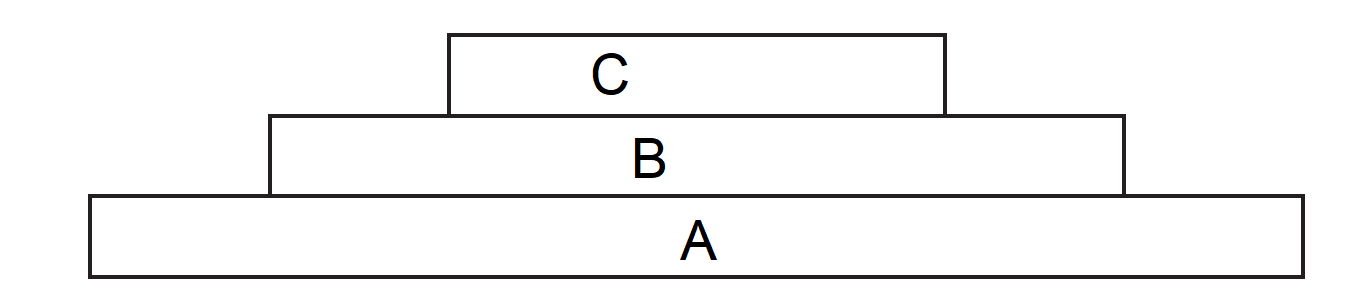
What organism is at the middle of the pyramid. Letter B.
Read all questions carefully.
Answer every question to the best of your ability.
Stay quiet and keep your eyes on your own computer.
Raise your hand if you have a question.
Check your answers before turning in your test.
Match the definition with the vocabulary word
| Draggable item | arrow_right_alt | Corresponding Item |
|---|---|---|
Eats or breaks down dead things | arrow_right_alt | Heterotroph |
Gets energy by eating other organisms. Another name for consumer | arrow_right_alt | Omnivores |
Eats only plants | arrow_right_alt | Carnivores |
Eats both plants and animals | arrow_right_alt | Autotroph |
Collects energy to produce their own food | arrow_right_alt | Primary Consumer |
Eats only animals | arrow_right_alt | Decomposers |
What organism is at the middle of the pyramid. Letter B.
Why is an ecological pyramid smaller at the top than at the bottom?
Grass has 10,000 calories. How many calories would the grasshopper receive?

Match the vocabulary to the definition
| Draggable item | arrow_right_alt | Corresponding Item |
|---|---|---|
Biotic | arrow_right_alt | Relationship where both organisms benefit |
Abiotic | arrow_right_alt | Relationship where one organism benefits and the other is neither helped nor harmed |
Mutualism | arrow_right_alt | Relationship where one organism harms another |
Parasitism | arrow_right_alt | Nonliving factors in the environment like temperature and nutrients levels |
Commensalism | arrow_right_alt | Living factors in the environment like plants, animals, and bacteria |
How do producers get energy?
Look at the food web below to answer the following question:
Which organism is both a primary and secondary consumer?

Look at the food web below to answer the following question:
What would happen to the hawk population if there was a decrease in grouse population?
Look at the food web below to answer the following question:
Which two organisms are in competition?
Remora fish can attach themselves to larger aquatic animals, such as whales. When the whales eat, the fish detach themselves and eat leftover scraps of food. These fish do not harm or help the whales.
What is the ecological relationship between the remora fish and the whales?
Match the definition and symbol to the correct symbiotic term
One organism benefits while the other is neither helped nor harmed
+/+
+/-
Both organisms benefit
+/0
One organism harms another
Mutualism
Parasitism
Commensalism
Match the term to the definition
| Draggable item | arrow_right_alt | Corresponding Item |
|---|---|---|
Community | arrow_right_alt | A single organism (a tiger) |
Ecosystem | arrow_right_alt | A group of the same organisms (a group of tigers) |
Population | arrow_right_alt | Two or more populations living in the same organism (tigers and zebras ) |
Biosphere | arrow_right_alt | A community interacting with the nonliving environment (tigers, zebras, trees, the weather all living together) |
Organism | arrow_right_alt | All life, land, water, and air on earth |
Define Competition
Define Symbiosis
Birds follow wildebeest around and eat the bugs that wildebeest dig up as they eat grass. The birds benefit by getting food and the wildebeest are not helped nor harmed. What type of relationship is this?
A tick drinks the blood of a wildebeest. The wildebeest is harmed and the tick benefits
Algae lives on the spider crab. The algae gets a place to live and food. The spider crab is able to blend in with the surrounding. Both benefit from this relationship.

Review the energy pyramid. Match the trophic level with the correct ecological term.
| Draggable item | arrow_right_alt | Corresponding Item |
|---|---|---|
C - snakes | arrow_right_alt | producers |
D - hawks | arrow_right_alt | primary consumers |
B - rabbits | arrow_right_alt | secondary consumers |
A - grass | arrow_right_alt | tertiary consumers |

Organisms must use energy to grow, move, and perform other molecular functions. This decreases the efficiency of energy transfer from one organism to another.
As a result, organisms at the A level of the energy pyramid have the _________________ amount of energy available, and organisms at the D level of the energy pyramid have the ________________ amount of energy.
Rabbits were introduced into Australia over 100 years ago have become a serious pest to farmers. Rabbit populations increased so much that they displaced many native species of plant eaters. What is the MOST logical explanation for their increased numbers?

In this food chain the __________ has the LEAST energy available to it for its life processes.
If the producer level has 5,000 units of energy, about how much energy would be available to primary consumers?
Tapeworms are organisms that live inside the intestines of animals, such as pigs. The worms consume partially digested food from the pigs, taking nutrients away from the pigs. In this relationship between pig and tapeworm, the pig is a–
________ is the source of energy for almost all living things.
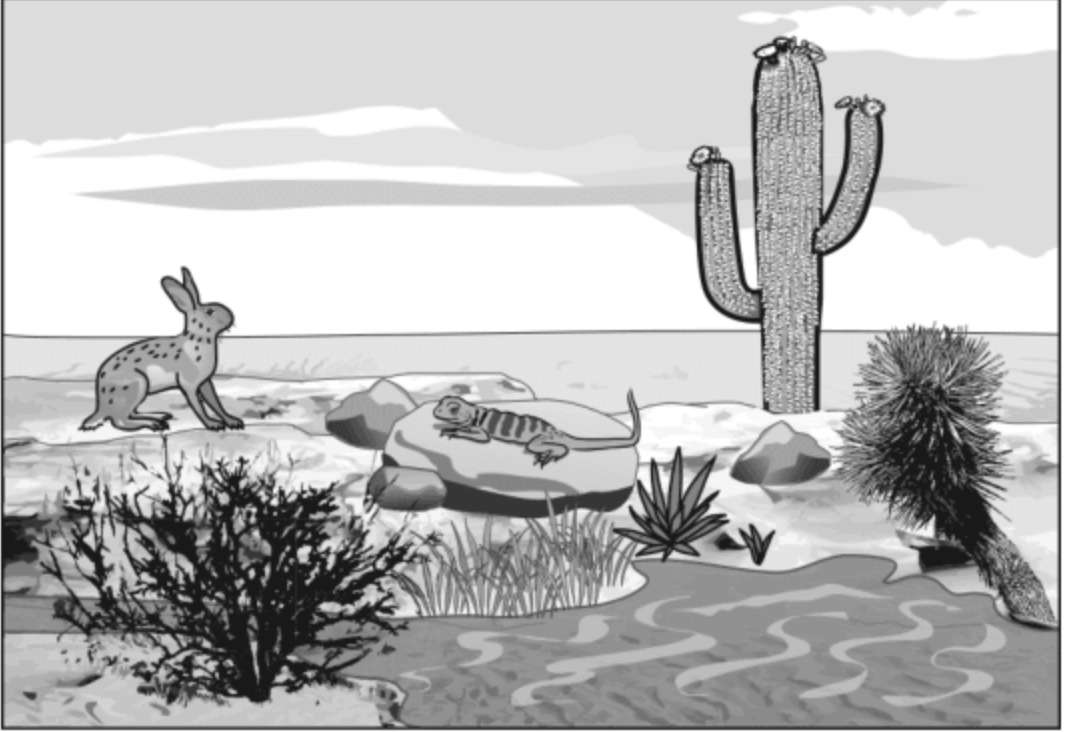
Ecosystems are made up of both biotic and abiotic factors. This picture shows some biotic and abiotic factors in a desert ecosystem.
A.) Identify one biotic factor in the ecosystem.
B.) Identify one abiotic factor in this ecosystem with which the biotic factor you named in PART A interacts.
C.) Explain why it is important for the biotic factor to interact with the abiotic factor you identified in Part B.