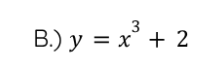
LT16A: Determine if the function is even, odd, or neither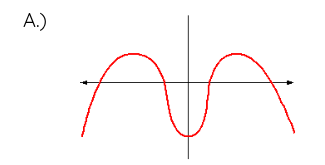
LT16A: Determine if the function is even, odd, or neither
LT15A: Simplify this polynomial and write it in Standard Form:
LT15A: What is the Degree from problem 1?
LT15A: What is the Leading Term from problem 1?
LT15A: What is the classification of the simplified answer from problem 1?
LT15A: What is the Leading Coefficient from problem 1?
LT15B: Perform the operation
LT15B: Perform the operation
LT15B: Perform the operation
LT15B: Perform the operation
LT15C: Factor
LT15C: Factor
LT15C: Factor
LT15C: Factor
LT15C: Factor
LT15D: Solve the equation
LT16A: Determine if the function is even, odd, or neither
LT16A: Determine if the function is even, odd, or neither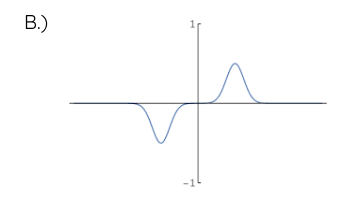
LT16B: Describe the transformation from the parent functions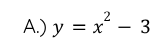
LT16B: Describe the transformation from the parent functions
LT16C: X-intercept(s) of this graph?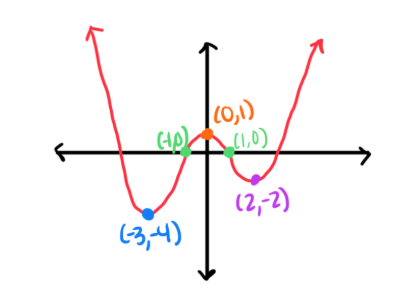
LT16C: Y-intercept(s) of this graph?
LT16C: Relative maximum(s) of this graph?
LT16C: Relative maximum(s) of this graph?
LT16C: Relative minimum(s) of this graph?
LT16C: Increasing interval(s) of this graph?
LT16C: Decreasing interval(s) of this graph?
LT16C: Constant interval(s) of this graph?
LT16C: X-intercepts(s) of this function?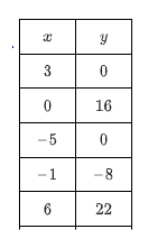
LT16C: Y-intercepts(s) of this function?
LT16D: What is the end behavior?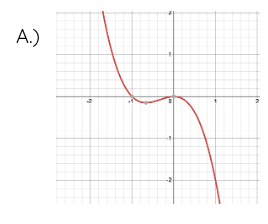
LT16D: What is the end behavior?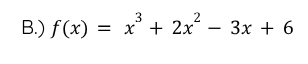
LT16D: What is the end behavior?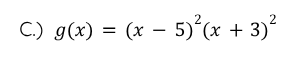
LT16D: Write a possible polynomial equation
A.) Given its solutions are -1, 3, and 8
LT16D: Write a possible polynomial equation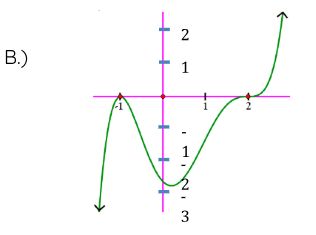
LT17A:
LT17A:
LT17B: Divide the following polynomial
LT17B: Divide the following polynomial
LT17B: Divide the following polynomial using synthetic division
LT17B: Factor the polynomial
LT17B: Identify the x-intercept(s) from problem 40
LT17B: Graph the function from problem 40 and 41
LT18: Find the inverse of this function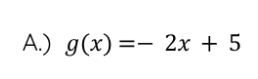
LT18: Find the inverse of this function