Use the Solubility Curve to the right: How many more grams of KCl can dissolve in 100 grams of water at 80°C than at 10°C?
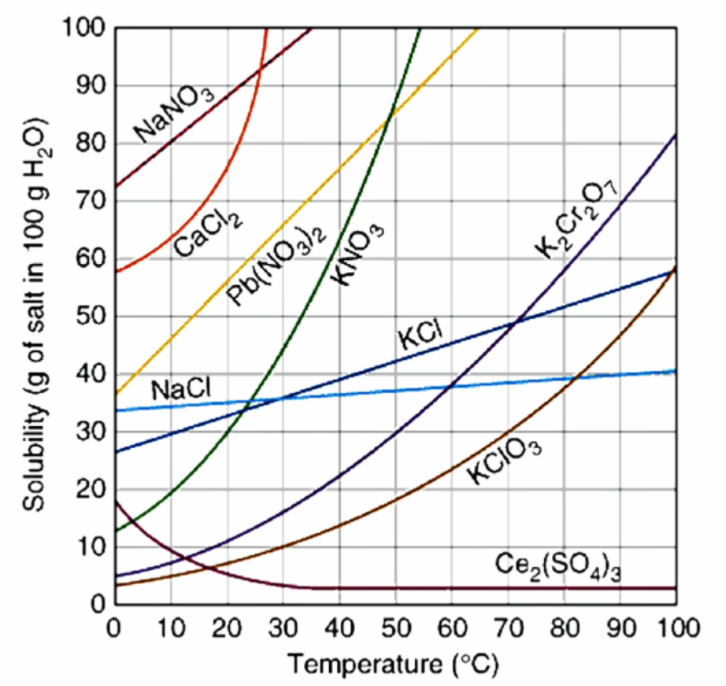
Use the Solubility Curve to the right: How many more grams of KCl can dissolve in 100 grams of water at 80°C than at 10°C?
Which of the following compounds will dissolve in water? (select all that apply)
Use the Solubility Curve to the right: How many more grams of KCl can dissolve in 100 grams of water at 80°C than at 10°C?
If a saturated solution of KClO3 is cooled from 70°C to 30°C, how much solid is expected to fall out of the solution?
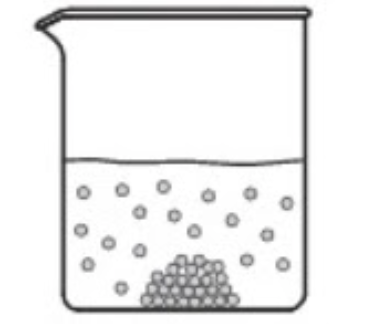
The solution shown in the beaker is well mixed and has been dissolving for days. It can be considered…
(Note: There are some dissolved particles floating around and some undissolved particles resting on the bottom)
The solubility of gases in liquids such as carbon dioxide in a soft drink...
Which of the following are acidic? (check all that apply)
Baking soda (a base) and vinegar (an acid) are mixed together. What type of reaction is this?
Which of the following statements is FALSE about how acids affect our environment?
At constant temperature and for a fixed mass, the volume of a gas will ________________ when the pressure increases.
What causes pressure in a gas?
At constant pressure and for a fixed mass, the volume of a gas will ___________ when the temperature decreases.
When one variable increases and the other variable decreases, this relationship is called:
Charles’ Law states that if you increase the temperature of a gas, the volume will: (assume Pressure remains constant)
What happens to a sealed bag of potato chips when it is driven up a tall mountain? Assume temperature remains the same.
At a constant volume and mass, the pressure of a gas will ___________ when the temperature increases.
Which of the following are electrolytes when dissolved in water?
Which of the following is true about electrolyte solutions?
Which of the following is true about bases?
A Bronsted-Lowry acid is defined as a substance that
You have two beakers containing acid solutions, labeled Beaker A and Beaker B. When you put a lightbulb probe into each solution, Beaker A produces a dim light while Beaker B produces a bright light. What can you conclude about the two acids?
What of the following is true about strong versus weak acids?