Log in
Sign up for FREE
arrow_back
Library
India Quiz (TCI L13) - Geography - Harp (2/2026)
By Haylee S Harp
star
star
star
star
star
Share
share
Last updated 23 days ago
10 questions
Add this activity
Instructions
Required
1
Required
1
Required
1
Required
1
Required
1
Required
1
Required
1
Read each question and all of the answer choices carefully. Choose the
best
answer.
Lesson 13
zoom_in
Question 1
1.
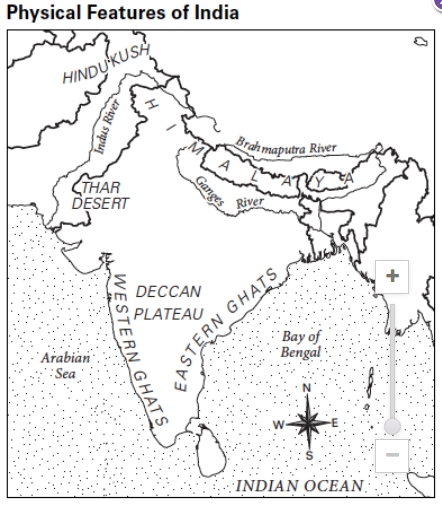
Because of its large size and its position in relation to large masses of land and water, India is called...
a plateau.
an isthmus.
an ecosystem.
a subcontinent.
Question 2
2.
Which phrase best describes the Eastern and Western Ghats?
fertile plains
sandy beaches
mountain ranges
marshy wetlands
Question 3
3.
Much of the water in the Indus, Ganges, and Brahmaputra rivers comes from...
natural springs in the desert.
melting ice in the mountains.
rain-fed streams in the plateau.
large lakes in the northern plain
Question 4
4.
How has the location of the Himalaya Mountains benefited India? Choose the best response.
roads for trade routes
consistent water supply
protection from enemies
prevention of earthquakes
Question 5
5.
How are the Indus and Ganges rivers similar to the Nile River in Egypt?
They begin in the same general area.
They carry silt that enriches the soil.
They flow in the same general direction.
They have big floods that prevented early settlement.
Question 6
6.
During the summer in India the monsoon would bring heavy rain.
True
False
Question 7
7.
A traveler in the Thar Desert would be most likely to see
Sand dunes
Small farms
Elephants
Walled Cities
zoom_in
Required
1
Required
1
Question 9
9.
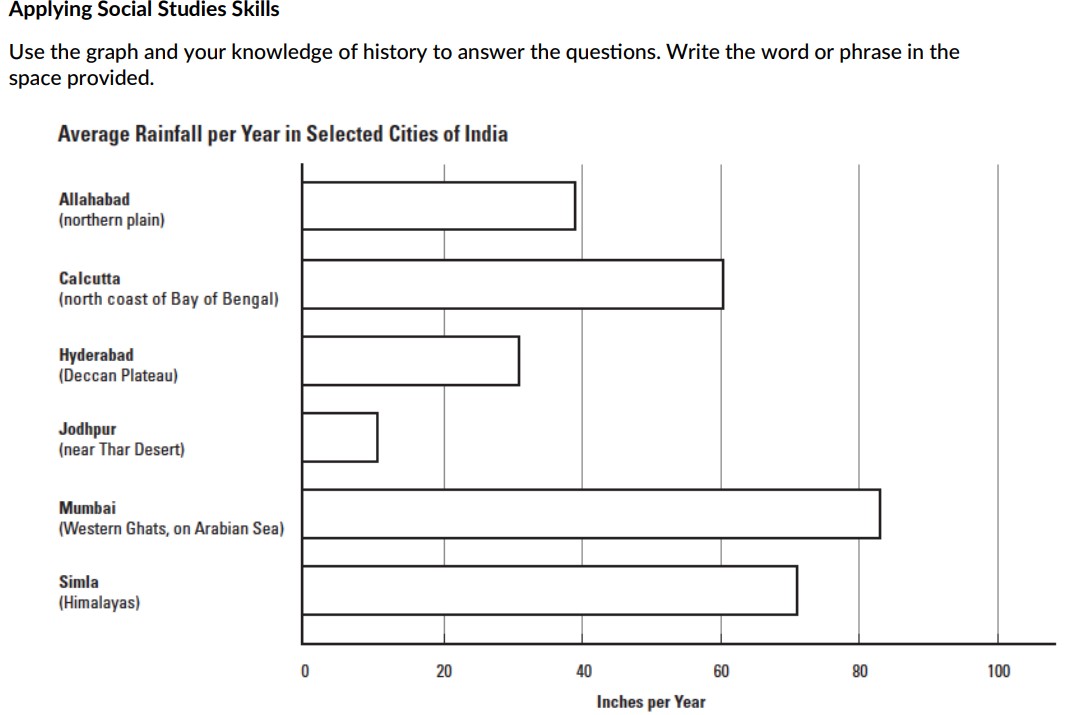
Looking at the graph: Which city has the second largest amount of rainfall per year?_______
Required
1
Question 8
8.
Using the graph: Which of these cities gets the least amount of rainfall?
Calcutta
Mumbai
Jodhpur
Simla
Question 10
10.
Looking at the chart: Because of the quantity of rainfall, the hardest place to farm would be
Allahabad
Hyderabad
Jodhpur
Simla