
Taking the Oath
This text is provided courtesy of the New-York Historical Society.
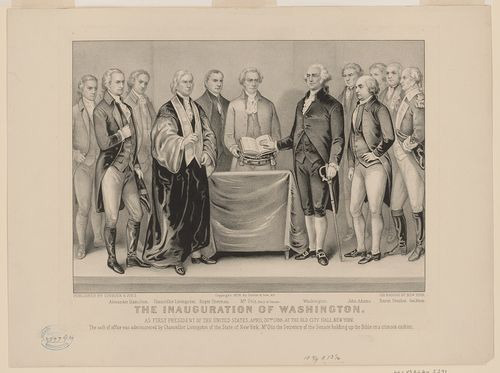
The inauguration of Washington: as first President of the United States, April 30th 1789; at the old city hall, New York, ca. 1876. New York: Published by Currier & Ives. Photograph. Retrieved from the Library of Congress.
April 30, 1789 was the day of the nation's first presidential inauguration. Around noon, mounted soldiers and members of Congress escorted George Washington from his residence on Cherry Street to Federal Hall, followed by a jubilant crowd. When his carriage arrived at Federal Hall, he found cheering people everywhere—packed on Broad and Wall Streets, waving from windows, sitting on rooftops. He entered the building and walked upstairs to the room where members of both the Senate and the House of Representatives had gathered. John Adams, who had already been sworn in as vice president, delivered an official greeting and announced that the time had come for Washington to take the oath of office. Accompanied by members of Congress, he walked onto the balcony where the oath would be administered in full view of Congress and the public.
The people gathered below roared when they saw him, and Washington bowed several times in response. One witness said that the tall, stately Washington had the "soul, look, and figure of a hero." Robert R. Livingston, the chancellor of New York State, read the brief oath of office, which Washington repeated: "I do solemnly swear that I will faithfully execute the Office of President of the United States, and will to the best of my ability, preserve, protect and defend the constitution of the United States." He picked up the bible held for him by Chancellor Livingston, and kissed it. There is a debate about whether he then added, "So help me God." Chancellor Livingston, thinking that Washington's voice had been too soft for the crowd to hear him repeat the oath, said clearly, "It is done."
Cameras were not invented until long after Washington's inauguration, so there are no photographs of this event. And no artist was there recording the event exactly as it happened. But many later painters have tried to picture this important moment in the nation's history, and capture not only what it looked like, but what it meant.
