Honeybee Heat Regulation
Honeybees live in colonies that depend on group behavior to maintain stable temperature conditions - a key factor for their survival, especially in cold climates. When outside temperatures drop below about $10^\circ\text{C}$ (50°F), individual bees cannot maintain their body temperature and would quickly die from exposure. Instead, bees form a thermoregulatory cluster, huddling together inside the hive or around the queen to preserve heat.
In these clusters, bees on the outer layer press tightly together, forming an insulating shell, while inner bees remain in constant motion, vibrating their flight muscles to generate heat. This combination keeps the cluster core at around $35^\circ\text{C}$ (95°F) - warm enough for larvae to develop and for adults to survive the winter. As temperatures fluctuate, the cluster expands when it warms and contracts when it cools, maintaining a balance between heat retention and ventilation.
Research by Heinrich (1981) and later studies using thermal sensors show that core temperature remains remarkably constant even when ambient air falls well below freezing. For example, when air temperature dropped from $15^\circ\text{C}$ to $0^\circ\text{C}$, the cluster’s core stayed above $33^\circ\text{C}$, demonstrating precise collective thermoregulation.
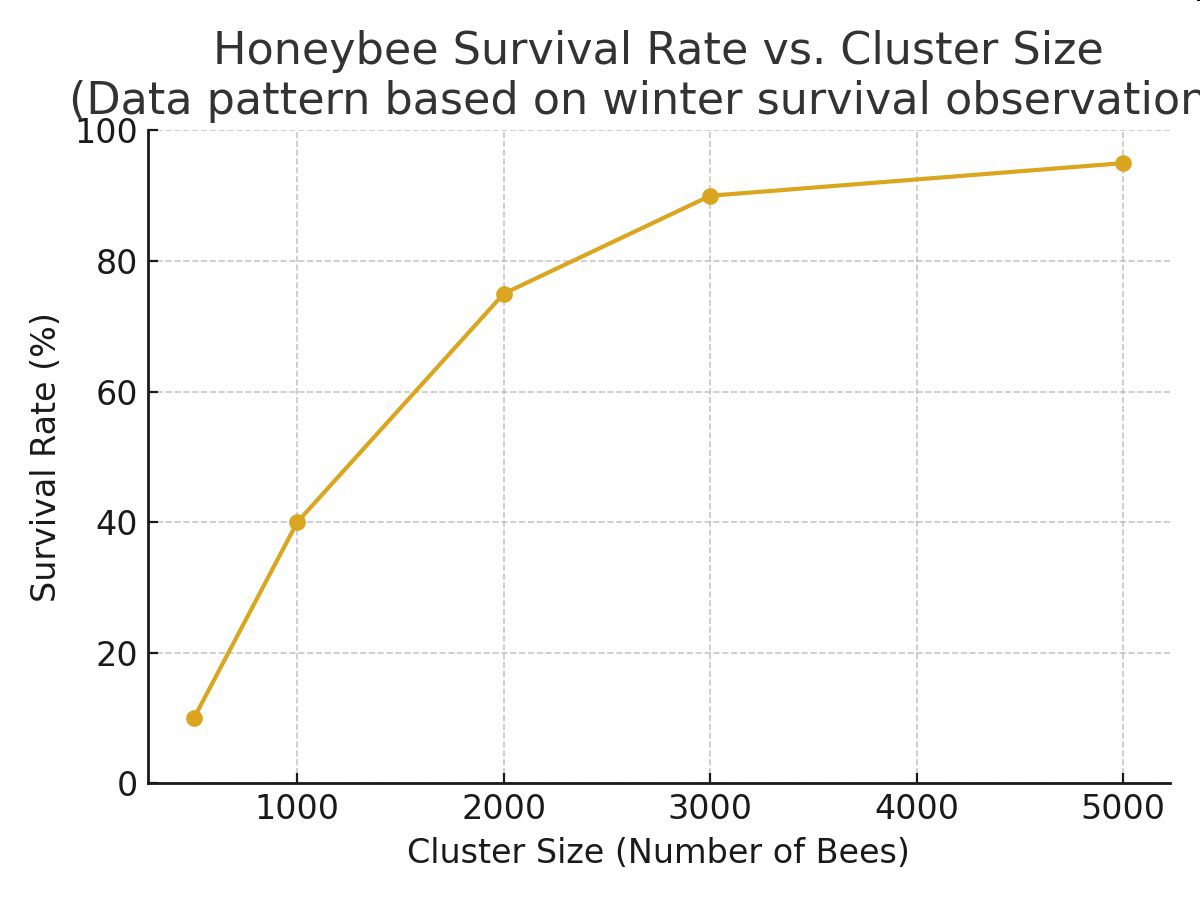
Experimental studies also reveal that cluster size affects survival. Smaller groups lose heat quickly and have lower survival rates, while larger groups are able to maintain warmth longer. In controlled trials, bee groups of 2,000–3,000 individuals survived subfreezing nights, while groups below 1,000 often perished due to rapid heat loss.
This cooperation is essential: no single bee can produce or conserve enough heat alone. By clustering, bees share energy costs, reduce individual heat loss, and ensure colony survival. The phenomenon is a clear example of group behavior improving survival under environmental stress.
Graph of Information - Figure 1.
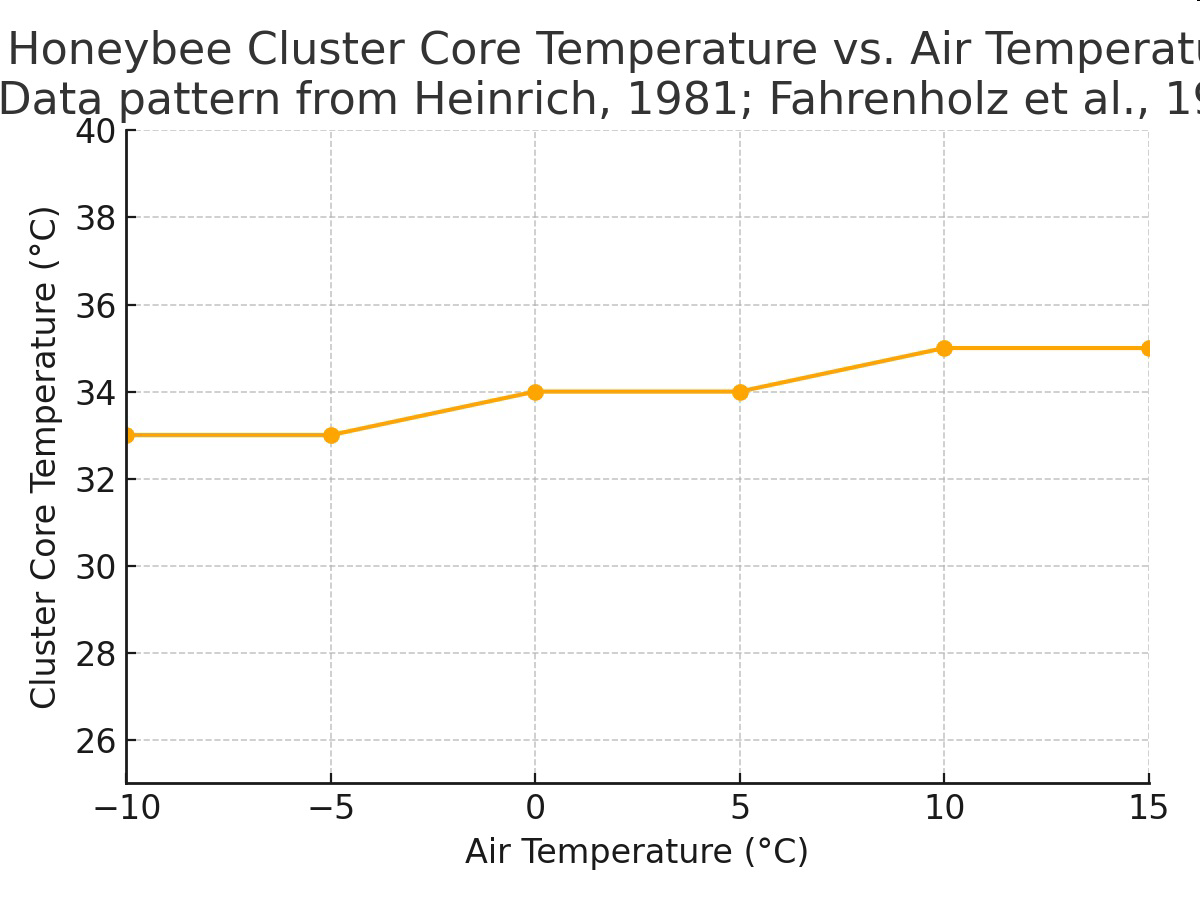
Graph of Information - Figure 2.