Monarch Butterfly Life Cycle and Timing
Monarch butterflies (Danaus plexippus) are famous for their long-distance migration and distinct four-stage life cycle: egg 2192 larva (caterpillar) 2192 pupa (chrysalis) 2192 adult butterfly. Each stage has a unique form and function, but together they complete the same biological pattern shared by all living things - birth, growth, reproduction, and death.
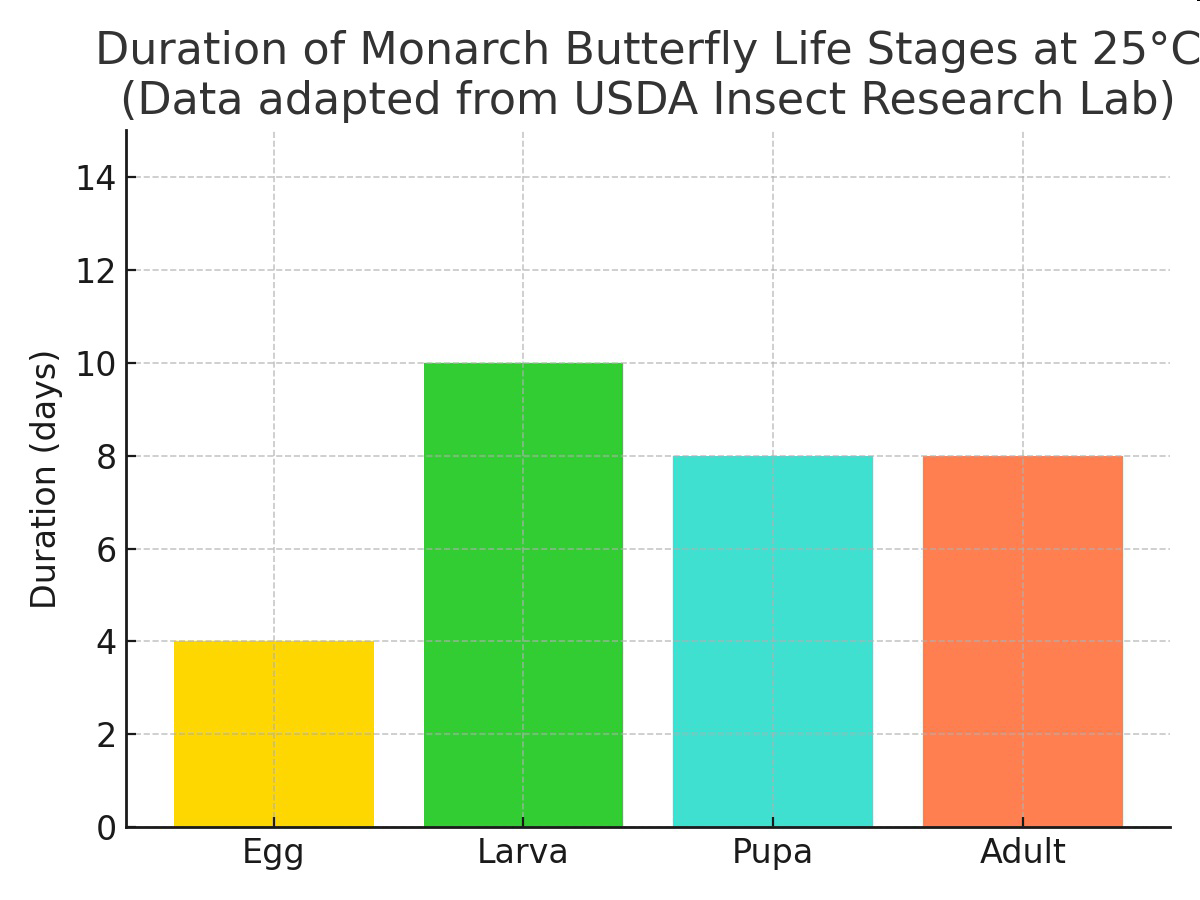
Female monarchs lay eggs on milkweed leaves, and after 3 - 5 days, caterpillars hatch and begin to feed. The larval stage lasts about 10 - 14 days, during which the caterpillar grows rapidly, shedding its skin several times. Then it forms a chrysalis, where it remains for 8�612612 days before emerging as an adult butterfly. Adults live about 2 - 6 weeks, except for the migratory generation, which can live up to 8 months to complete migration and reproduction.
Environmental conditions - especially temperature - affect how quickly monarchs move through their life stages. Field and lab studies by the Monarch Joint Venture and USDA Insect Research Lab show that at cooler temperatures, development slows significantly:
At $20^\circ C$, the full life cycle takes about 45 days.
At $25^\circ C$, it takes 30 days.
At $30^\circ C$, it can be as short as 22 days.
Although temperature changes timing, the basic sequence of the life cycle remains the same. Monarchs, like all organisms, are born, grow, reproduce, and eventually die - illustrating the unity of life's pattern amid the diversity of living forms.
Table 1.
Temperature (oC) | Total Life Cycle Duration (days) | Egg Stage Duration (days) | Larva Stage Duration (days) | Pupa Stage Duration (days) | Adult Stage Duration (days) |
|---|
20 | 45 | 5 | 14 | 12 | 14 |
25 | 30 | 4 | 10 | 8 | 8 |
30 | 22 | 3 | 8 | 6 | 5 |
Graph of Information - Figure 1.
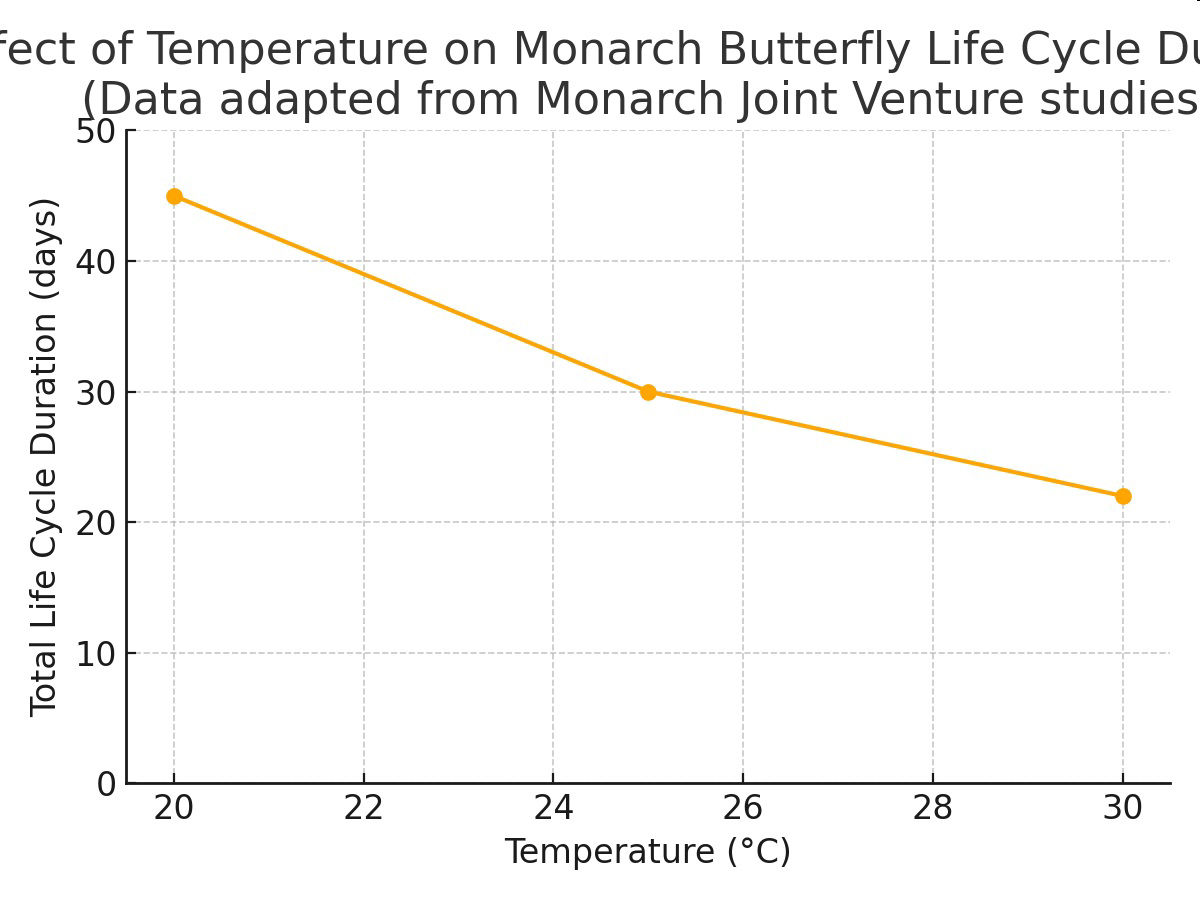
Graph of Information - Figure 2.