Salmon Life Cycle and Migration
Pacific salmon ($Oncorhynchus spp.$) have one of the most remarkable and well-studied life cycles on Earth. Their pattern demonstrates both diversity and the shared sequence of birth, growth, reproduction, and death that all living organisms follow.
The Salmon Life Cycle
Egg Stage (Birth): Salmon lay eggs in freshwater gravel nests called redds. The eggs incubate through winter and hatch in early spring.
Alevin Stage: The young fish, still carrying a yolk sac, remain hidden in gravel for several weeks.
Fry and Parr: As the yolk is absorbed, fry emerge and begin feeding. They grow into parr with distinct markings and live in freshwater for 1–3 years.
Smolt: The fish undergo physiological changes that allow them to survive in saltwater and begin their migration to the ocean.
Adult: After several years at sea, adults return to the same river to spawn.
Death: Most Pacific salmon die shortly after spawning, releasing nutrients that feed other organisms.
Studies from NOAA Fisheries and the USGS Columbia River Basin Monitoring Program show that temperature and river flow affect salmon growth and survival at each stage:
In cool, stable rivers (10–12oC), egg survival is around 80%, but drops below 50% in warmer waters.
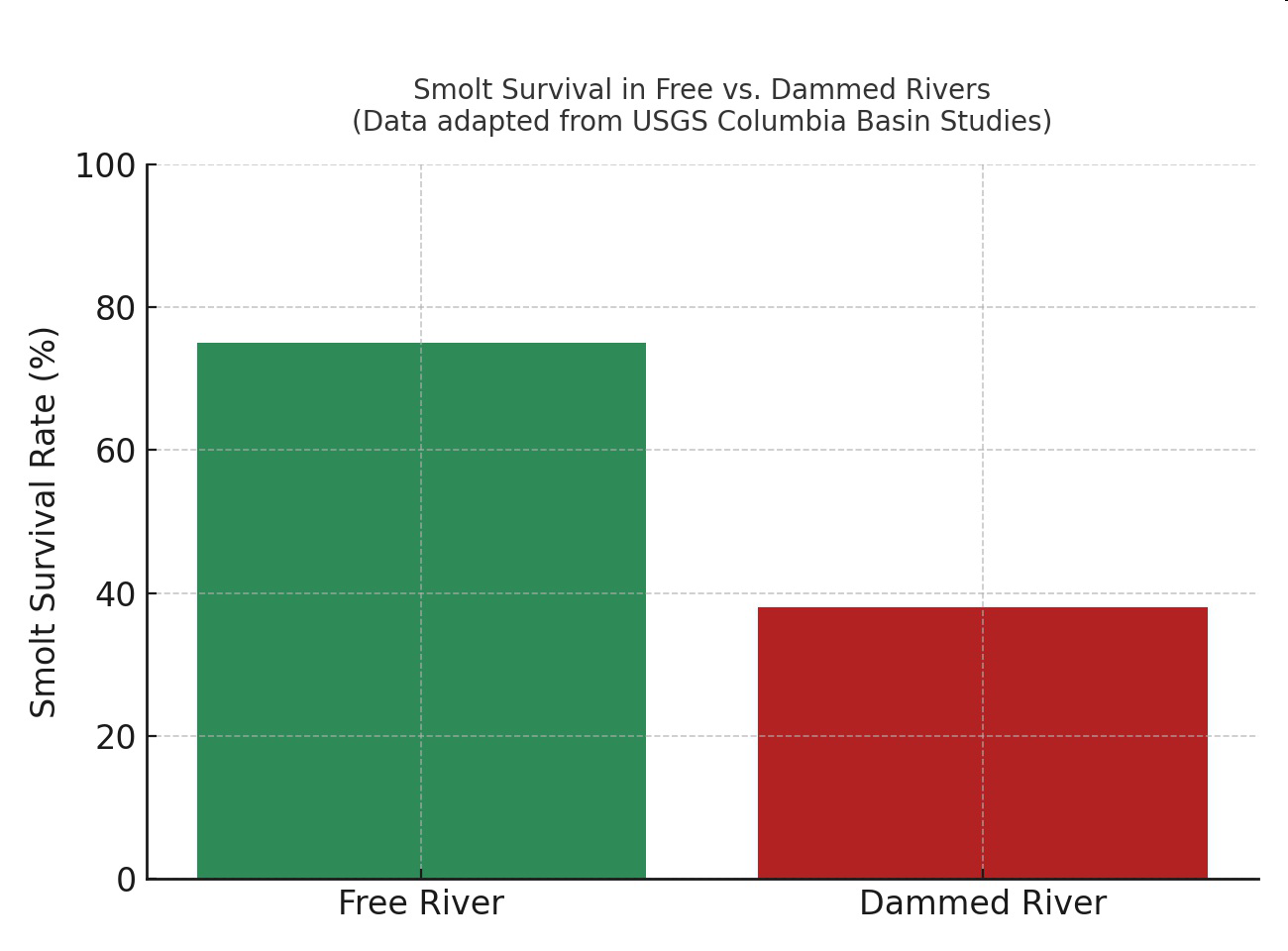
In rivers with strong flow and clear passage, smolt survival exceeds 75%; in dammed or polluted systems, survival can fall to 30–40%.
Ocean stage duration varies: warmer ocean temperatures shorten lifespan but reduce reproductive success.
Despite the complexity of environments and timing, the same pattern repeats: birth to growth to reproduction to death. Modeling the salmon's journey helps students see how life cycle diversity still reflects the unity of biological processes.
Table 1.
Water Temperature (oC) | Egg Survival Rate (%) | Smolt Survival in Free Rivers (%) | Smolt Survival in Dammed Rivers (%) |
|---|
8 | 88 | | |
10 | 84 | | |
12 | 80 | | |
14 | 68 | | |
16 | 55 | 75 | 40 |
18 | 40 | 78 | 35 |
Graph of Information - Figure 1.
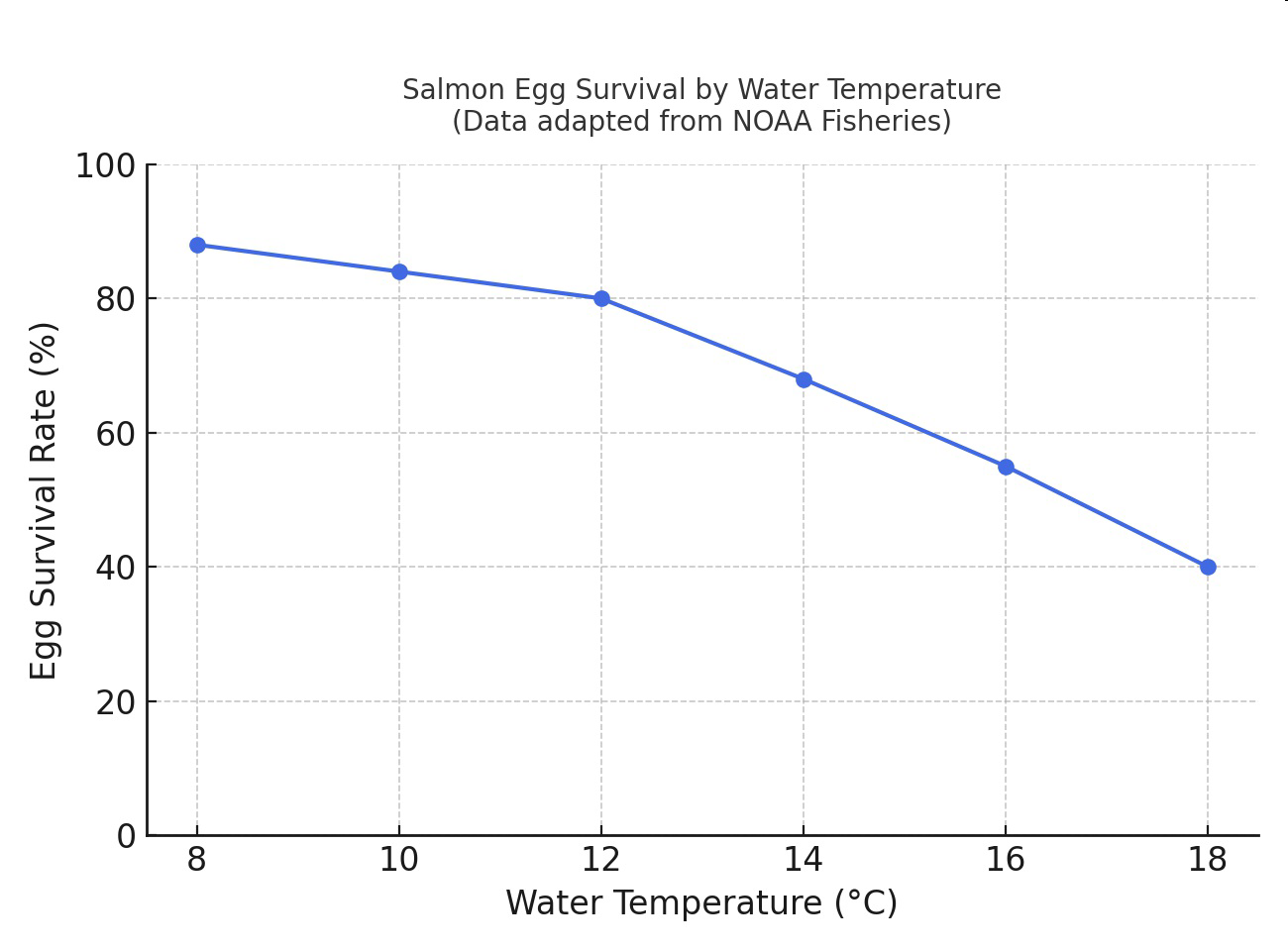
Graph of Information - Figure 2.