Desert Plants and Rainfall Availability
Deserts receive very little rainfall - often less than 25 centimeters (10 inches) per year - but even within these dry ecosystems, different plant species vary widely in how well they survive during drought.
In the Mojave Desert of North America, long-term studies have tracked how three common species respond to changes in rainfall:
Creosote bush (Larrea tridentata) has deep roots that tap groundwater and waxy leaves that prevent water loss. It can survive through multi-year droughts.
Cholla cactus (Cylindropuntia spp.) stores water in its stem but depends on occasional rain to refill reserves. It can survive moderate droughts but declines in prolonged dry periods.
Desert annual wildflowers, such as Desert Gold and Sand Verbena, sprout only after heavy rains and complete their life cycle quickly. In dry years, their seeds remain dormant or fail to germinate at all.
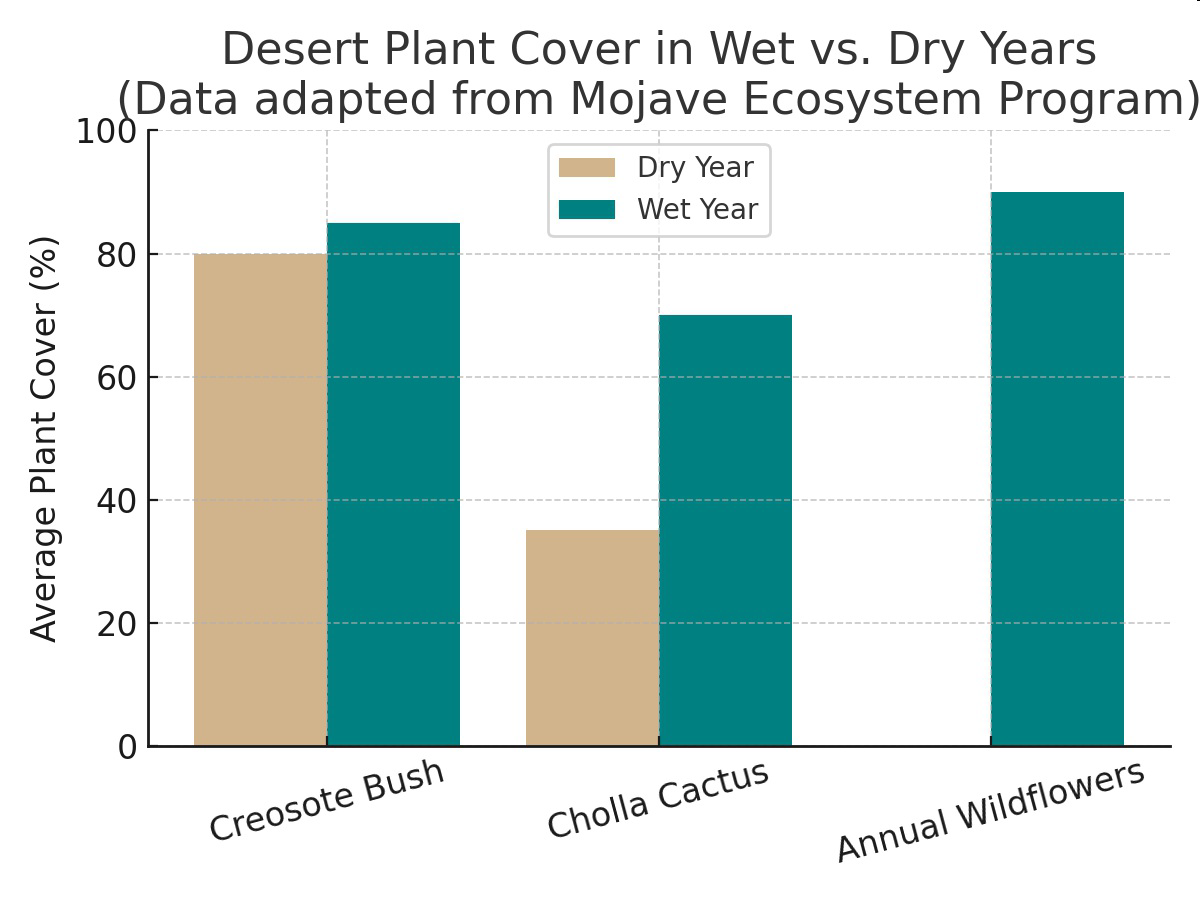
Researchers at the U.S. Geological Survey’s Mojave Desert Ecosystem Program found that during wet years (rainfall above 20 cm), all three species flourish, but in dry years (below 10 cm), creosote bushes maintain stable cover, cholla cactus populations decline by about 40%, and annual wildflowers disappear completely.
These data show that some organisms (creosote bush) survive well in harsh desert conditions, others (cholla cactus) survive less well, and some (wildflowers) cannot survive at all without sufficient rainfall. The patterns demonstrate how differences in adaptation determine which species persist when conditions become extreme.
Table 1.
Rainfall (cm/year) | Creosote Bush Survival Rate (%) | Cholla Cactus Survival Rate (%) | Annual Wildflower Survival Rate (%) |
|---|
5 | 90 | 40 | 0 |
10 | 95 | 60 | 5 |
15 | 96 | 75 | 40 |
20 | 97 | 85 | 80 |
25 | 98 | 90 | 95 |
Graph of Information - Figure 1.
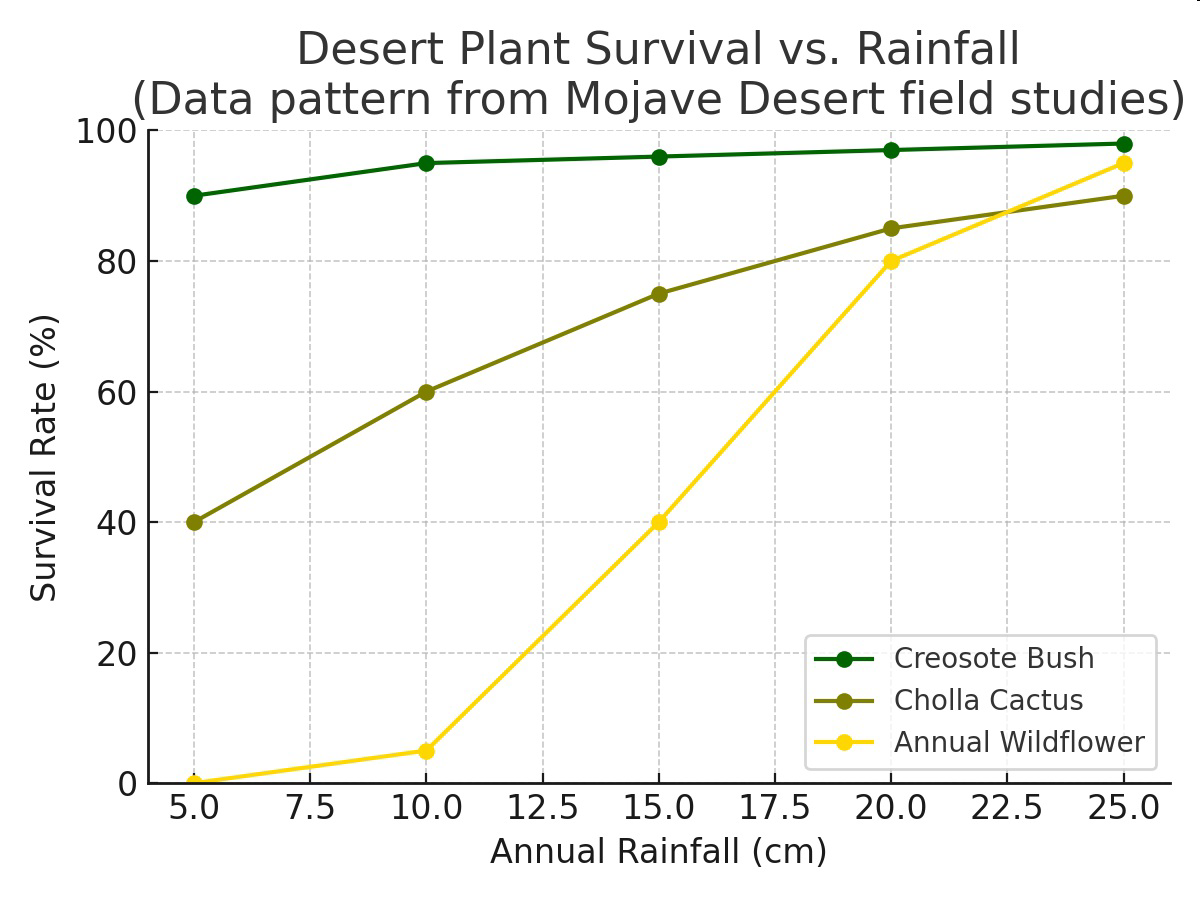
Graph of Information - Figure 2.