Dinosaur Trackways and Behavior
Fossilized footprints - called trackways - provide direct evidence of how ancient animals moved, behaved, and interacted with their environments. Unlike skeletons, which show structure, trackways record behavior in action: walking, running, turning, or even moving in groups.
Trackways are preserved when an animal walks across soft sediment, such as mud or sand, that later hardens into rock. By measuring stride length, track size, and trackway spacing, scientists can estimate an animal’s speed, posture, and sometimes group behavior.
At several sites in North America, China, and Argentina, paleontologists have discovered parallel trackways made by multiple dinosaurs moving in the same direction. In one site in Texas, sauropod (long-necked dinosaur) trackways show large and small individuals traveling together, suggesting herding behavior and parental care. The similar stride lengths and consistent spacing imply that the animals were moving as a coordinated group rather than randomly.
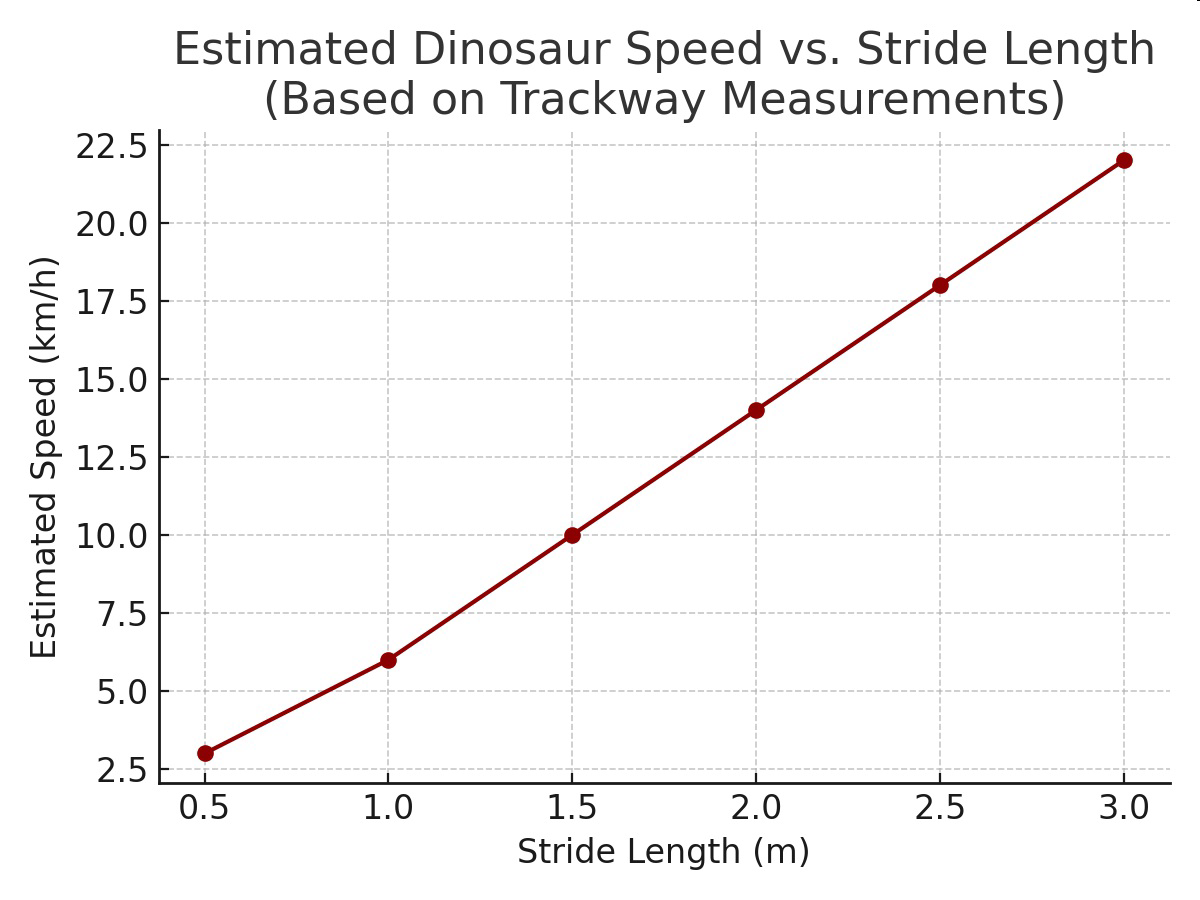
At other sites, different species’ tracks appear in the same layers - sometimes overlapping - revealing interactions between predators and prey. Measurements of track spacing and depth also show differences in walking vs. running speeds. Using modern comparisons, scientists can estimate speed using the formula:
$\text{Speed} = 0.25 \times g^{0.5} \times (\text{stride length})^{1.67} / (\text{hip height})^{1.17}$
where g is gravitational acceleration. Data suggest some theropods (two-legged carnivores) were running at speeds over 20 km/h, while large sauropods moved much slower.
Together, these data show that trace fossils like footprints can reveal both the organisms that made them and the environments and behaviors of long-extinct species.
Table 1.
Site Location | Dominant Track Type | Trackway Pattern | Inferred Behavior |
|---|
Paluxy River, Texas (USA) | Sauropod | Parallel trackways, adults & juveniles | Group travel / herding |
Shandong, China | Theropod | Alternating, increasing stride length | Running or pursuit |
La Rioja, Argentina | Ornithopod | Consistent spacing & direction | Coordinated group movement |
Isle of Skye, Scotland | Sauropod + Theropod | Overlapping predator/prey tracks | Predation interaction |
Graph of Information - Figure 1.