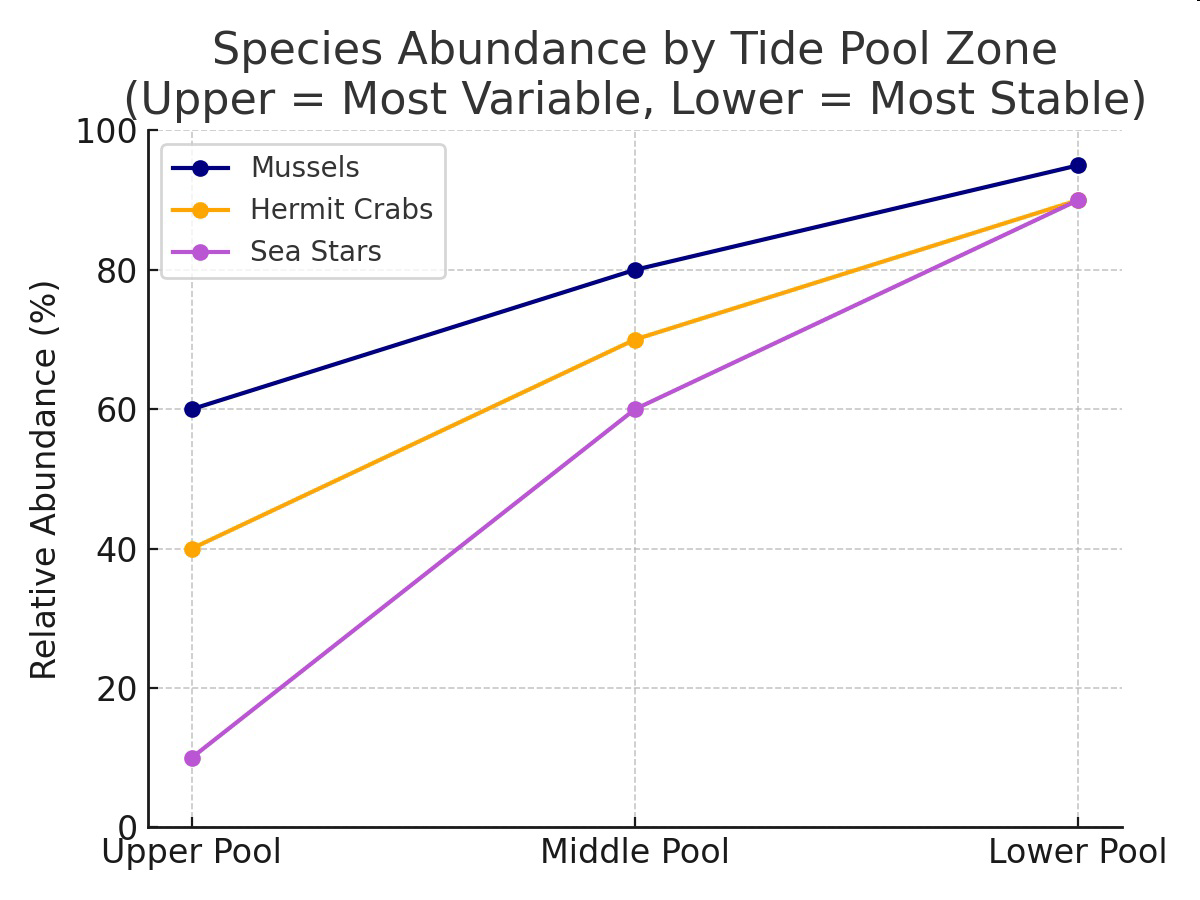
Tide Pool Organisms and Salinity Fluctuations
Along rocky coastlines, tide pools form in shallow depressions that fill with seawater during high tide and partially dry during low tide. These pools experience dramatic daily changes in temperature, oxygen, and especially salinity as water evaporates or rainwater dilutes the salt concentration.
Different organisms vary widely in how well they tolerate these fluctuations:
Mussels and barnacles can tightly close their shells to prevent water loss and tolerate short periods of exposure.
Hermit crabs and small snails can survive moderate salinity changes but must retreat to deeper pools during extreme conditions.
Sea stars and sea cucumbers require stable, fully marine conditions and often die if trapped in upper pools that dry out or become too fresh after rain.
Field data from the Monterey Bay Aquarium Research Institute (MBARI) and University of Oregon intertidal surveys show that survival rates depend strongly on how much the salinity changes. In upper tide pools where salinity can swing from $15–50\ \text{ppt}$ (parts per thousand) in a single day, only $30–40\%$ of organisms survive through the season. In lower pools that remain near normal seawater salinity ($\sim 35\ \text{ppt}$), survival rates exceed $80\%$.
These patterns illustrate that within one small habitat, some organisms survive well (mussels, barnacles), some less well (crabs, snails), and some cannot survive at all (sea stars, sea cucumbers) when environmental stress exceeds their tolerance limits.
Table 1.
Salinity (ppt) | Mussel Survival (%) | Hermit Crab Survival (%) | Sea Star Survival (%) |
|---|
15 | 65 | 40 | 0 |
25 | 80 | 70 | 20 |
35 | 90 | 85 | 85 |
45 | 75 | 55 | 15 |
50 | 60 | 30 | 0 |
Graph of Information - Figure 1.
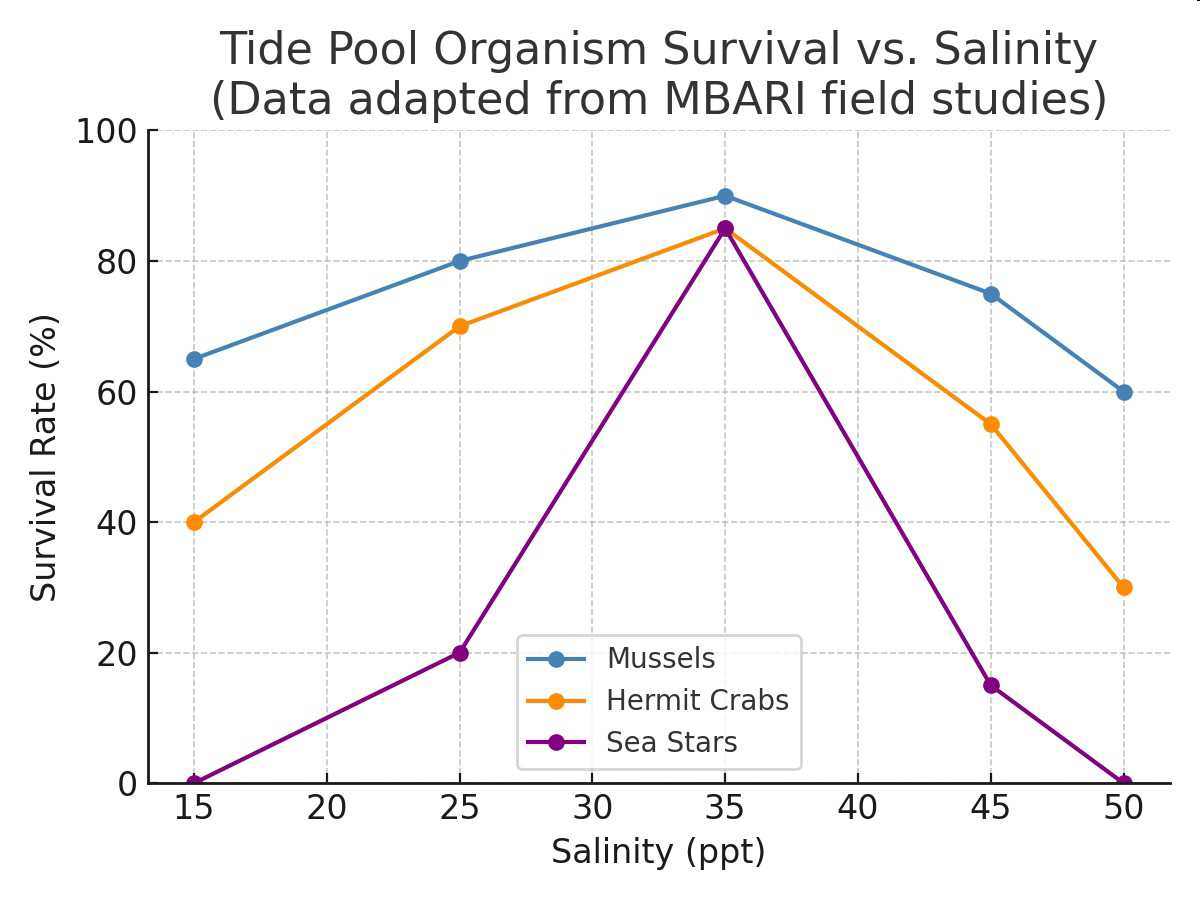
Graph of Information - Figure 2.