Carbon Dioxide Uptake and Release in Plants
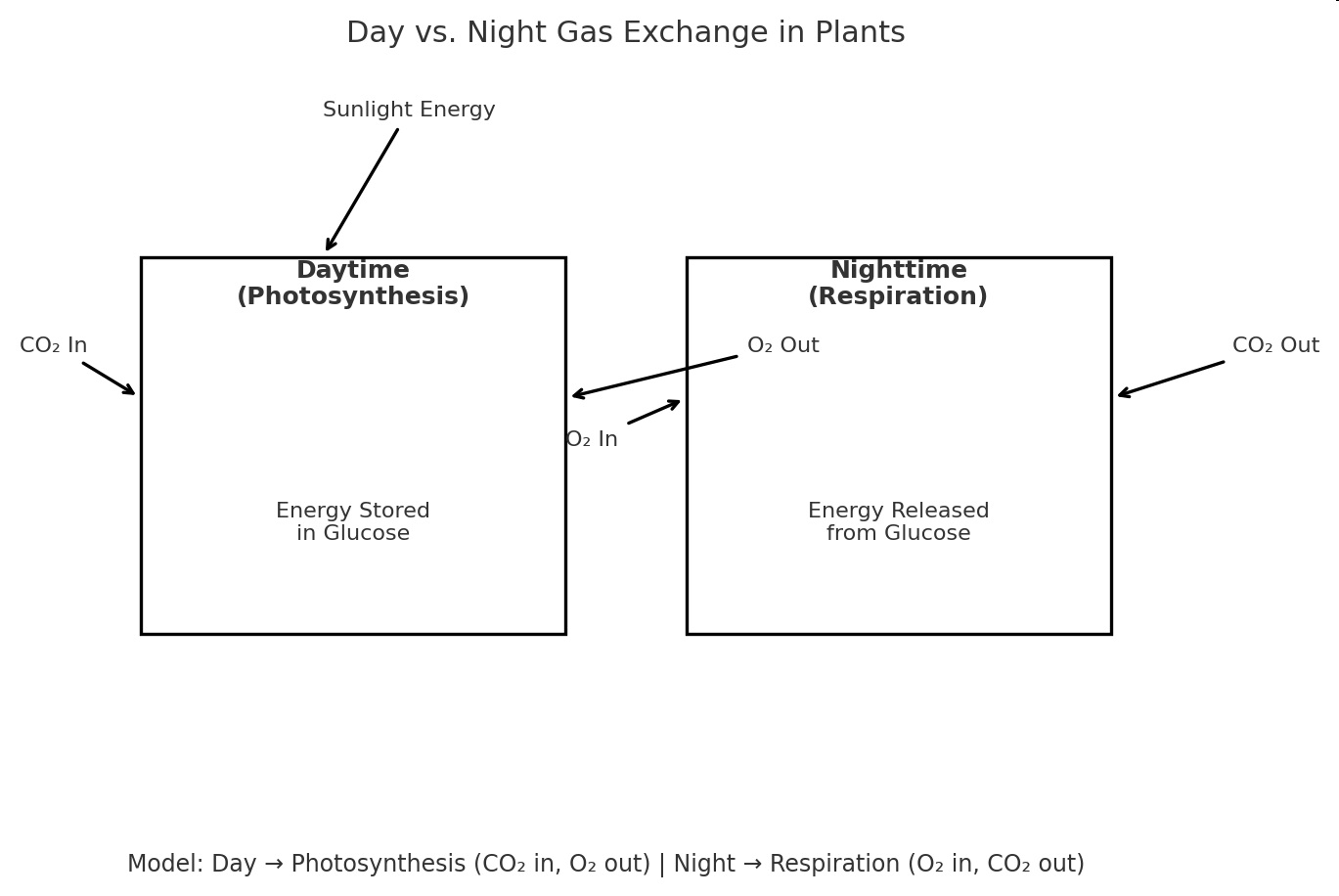
Plants are constantly exchanging gases with their environment. They use photosynthesis to take in carbon dioxide ($CO_2$) and release oxygen ($O_2$) during daylight, and they use cellular respiration to release $CO_2$ and take in $O_2$ all the time - even in darkness.
During photosynthesis, light energy from the Sun powers the chemical reaction that produces glucose and oxygen from $CO_2$ and water. During cellular respiration, the plant breaks down that glucose to release stored energy for growth and repair. This process releases $CO_2$ as a byproduct.
In daylight, photosynthesis occurs faster than respiration, so plants absorb more $CO_2$ than they release - the overall result is a net decrease in $CO_2$ and an increase in $O_2$ in the air. At night, photosynthesis stops because there is no sunlight to provide energy, but respiration continues. As a result, plants release a small amount of $CO_2$ back into the environment.
This 24-hour cycle illustrates how plants regulate matter and energy flow - capturing solar energy during the day and releasing stored energy at night - maintaining balance in ecosystems.
Table 1.
Time of Day | Light Level (lux) | CO₂ Concentration Change (ppm/hour) | O₂ Concentration Change (ppm/hour) | Dominant Process | Energy Flow Direction |
|---|
Morning (8 AM) | 5000 | -40 | 45 | Photosynthesis | Energy Stored |
Midday (12 PM) | 10000 | -75 | 80 | Photosynthesis | Energy Stored |
Evening (6 PM) | 500 | -10 | 12 | Balanced | Transition |
Night (12 AM) | 0 | 30 | -25 | Respiration | Energy Released |
Graph of Information - Figure 1.
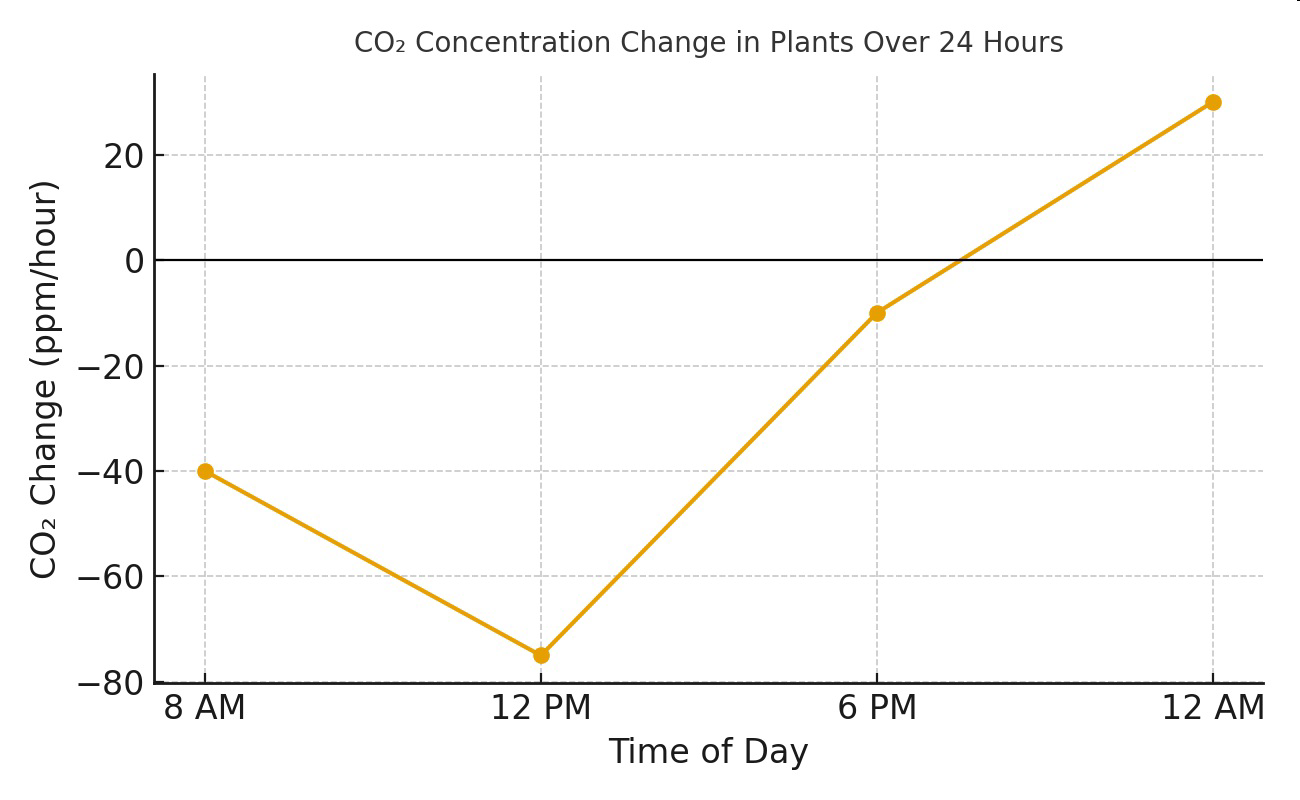
Figure 2.