Van Helmont’s Willow Tree Experiment
In the 1600s, the scientist Jan Baptista van Helmont wanted to know where plants get their mass as they grow. At the time, most people believed plants “ate” soil. To test this, van Helmont planted a small willow tree in a pot of measured soil and carefully tracked its mass and the soil mass for five years.
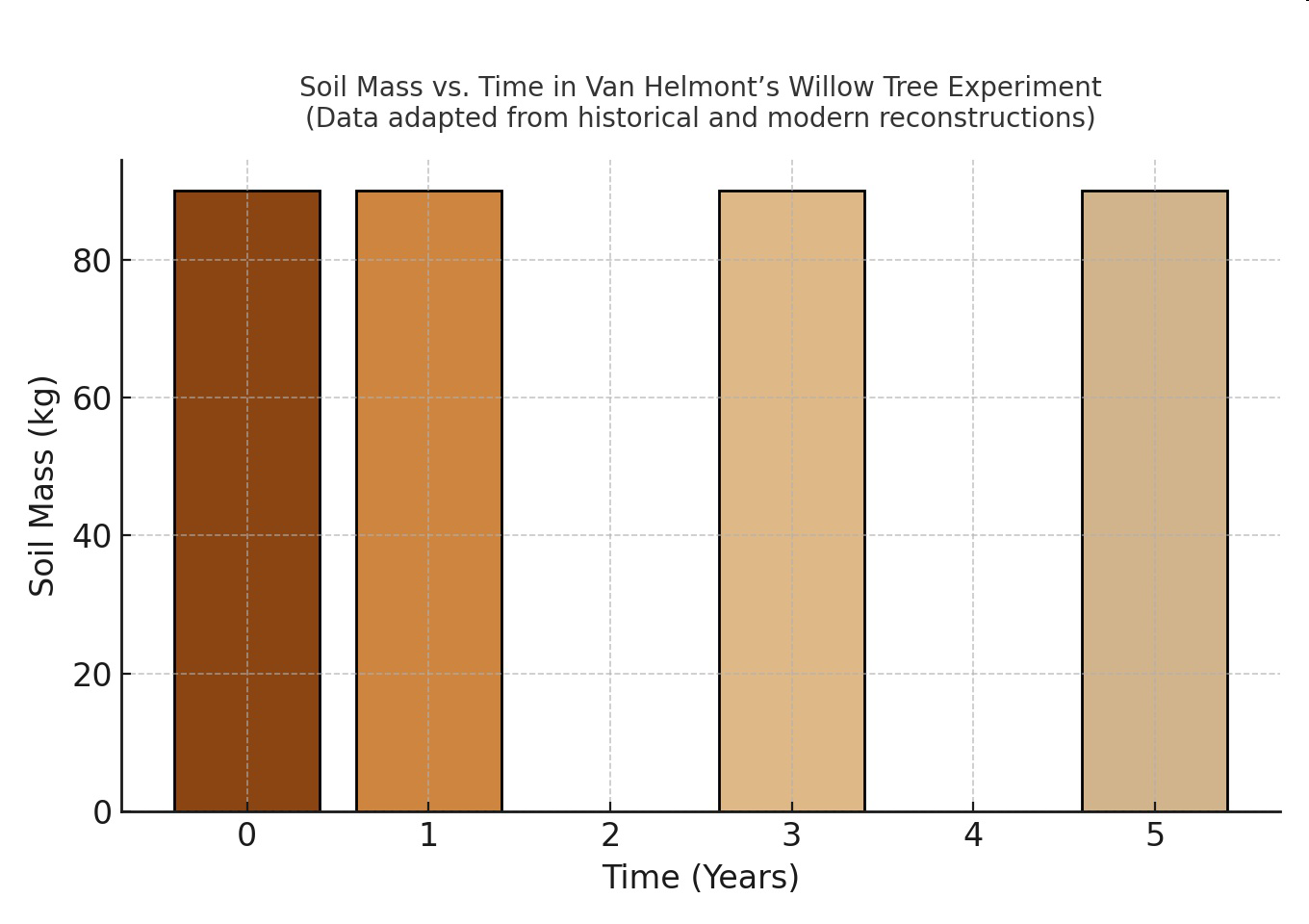
He watered the tree regularly with rainwater and covered the pot to prevent dust from entering. After five years, the tree had gained $74 \text{ kg}$ in mass, but the soil mass had decreased by only $57 \text{ grams}$.
This experiment showed that most of the tree’s increase in mass did not come from the soil. Instead, we now know that the tree’s growth came from carbon dioxide in the air and water, which the plant used to build sugars and other compounds through photosynthesis.
Table 1.
Time (Years) | Tree Mass (kg) | Soil Mass (kg) | Water Added (L) |
|---|
0 | 2.3 | 90 | 0 |
1 | 5.5 | 89.99 | 150 |
3 | 22 | 89.97 | 450 |
5 | 76.3 | 89.94 | 750 |
Even though the willow tree’s mass increased by more than $70 \text{ kg}$, the soil mass hardly changed. This shows that the tree’s matter did not come from the soil. We now know that plants take in carbon dioxide ($\text{CO}_2$) from the air and water ($\text{H}_2\text{O}$) through their roots, using sunlight to make sugars that become new plant tissue.
This experiment provided the first evidence that air and water are the main sources of plant mass, not soil. It helps students connect modern photosynthesis concepts with one of the earliest controlled scientific experiments in plant biology.
Graph of Information - Figure 1.
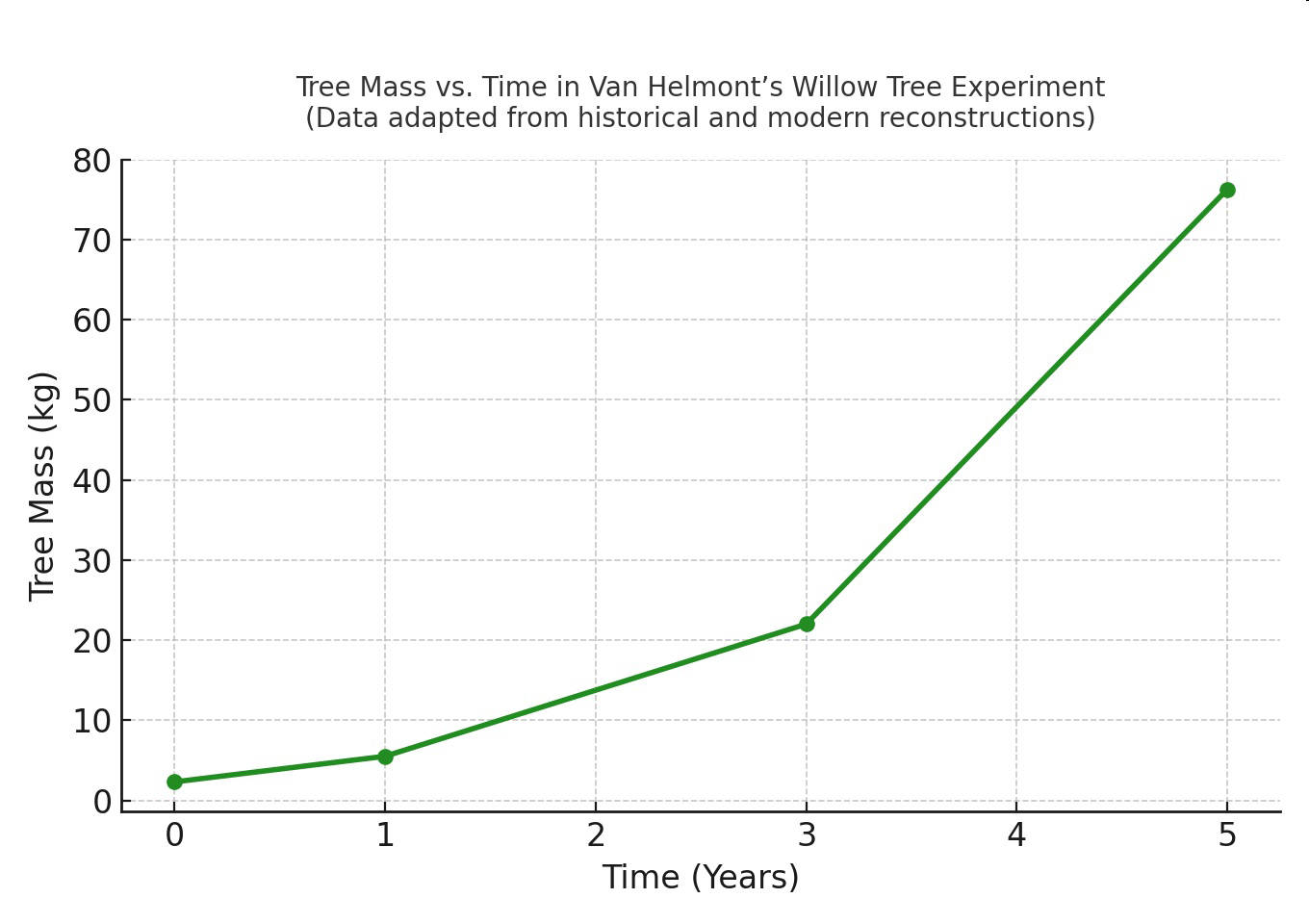
Graph of Information - Figure 2.