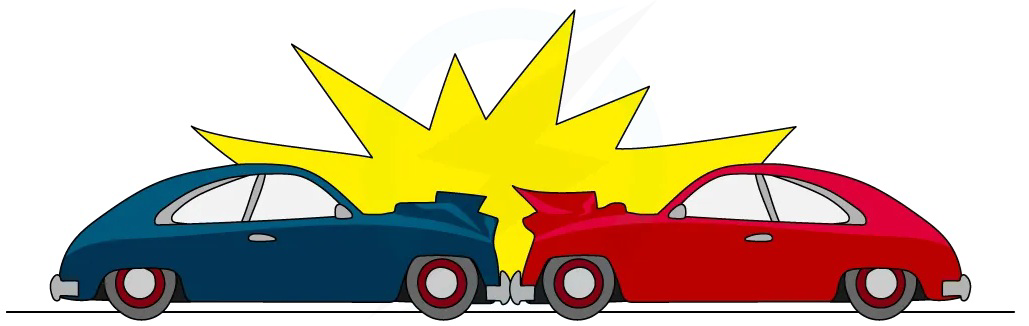
Toy Car Colliding With a Stack of Blocks
Diagram 1.
Source: https://pressbooks.bccampus.ca/universityphysicssandbox/chapter/conservation-of-linear-momentum/
Phenomenon:
Students roll a toy car into a stack of wooden blocks at slow, medium, and fast speeds.
They observe:
At slow speed, only one block moves slightly.
At medium speed, a few blocks fall over.
At fast speed, blocks scatter across the table.
Students wonder:
How can changing the car’s speed help us ask questions and predict the outcomes of the collision?
When an object is moving, it has motion energy. The faster it moves, the more motion energy it has. When the toy car crashes into the stack of blocks, the car’s motion energy is transferred to the blocks during the collision. This energy transfer is what causes the blocks to move or fall over.
At a slow speed, the car has only a small amount of motion energy, so it can barely move a block. At medium speed, it has more energy to transfer, so more blocks tip over. At fast speed, the car has the greatest amount of motion energy. As a result, the blocks may fall, slide, or scatter farther across the table.
Energy is conserved during the collision: the motion energy does not disappear - it moves from the car into the blocks and becomes their motion, sound, and small amounts of heat from friction. Students can measure how many blocks fall and how far they move to help them ask and answer questions such as: If the car goes faster, how many blocks will fall? How far will they travel?
Table 1.
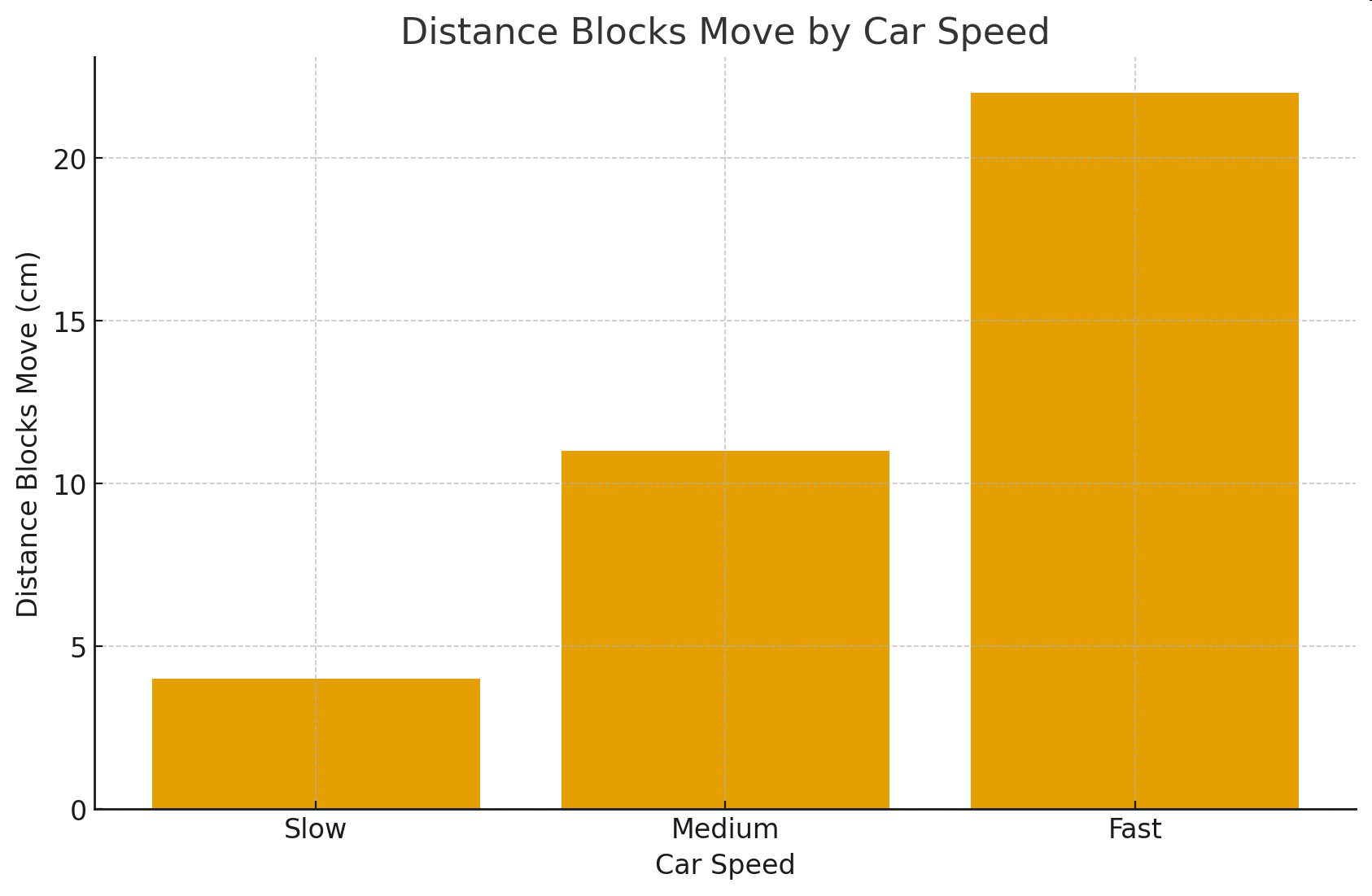
Car Speed | Blocks Knocked Over | Average Distance Blocks Move (cm) |
|---|---|---|
Slow | 1 | 4 |
Medium | 3 | 11 |
Fast | 6 | 22 |
Graph of Information - Figure 1.
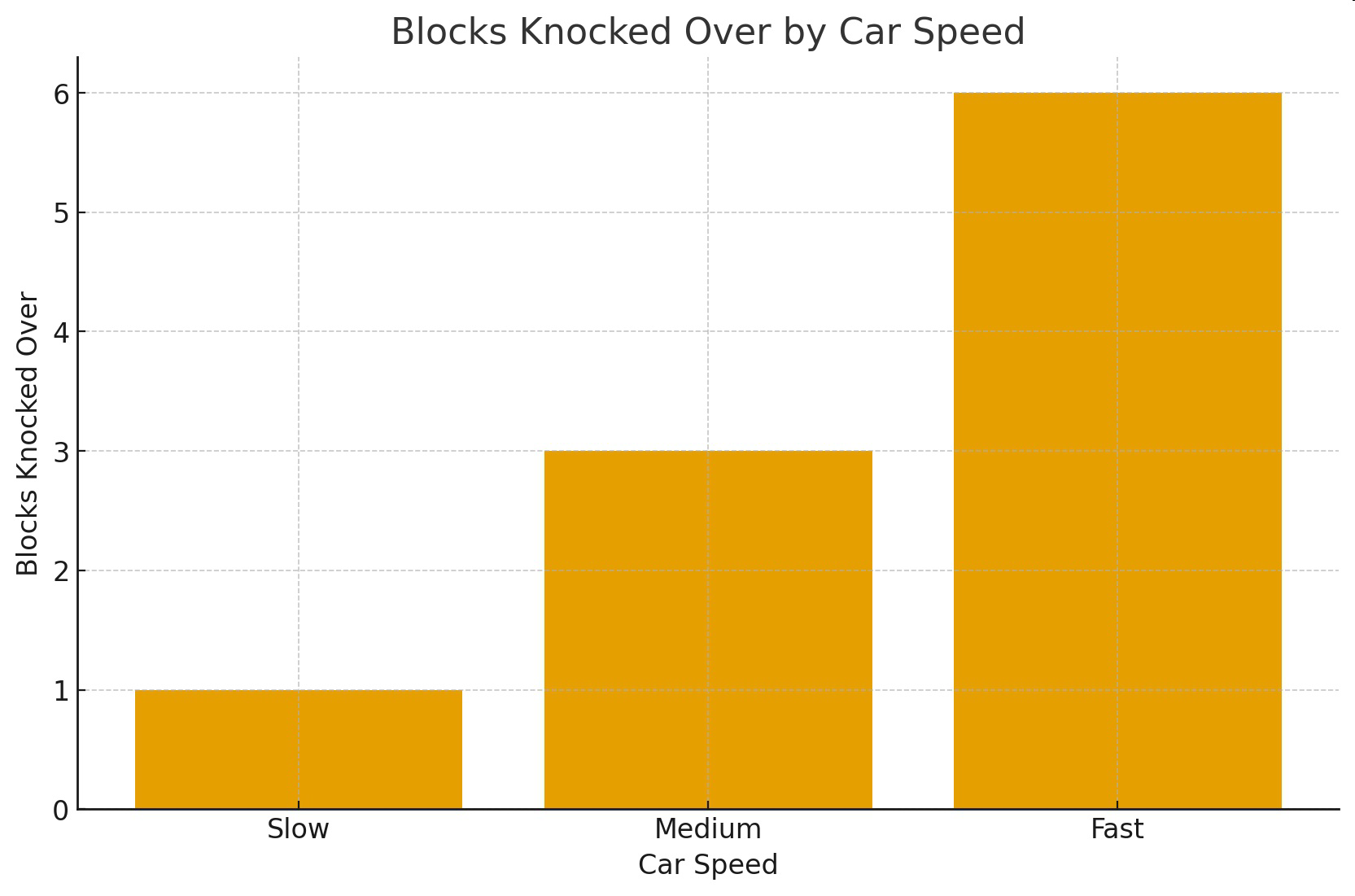
Graph of Information - Figure 2.