Twa kɔ nsɛm atitiriw so
Log in
Sign up for FREE
arrow_back
Laabri

Water Flowing Downhill - ES - PS - Space Systems

star
star
star
star
star
Last updated 4 months ago
6 Nsɛmmisa
Hyɛ no nsow a efi ɔkyerɛwfo no hɔ:

Directions: Use the information provided and your knowledge of Physical Science to answer the following questions. Show all work where necessary.

Directions: Use the information provided and your knowledge of Physical Science to answer the following questions. Show all work where necessary.

0
Ɛhia
4
DOK 2
5-PS2-1
Ɛhia
6
DOK 3
5-PS2-1
Ɛhia
6
DOK 3
5-PS2-1
Ɛhia
4
DOK 2
5-PS2-1
Ɛhia
6
DOK 3
5-PS2-1
Ɛhia
8
DOK 4
5-PS2-1

Water Flowing Downhill

Phenomenon

Students pour water onto a slanted tray, ramp, or outdoor slope. The water always flows downward toward the lowest point, even when the surface curves or changes shape.

Students notice:

  • Water always flows downward

  • Water never flows uphill on its own

  • Changing the slope changes speed, not direction

Students ask:

  • Why does water always move downward toward the ground?

Diagram 1.
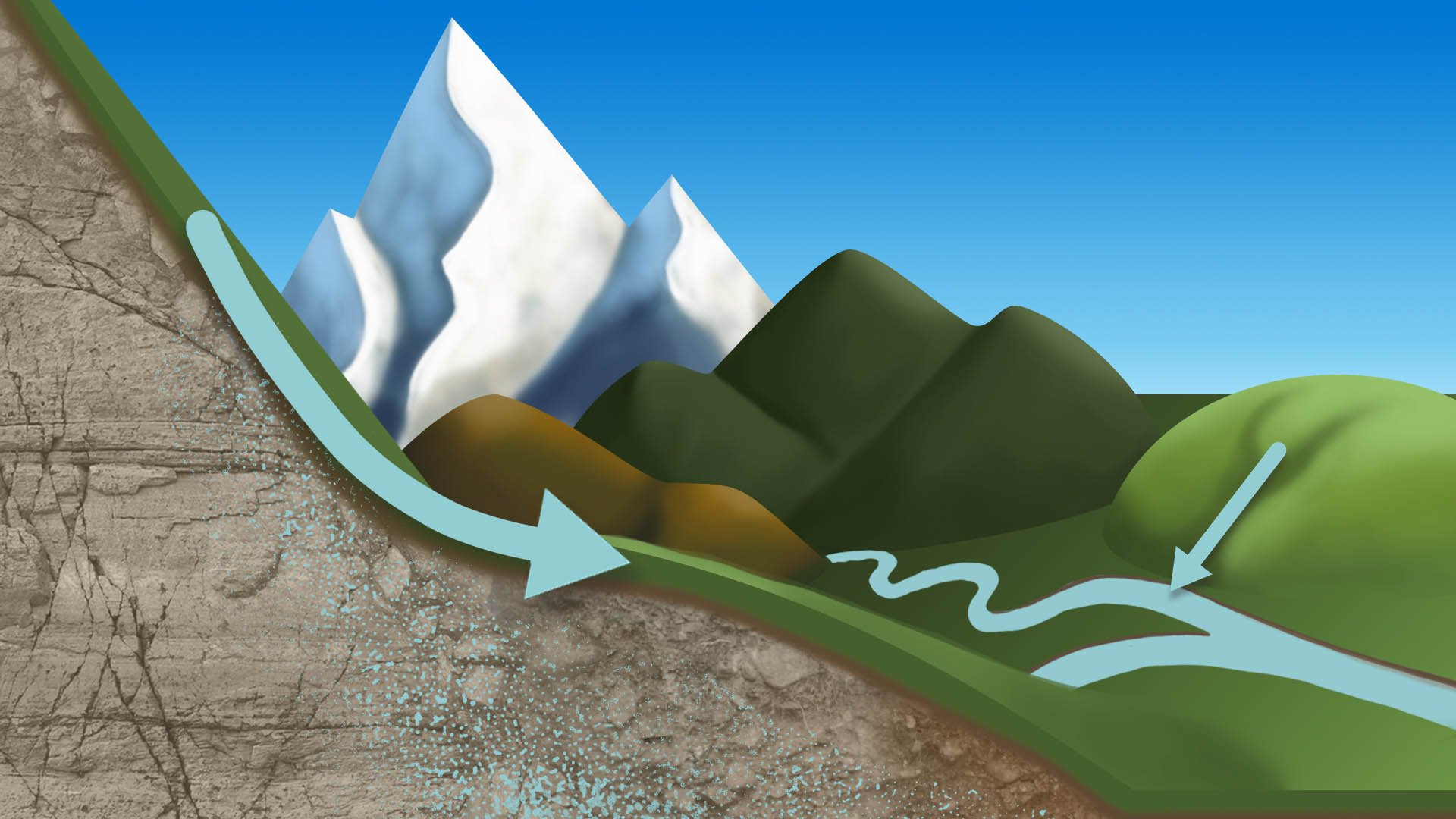
Diagram showing water flowing downhill from mountains into a river valley.Source:

https://landscapedna.org/actions/

Earth pulls on all matter with a force called gravity. Gravity pulls objects and materials toward Earth, which means the force of gravity is directed downward.

Water is made of many tiny particles that can move freely. When water is placed on a flat surface, gravity pulls downward, but the surface keeps the water in place. When the surface is sloped, gravity causes the water particles to move toward the lowest point.

Even though water spreads out and flows around objects, the direction of the gravitational force does not change. Gravity does not pull water sideways or upward. It always pulls downward toward Earth. When the slope becomes steeper, the water moves faster, but it still flows in the same downward direction.

In this investigation, students observe water flowing down a sloped surface. The repeated pattern of water always moving downhill supports the argument that Earth’s gravitational force on objects and materials is directed down. Water provides clear evidence because it responds quickly and consistently to gravity.

Table 1.

Slope Angle (degrees)

Direction of Water Flow

Time to Reach Bottom (seconds)

5

Down

6

15

Down

3.5

25

Down

2

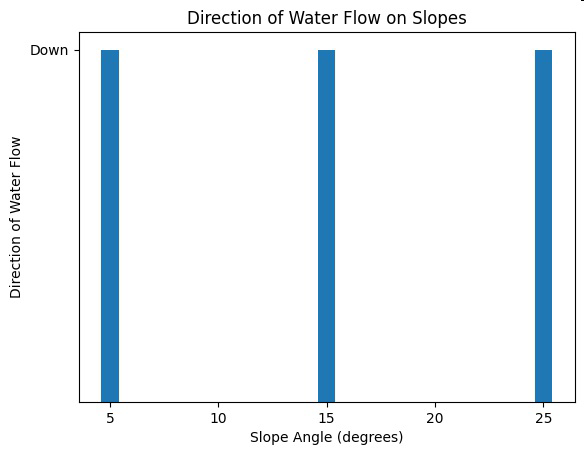
Graph of Information - Figure 1.

Bar graph titled 'Direction of Water Flow on Slopes' showing water flows down for slope angles 5, 15, and 25 degrees.

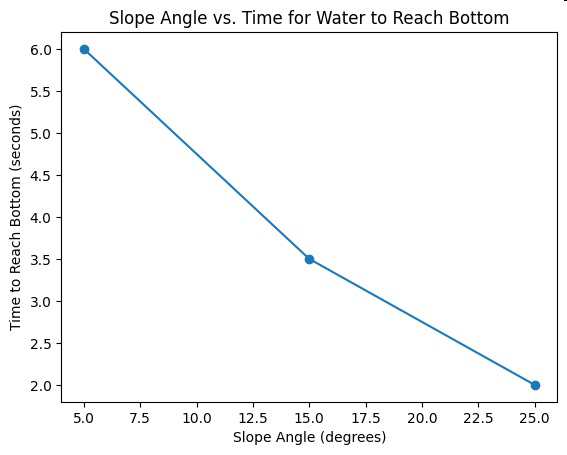
Graph of Information - Figure 2.

Line graph titled 'Slope Angle vs. Time for Water to Reach Bottom' showing times of 6 seconds at 5 degrees, 3.5 seconds at 15 degrees, and 2 seconds at 25 degrees.

Asemmisa {{asɛmmisaAhyɛnsode}}
1.

When water is poured onto a sloped surface, which direction does it move?

Asemmisa {{asɛmmisaAhyɛnsode}}
2.

Look at Table 1. What is the direction of water flow at slope angles of $5^{\circ}$, $15^{\circ}$, and $25^{\circ}$?

Asemmisa {{asɛmmisaAhyɛnsode}}
3.

Using Figure 1, describe the pattern you observe in the direction of water flow as the slope angle changes.

Asemmisa {{asɛmmisaAhyɛnsode}}
4.

Which observation best supports the idea that gravity pulls downward?

Asemmisa {{asɛmmisaAhyɛnsode}}
5.

Look at Table 1 and Figure 2. How does the time for water to reach the bottom change as the slope becomes steeper?

Asemmisa {{asɛmmisaAhyɛnsode}}
6.

How do the water-flow data support the claim that Earth’s gravitational force on objects is directed down?

Claim:
Evidence:
Reasoning: