Objects Sliding Off a Tilted Surface
Phenomenon
Students place a book or toy car on a tilted board or ramp. When the board is lifted slightly, the object begins to slide. When the board is lifted higher, the object slides faster, but it always moves down the ramp toward the floor.
Students notice:
Objects slide downward along the ramp
Changing the steepness changes speed, not direction
Objects never slide upward on their own
Students ask:
Why do objects always move downward on a ramp?
Diagram 1.
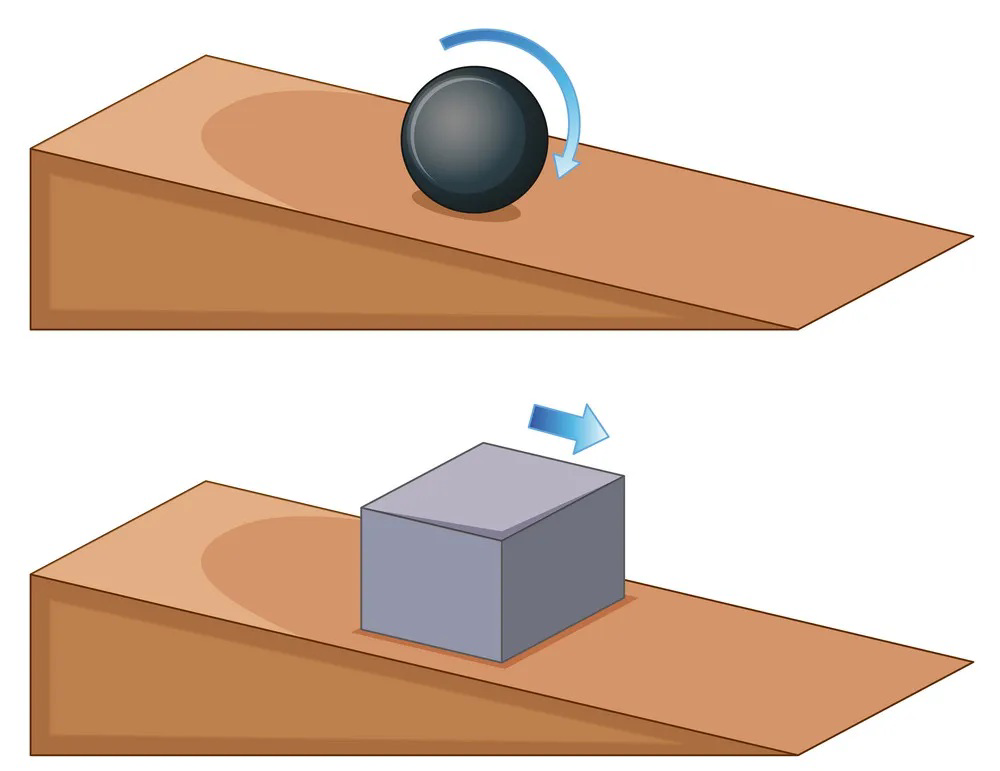
Source: https://www.vectorstock.com/royalty-free-vector/two-objects-rolling-on-slope-vector-28333332
Earth pulls on all objects with a force called gravity. Gravity always pulls objects toward the ground, which means the gravitational force is directed downward.
When an object is placed on a flat surface, gravity pulls it down, but the surface pushes up and keeps the object in place. On a tilted surface, the surface no longer pushes straight up. Because of this, gravity can cause the object to move.
Even though the object moves along the ramp, the force of gravity is not pulling it along the ramp. Gravity is still pulling straight downward. The object moves down the ramp because part of the downward pull is not blocked by the surface.
In this investigation, students change the steepness of a ramp. As the ramp gets steeper, the object moves faster, but it still moves downward every time. These observations help students understand that motion can change direction, but the direction of the gravitational force does not change. This supports the argument that Earth’s gravitational force on objects is always directed down.
Diagram 2.
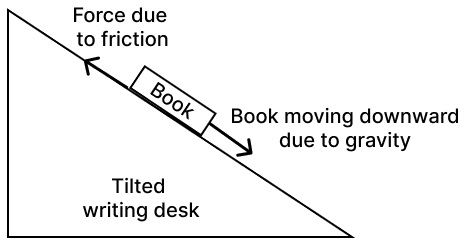
Source: https://www.knowledgeboat.com/learn/class-8-ncert-science-cbse/solutions/dev0b5/friction
Table 1.
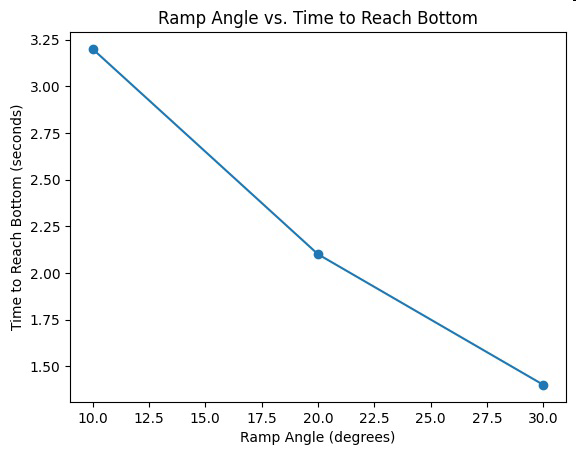
Ramp Angle (degrees) | Direction of Motion | Time to Reach Bottom (seconds) |
|---|
10 | Down | 3.2 |
20 | Down | 2.1 |
30 | Down | 1.4 |
Graph of Information - Figure 1.
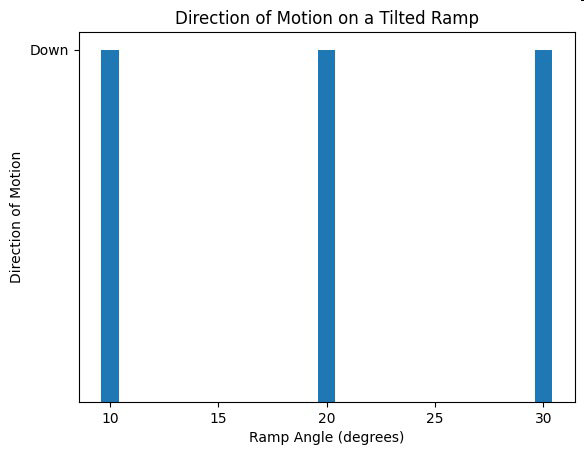
Graph of Information - Figure 2.