Colored Paper Under Different Light
Diagram 1.
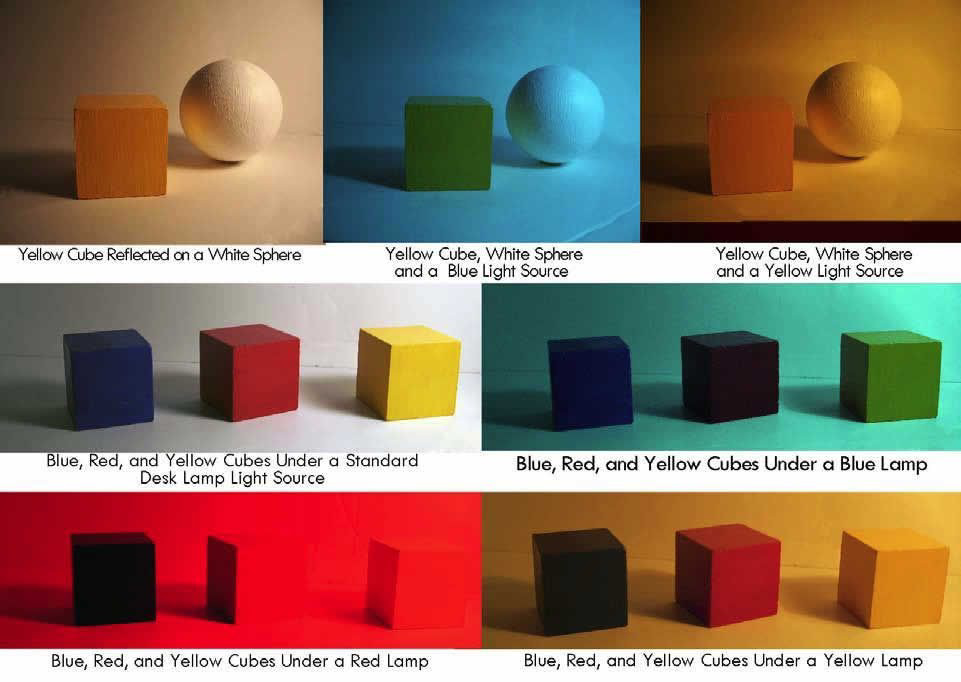 Source:
https://vamosarema.com/
Phenomenon
Students place sheets of different colored paper (red, blue, green, yellow, and black) on a table in a dim room. A white flashlight shines on each paper from the same distance. Students observe that all papers become visible when light shines on them, but some appear brighter than others.
Students notice:
Papers cannot be seen well without light
With light, all papers are visible
Some colors appear brighter than others
Students ask:
How does reflected light allow us to see colored objects?
Light allows us to see objects because it reflects off objects and enters our eyes. White light is made of many colors. When white light shines on an object, the object reflects some colors of light and absorbs others.
The color we see depends on which light is reflected into our eyes. For example, red paper reflects mostly red light and absorbs other colors. Blue paper reflects blue light. Black paper absorbs most light and reflects very little, so it appears dark.
In this investigation, students shine a flashlight on different colored papers. Light travels from the flashlight to the paper and then reflects into the eye. Because each color reflects a different amount of light, some papers appear brighter than others.
This shows that seeing color still depends on light reflecting into the eye. If no light reaches the paper, or if no reflected light reaches the eye, the object cannot be seen. By modeling the path of light, students can explain how light reflection allows us to see both objects and their colors.
Table 1.
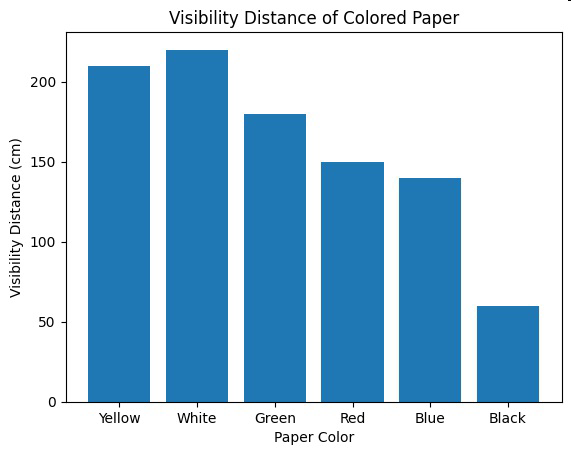
Paper Color | Brightness Rating (1–5) | Visibility Distance (cm) |
|---|---|---|
Yellow | 5 | 210 |
White | 5 | 220 |
Red | 3 | 180 |
Blue | 3 | 150 |
Green | 4 | 140 |
Black | 1 | 60 |
Graph of Information - Figure 1.
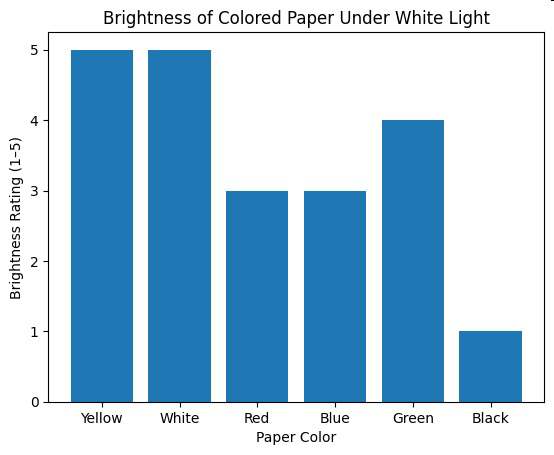
Graph of Information - Figure 2.