Using a Mirror to See an Object Around a Corner
Phenomenon
Students place an object (such as a toy or block) behind a barrier so it cannot be seen directly. When students look straight ahead, the object is not visible. When they hold a mirror at an angle, the object suddenly becomes visible in the mirror.
Diagram 1.
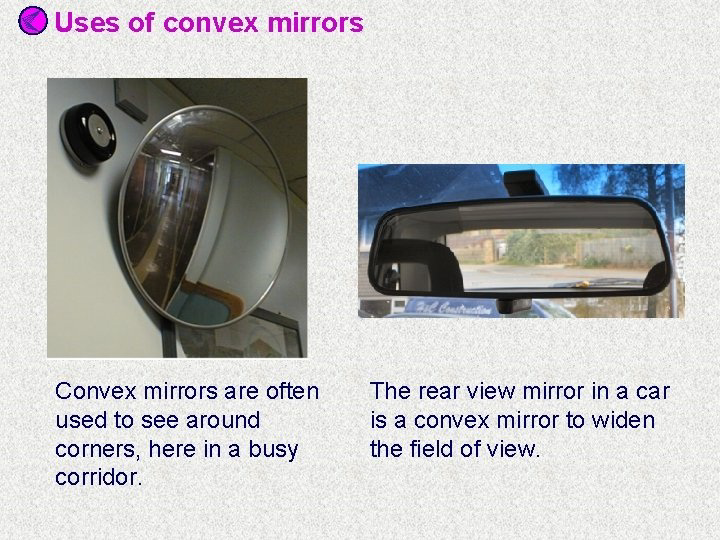 Source:
https://slidetodoc.com/types-of-mirror-when-we-draw-a-ray/
Students notice:
No mirror → object cannot be seen
Mirror angled correctly → object can be seen
Students ask:
How does reflected light allow us to see objects that are not in a straight line from our eyes?
Light travels in straight lines from a source. To see an object, light must reflect off the object and enter our eyes. When an object is hidden behind a barrier, light from the object cannot travel directly to the eye, so the object cannot be seen.
Diagram 2.
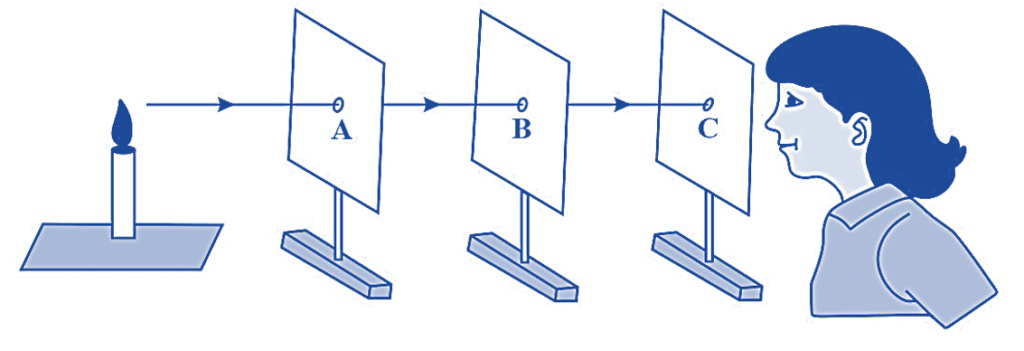 Source: https://88guru.com/library/physics/light-travels-along-a-straight-line
A mirror changes the path of light. When light hits a mirror, it reflects, or bounces off, the surface. The mirror can redirect the reflected light toward the eye. This allows the eye to receive light from an object that is not directly in front of it.
In this investigation, students use a mirror to see an object around a corner. Light travels from the flashlight to the object, reflects off the object, then reflects off the mirror, and finally enters the eye. The mirror helps guide the light to the eye.
By drawing and using a model that shows the path of light, students can explain why the object becomes visible when the mirror is used. This investigation helps students understand that seeing depends on reflected light entering the eye, even when the light changes direction.
Table 1.
Trial | Mirror Used | Object Visible |
|---|---|---|
1 | No | No |
2 | Yes | Yes |
3 | No | No |
4 | Yes | Yes |
Graph of Information - Figure 1.
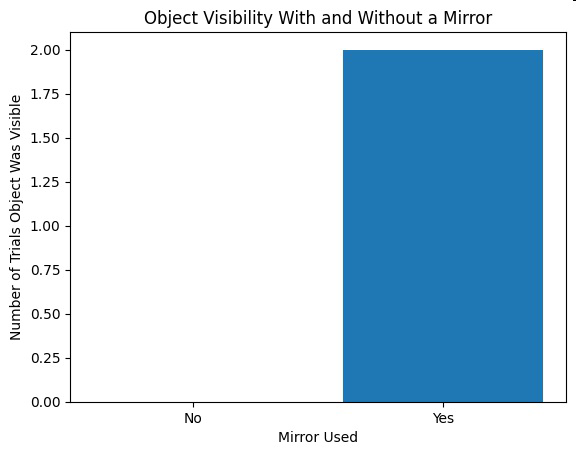
Table 2.
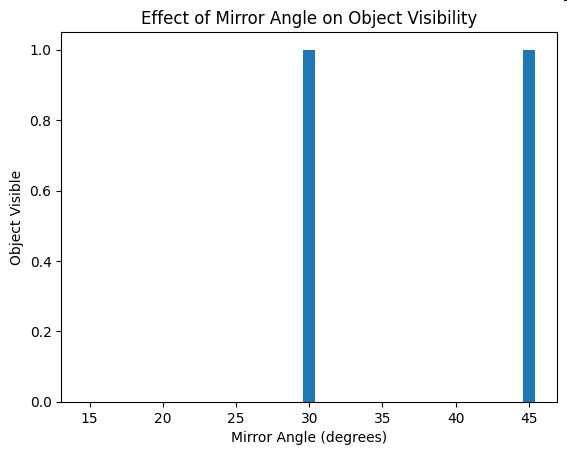
Mirror Angle (degrees) | Object Visible (Yes=1, No=0) |
|---|---|
15 | 0 |
30 | 1 |
45 | 1 |
Graph of Information - Figure 2.