Seeing Objects With a Flashlight in the Dark
Phenomenon
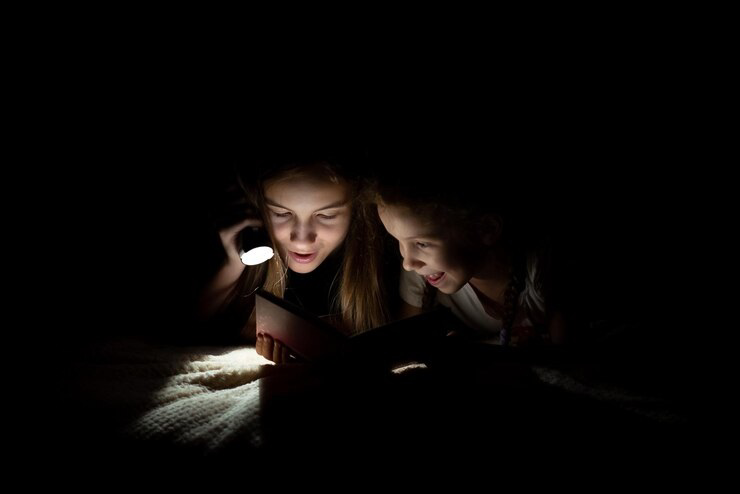
Students enter a darkened classroom where several objects are placed on a table. When the lights are off and no flashlight is used, the objects cannot be seen. When a flashlight shines on the objects, they become visible immediately.
Diagram 1.
Source:
https://www.freepik.com/premium-photo/teenage-girl-with-her-sister-read-dark-with-flashlight_32641745.htm
Students notice:
Students ask:
To see an object, light must enter our eyes. Objects do not usually make their own light. Instead, we see most objects because light reflects off them and travels into our eyes.
In a dark room, there is very little light. Without light shining on an object, there is no light to reflect into our eyes, so the object cannot be seen. When a flashlight shines on an object, light travels from the flashlight to the object. The light then reflects off the surface of the object and enters our eyes. This reflected light allows our brains to recognize the object.
Different objects can reflect light in different ways, but all visible objects must reflect at least some light to be seen. If no light reaches the object, or if reflected light does not reach our eyes, the object remains invisible.
By using a flashlight in a dark room, students can model the path of light. The model shows light traveling from the source, bouncing off the object, and entering the eye. This investigation helps explain why light reflection is necessary for vision.
Table 1.
Trial | Light Source On | Object Visible |
|---|
1 | No | No |
2 | Yes | Yes |
3 | No | No |
4 | Yes | Yes |
Graph of Information - Figure 1.
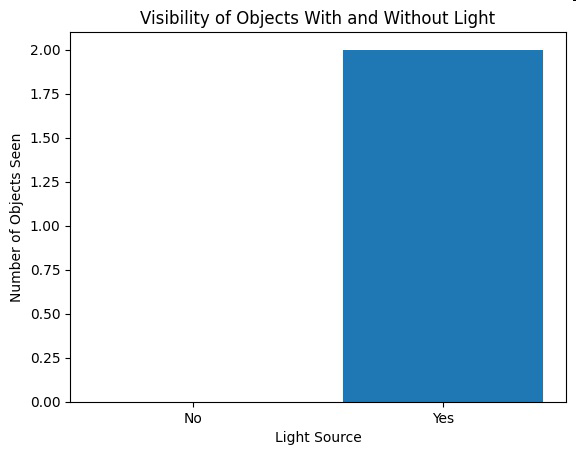
Table 2.
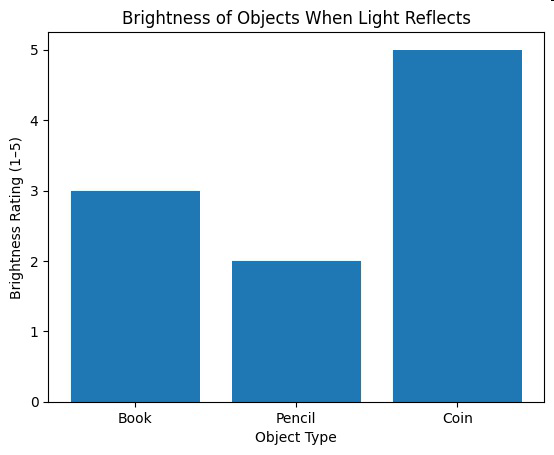
Object Type | Brightness Rating (1 to 5) |
|---|
Book | 3 |
Pencil | 2 |
Coin | 5 |
Graph of Information - Figure 2.