“Beeper” Messages Using Sound Patterns
Phenomenon
Students stand in different parts of the classroom. One student sends messages using sound patterns made by clapping or using a simple beeper or metronome app. Another student listens and tries to decode the message.
Diagram 1.
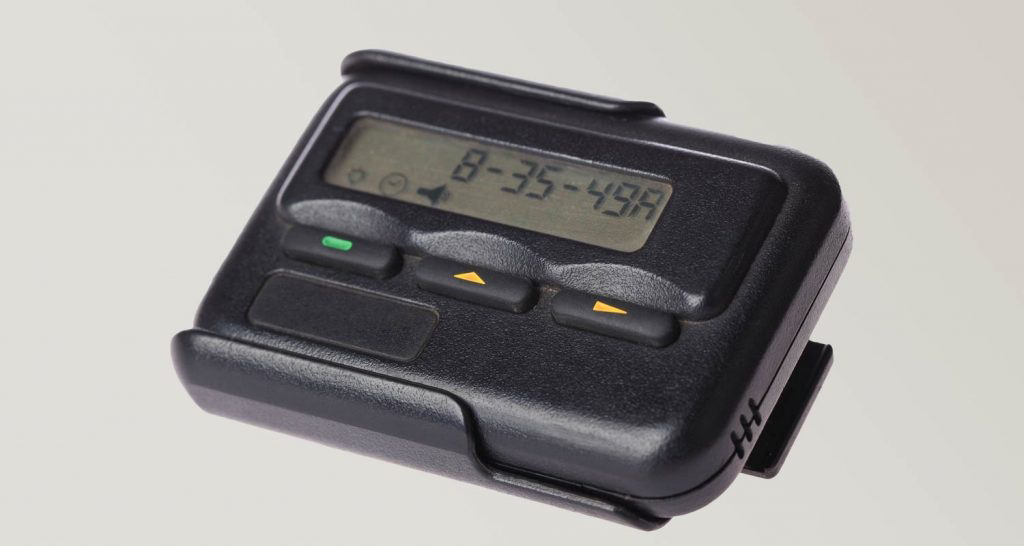
Students design and test three different sound-pattern solutions:
Solution A: Number of beeps
1 beep = STOP
2 beeps = GO
3 beeps = HELP
Solution B: Loud vs. soft sounds
Loud clap = long sound
Soft clap = short sound
Solution C: Rhythm patterns
fast-fast
slow-slow
fast-slow
Students test each solution in quiet and noisy classroom conditions.
Sound can carry information through patterns. Clapping, beeping, and musical rhythms all use repeated sounds to send messages. These sounds travel as vibrations through the air and reach a listener’s ears.
In this investigation, students send information using sound patterns. The patterns must be clear so the listener can recognize them. Some sound patterns use counting sounds, while others use loud and soft sounds or rhythms. Each system is a possible solution for transferring information.
Sound patterns can be affected by noise. When a room is noisy, some patterns may be harder to hear or understand. Engineers test their designs in different conditions to see which solution works best.
By measuring how accurately messages are received and how long it takes to send them, students can compare sound-pattern systems. This helps them understand that patterns can transfer information, and that testing and comparing solutions helps identify the most effective way to communicate.
Table 1.
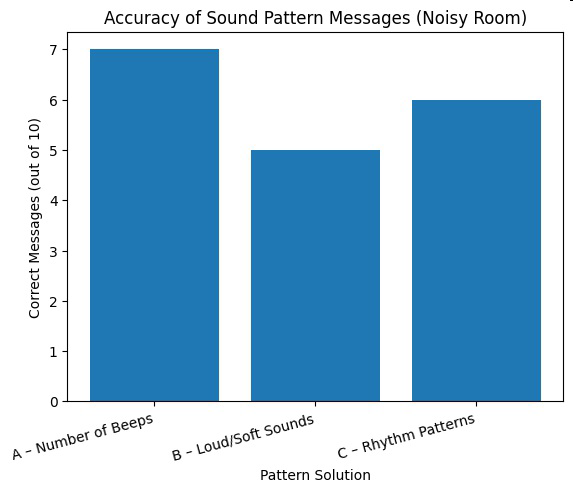
Solution | Quiet Room - Correct Messages (out of 10) | Noisy Room - Correct Messages (out of 10) |
|---|
A - Number of Beeps | 9 | 7 |
B - Loud/Soft Sounds | 7 | 5 |
C - Rhythm Patterns | 8 | 6 |
Graph of Information - Figure 1.
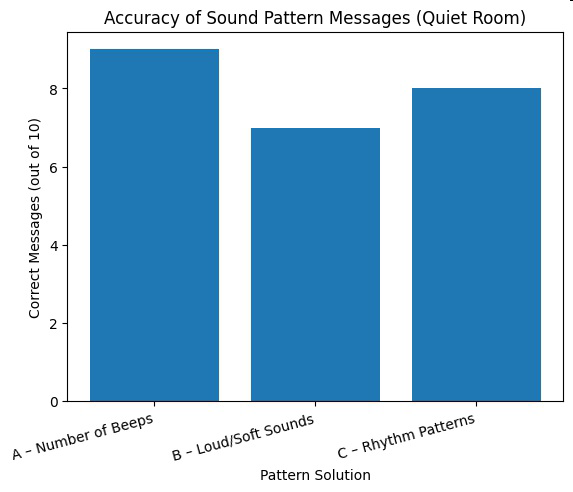
Graph of Information - Figure 2.