Flashlight Messages Using Light Patterns
Diagram 1.
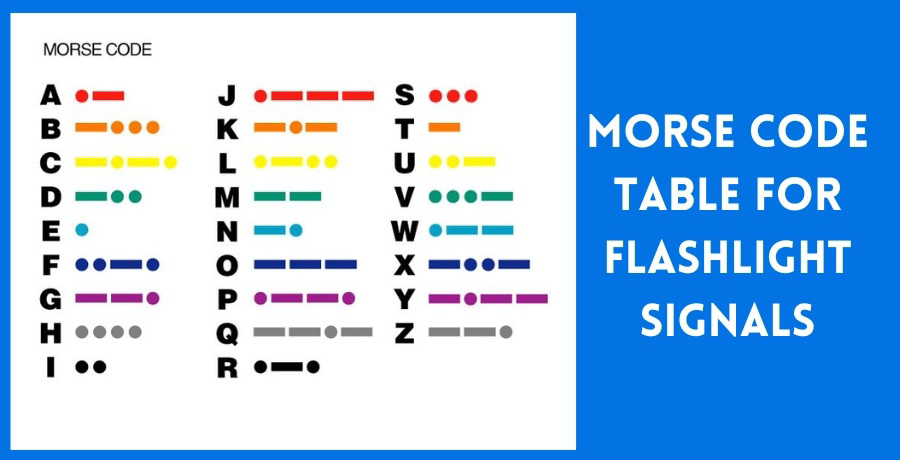 Source: https://morsecodeconverter.net/morse-code-flashlight/
Phenomenon
Students stand at opposite ends of a hallway or classroom. One student sends messages using a flashlight, and another student tries to decode the message by watching the light pattern.
Students design and test three different solutions for sending information with light:
Solution A: Short and long flashes
Solution B: Number of flashes for each letter
Solution C: Repeating flash patterns (AB, AAB, ABB)
Students compare how well each pattern system transfers information.
People often send information using patterns. Traffic lights, blinking signals, and emergency lights all use repeated patterns to communicate messages. Light can be a useful way to send information because it travels quickly and can be seen from far away.
In this investigation, students use a flashlight to send messages. The flashlight does not send words, but it sends patterns of light. These patterns must be clear so another person can understand the message.
Different pattern systems can be used to send the same message. Some systems use short and long flashes, while others use counting flashes or repeating patterns. Each system is a possible solution to the problem of transferring information.
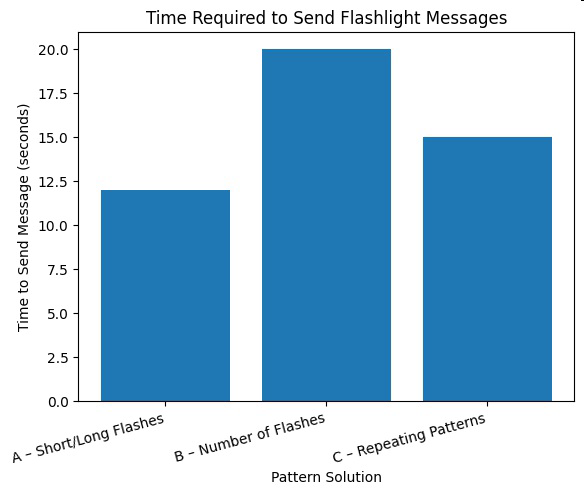
Scientists and engineers test multiple solutions to see which works best. They collect data on how accurate the message transfer is and how long it takes to send the message. By comparing results, students can decide which pattern system transfers information most effectively.
This investigation helps students understand that patterns can carry information and that comparing solutions helps identify the best design.
Table 1.
Solution | Correct Messages (out of 10) | Average Time to Send Message (s) |
|---|
A - Short/Long Flashes | 9 | 12 |
B - Number of Flashes | 6 | 20 |
C - Repeating Patterns | 8 | 15 |
Graph of Information - Figure 1.
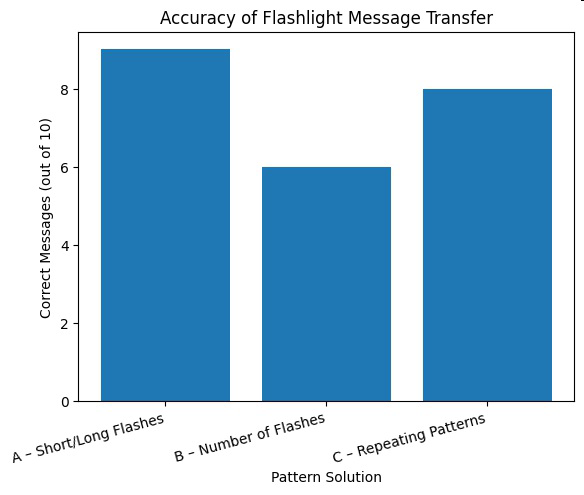
Graph of Information - Figure 2.