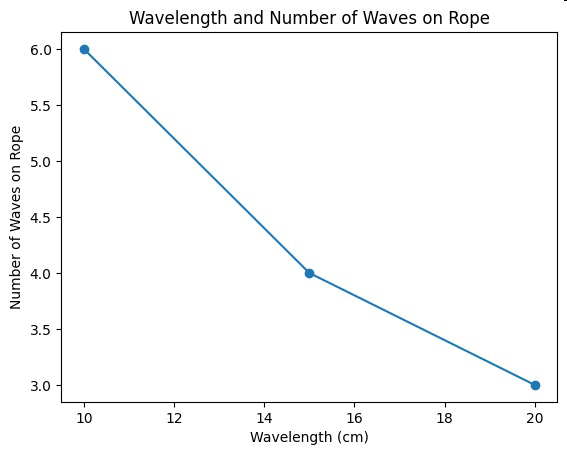
Rope Waves Moving a Paper Clip
Phenomenon
Students tie one end of a rope to a table and move the other end up and down to create waves. A paper clip rests on the rope. When students make small waves, the paper clip barely moves. When they make larger waves, the paper clip moves much farther along the rope.
Students ask:
How do wave patterns affect how objects move?
This investigation helps students model how waves have patterns (amplitude and wavelength) and how waves can cause objects to move.
Diagram 1.
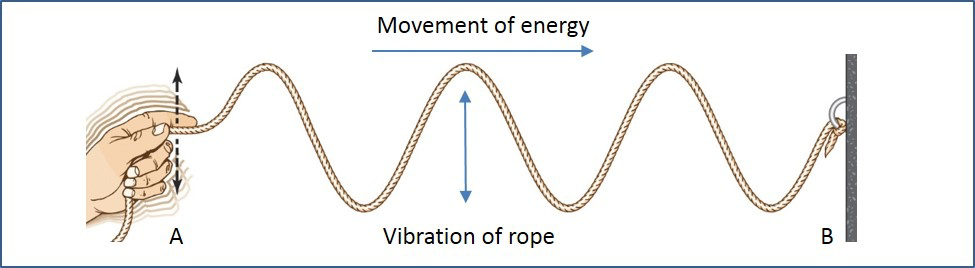 Source: https://ar.inspiredpencil.com/pictures-2023/transverse-wave-rope
Waves are patterns of motion that travel through materials like ropes, water, or air. When you shake a rope, you are not moving the rope itself down the line. Instead, you are creating a wave pattern that moves along the rope.
Two important properties of waves are amplitude and wavelength. Amplitude is how tall the wave is, measured from the middle position to the top of the wave. A larger amplitude means a bigger movement. Wavelength is the distance between one wave peak and the next. It describes how spread out the wave pattern is.
Waves can cause objects to move without carrying the object with them. When a wave travels along a rope, energy moves through the rope. Objects resting on the rope, like a paper clip, can move because the wave transfers energy to them.
In this investigation, students change how strongly they move the rope. This changes the amplitude of the wave. By measuring how far the paper clip moves, students can see how wave patterns affect motion. This helps students model how waves behave and how waves can cause objects to move.
Diagram 2.
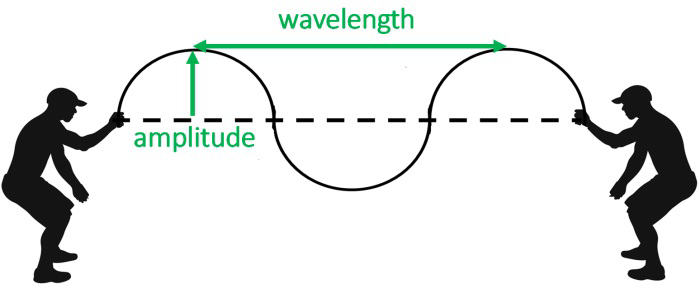
Source:
https://www.edplace.com/worksheet_info/science/keystage3/year7/topic/1290/13103/define-and-calculate-amplitude-frequency
Table 1.
Trial | Wave Amplitude (cm) | Distance Paper Clip Moved (cm) |
|---|
1 | 2 | 3 |
2 | 4 | 6 |
3 | 6 | 9 |
4 | 8 | 13 |
Graph of Information - Figure 1.
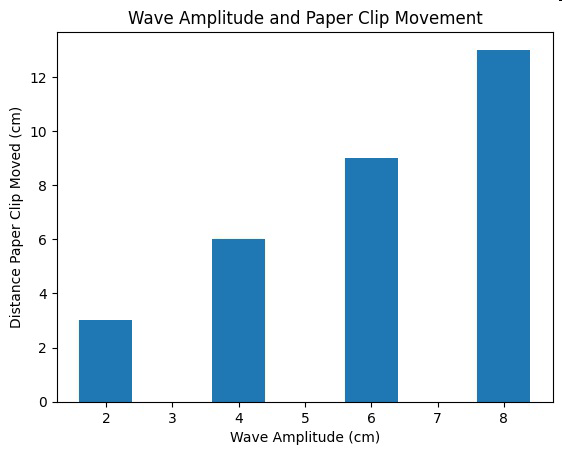
Table 2.
Trial | Wavelength (cm) | Number of Waves on Rope |
|---|
1 | 20 | 3 |
2 | 15 | 4 |
3 | 10 | 6 |
Graph of Information - Figure 2.