Sending Messages With Visual Symbol Patterns
Diagram 1.
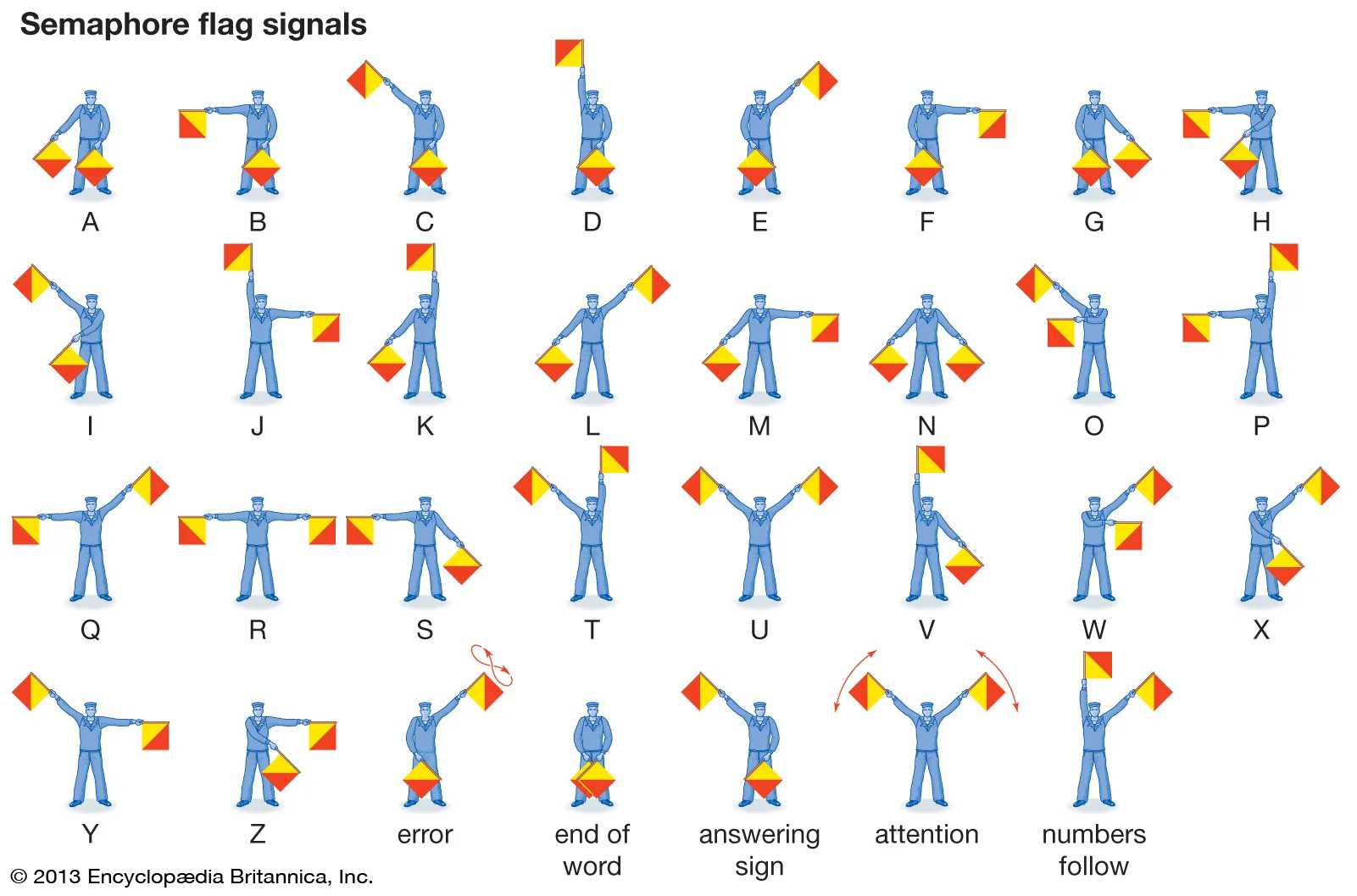 Source: https://www.britannica.com/technology/semaphore
Phenomenon
Students stand at opposite sides of the playground or classroom. One student sends messages using visual symbols or hand signals, and another student decodes the message by watching the pattern.
Students design and test three different visual-pattern solutions:
Solution A: Two-position hand signals
Arms up = YES
Arms down = NO
Solution B: Symbol cards
Triangle = STOP
Circle = GO
Square = HELP
Solution C: Repeating pattern cards
AB = YES
AAB = NO
ABB = HELP
Students compare which visual pattern system transfers information most accurately and quickly from a distance.
Information can be transferred using visual patterns. Traffic signs, signal flags, and hand signals all use repeated shapes or positions to send messages that people can understand without words.
In this investigation, students send information using visual symbols and patterns. The sender shows a pattern, and the receiver must recognize it correctly. Each pattern system is a different solution for transferring information.
Some visual patterns are very simple, like arms raised or lowered. Other systems use symbols or repeating patterns. These systems may work differently depending on how far apart students are or how complex the pattern is.
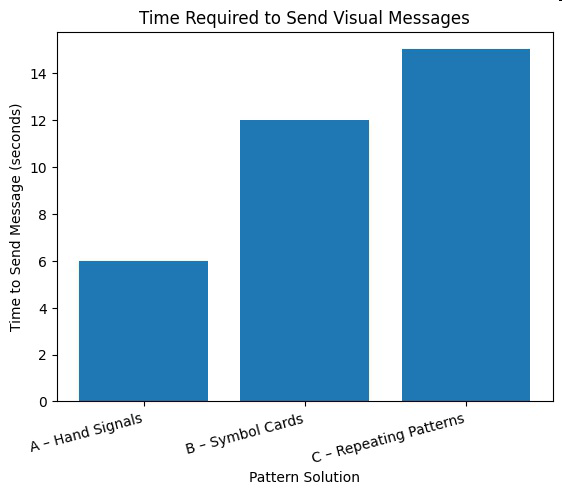
Engineers and scientists test multiple solutions to find the most effective one. They measure how accurately the message is received and how long it takes to send the message. By comparing results, students can decide which visual pattern system works best.
This investigation shows that patterns can transfer information, and that testing and comparing multiple solutions helps identify the best design for communication.
Table 1.
Solution | Correct Messages (out of 10) | Average Time to Send Message (s) |
|---|
A - Hand Signals | 10 | 6 |
B - Symbol Cards | 8 | 12 |
C - Repeating Patterns | 7 | 15 |
Graph of Information - Figure 1.
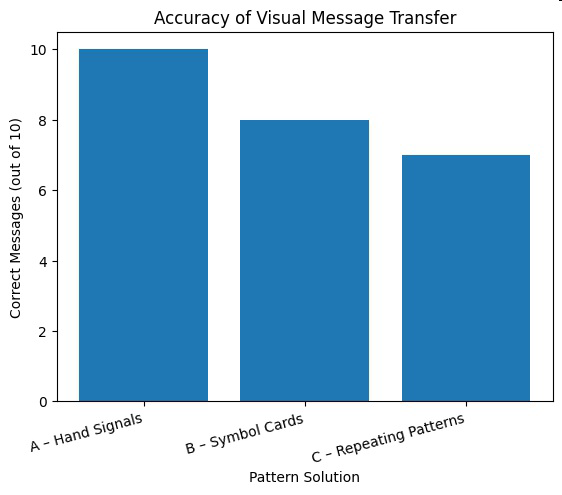
Graph of Information - Figure 2.