Water Waves Moving a Floating Cork
Phenomenon
Students fill a clear tub with water and place a small cork (or ping-pong ball) on the surface. They make waves by moving their hand up and down at one end of the tub.
Diagram 1.
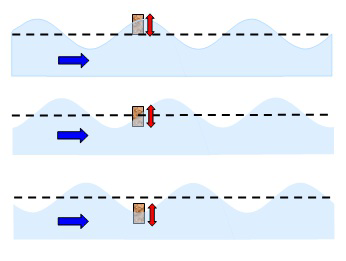 Source: https://www.schoolphysics.co.uk/age11-14/Wave%20properties/text/Waves_/index.html
They notice two things:
When they make bigger waves (higher amplitude), the cork moves up and down more and sometimes drifts farther.
When they make waves more quickly, the peaks get closer together (shorter wavelength).
Students ask:
How do wave patterns (amplitude and wavelength) relate to how objects move?
Waves are repeating patterns that travel through materials like water, rope, or air. When you make waves in water, the wave pattern moves across the surface, but the water itself does not travel across the tub the whole time. Instead, the water mostly moves up and down as the wave passes.
Two important wave features are amplitude and wavelength. Amplitude is the height of the wave from the calm water level to the top of a crest. Bigger amplitude means bigger movement. Wavelength is the distance from one wave crest to the next crest. It describes how spread out the wave pattern is.
Waves can also cause objects to move. A cork floating on water will bob up and down as wave crests pass by. If the waves are taller (greater amplitude), the cork usually moves up and down more. If the crests are closer together (shorter wavelength), more wave crests pass the cork in the same distance.
By measuring wave height, the spacing between crests, and how much the cork moves, students can build a model that shows how wave patterns connect to object motion.
Table 1.
Trial | Wave Amplitude (cm) | Cork Up-and-Down Motion (cm) |
|---|
1 | 1 | 1 |
2 | 2 | 2 |
3 | 3 | 3 |
4 | 4 | 4 |
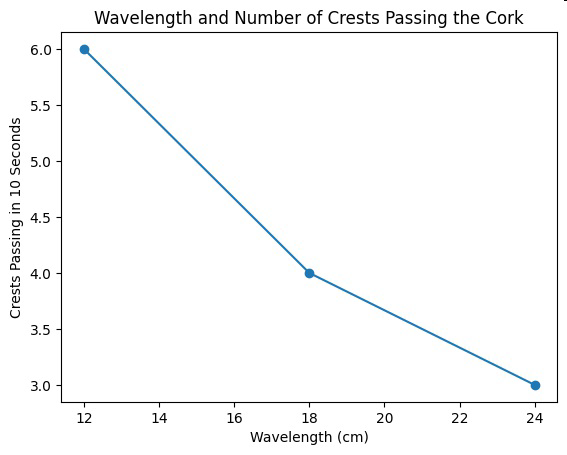
Graph of Information - Figure 1.
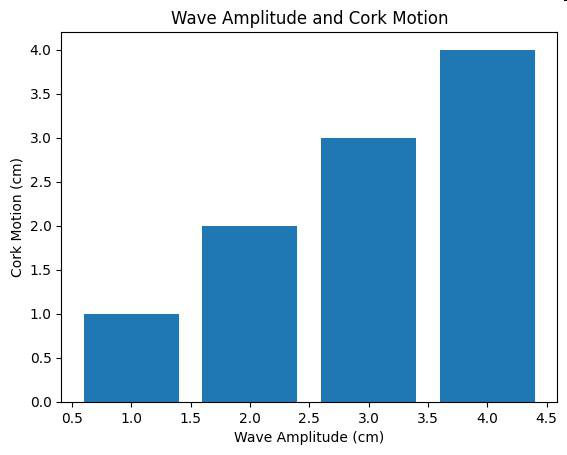
Table 2.
Trial | Wavelength (cm) | Crests Passing Cork in 10 s |
|---|
1 | 24 | 3 |
2 | 18 | 4 |
3 | 12 | 6 |
Graph of Information - Figure 2.