How did Hitler gain, consolidate and maintain power in Germany before the Great Depression?
Objectives: Understand how Hitler gained, consolidated and maintained power in Germany prior to the Great Depression.
Hitler’s early life
Hitler was born in 1889 in Austria. The son of a customs official, Hitler grew up in Linz. He had few friends and was something of a loner. In 1907 he was rejected for art school in Vienna and it was there that he developed more extreme racism and hatred for the Jews. Hitler settled in Germany in 1913.
The German workers’ party / a right-wing extremist party in Munich. This party focused on creating a scapegoat for the war and the Depression, as well as creating a ‘great, German’ Germany. It flew the hated war criminals. It took inspiration from the text of the Nazi Party.
1919–1929: The rise of the Adolf Hitler
Hitler’s rise to power cannot be attributed to one man. There are multiple reasons for Hitler’s rise to power including (some of these events happening before Hitler was able to exploit these events and a seemingly throughout the world and events happening the same time.)
1920–1: Hitler became the leader of the German Workers’ Party.
By 1921, Hitler had become a leader and was appointed head of the party by Anton Drexler. Hitler moved up the organisation and grew the party.
Hitler began to develop his oratory skills. He could quickly move from one subject to the next, from organisation to new devising for the party. His speeches strike a large number of people each time. Hitler spoke strongly and brought large crowds because at this time Germany suffered crisis after crisis.
Over the next two years, he had declared his plan for a coup or uprising and to overthrow the Weimar Republic by force in Bavaria. Hitler introduced the Führer or ‘Führer’ and changed the name of the party to the National Socialist German Workers Party, or Nazi party for short.
By 1922, the Nazi party had 50,000 members and was stronger than ever. Still angered by the economic problems of inflation and loss of leadership, the 1923 hyperinflation triggered a story of a ‘stab in the back’ theory which emphasised betrayal.
Source A
German Workers’ Party
Based on the information about Hitler’s early political activities and Source A, explain what Hitler’s goals were in his speeches to the German Workers’ Party and why these speeches drew large crowds.
How did Hitler Consolidate and Maintain Power in Germany Before the Great Depression?
Objectives: Describe how Hitler gained, consolidated and maintained power in Germany up to the Great Depression.
Nazi Party
Hitler had served five months of his five year sentence. During his incarceration, he dictated his ideas for the success of the Nazis to an ex‑veteran colleague of the Weimar Republic, by which he rose to power through constitutional means. Once he legally gained power, he could transform Germany into a nation with a larger than life dictator. Upon his release, Hitler reorganized the Nazi Party into a proper political organization and sought to compete for votes with other political parties. By 1929, the Nazi Party had become an official National Political Party.
One main cause of the Global Great Depression was the American Wall Street Crash of October 1929. The Wall Street Crash had a ripple effect throughout the world that resulted in high unemployment throughout Europe, especially in Germany, as very often Germans were forced to fight unemployment through schemes that offered Government support.
During Hitler’s rise to power the understanding of the Great Depression was the beginning of the end of German democracy, especially for unemployment. The current government was unable to see a plan that helped ease the suffering of shoppers and the working classes, who were hardest hit by the crisis. This fatality in the Weimar Republic would be a go‑ahead for the Nazis to gain support.
Communists made great economic promises to private property. Totalitarianism is a term used in history for control of the people by the hands of the government. In a totalitarian society, all control of power lies in the hands of the government, in a Stalin / totalitarian Communist government there was no ownership of private property. In totalitarian fascist government, however, people often feared restrictions although they had limited government included; yet, he enjoyed democracy. Under a limited socialist totalitarian nationalism, a rejection of democracy, private rights, basic democratic governments included, yet, they had many characteristics in common such as a justified control of every aspect of life. In a fascist government, troops in uniform used violence, propaganda, intimidation and strong control of the economy.
Totalitarian leaders often used sophisticated communication to reach their goals.
In the early 1930s, the mood in Germany was depressed. People had taken out of their employment through no fault of their own, if they were given assistance through government support, which they came to believe was too weak to pull them out of the Great Depression. The Germans lacked confidence in democracy due to their loss of suffering from the economic problems, also detailed in World War I.
Using the passage about the Nazi Party and the Great Depression, explain how economic crisis and weaknesses of the Weimar government helped Hitler gain support in Germany.

Summarize what you see in both of these posters.
What do you think is the purpose of these posters?
Do you think these posters are effective? Why or why not?
How did Hitler gain, consolidate and maintain power in Germany before the Great Depression?
Objectives: Discover how Hitler gained, consolidated and maintained power in Germany prior to the Great Depression.
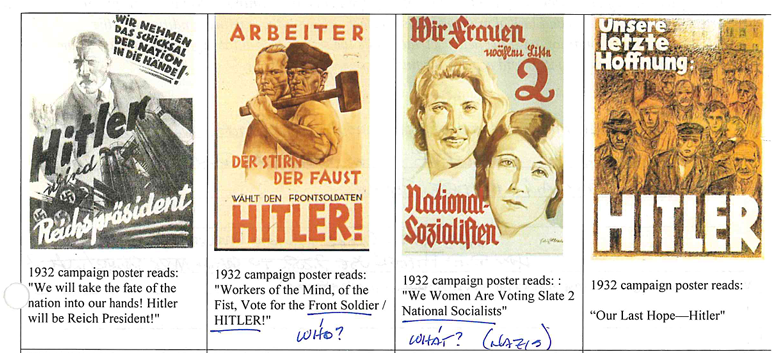
Directions: Examine the 1932 campaign posters below. Respond to the questions.

A 1932 campaign poster reads: “He will take out the knife — so will he be Reich President.” Who is this poster targeting, and what would this poster make people think or believe?
A 1932 campaign poster reads: “Workers of the Mind, of the Fist, Vote for the Front Soldier HITLER.” Who is this poster targeting, and what would this poster make people think or believe?
A 1932 campaign poster reads: “We Women are voting Slate 2 National Socialists.” Who is this poster targeting, and what would this poster make people think or believe?
A 1932 campaign poster reads: “Our Last Hope – HITLER.” Who is this poster targeting, and what would this poster make people think or believe?
Objectives: Identify how Hitler gained, consolidated and maintained power in Germany prior to and during the Great Depression.
Guiding Question: How did Hitler gain, consolidate and maintain power in Germany before the Great Depression, 1933?
As soon as Hitler became chancellor on January 30, 1933, he immediately ended democracy and created a totalitarian state. He sought to stamp out opposition in the March 1933 Reichstag elections, the Nazi Party did not obtain an absolute majority of the votes or control of the Parliament. Hitler made Hilter dictator of Germany. This Act let the Reichstag, or Parliament, process in a few short months, the Nazis eliminated all other parties and dissolved the Parliament. The Parliament was replaced by a Parliament of Nazi party representatives.
By mid-1933, Germany had become a totalitarian state, where the rights and freedoms of the people were limited by the power of the state. With Adolf Hitler as chancellor and, from 1933 to 1945, when it was destroyed by the downfall of the Nazi party, was created a moral state. In 1934, the Nazi Party sought to create a moral state, where his new government installed a totalitarian dictatorship through a series of strategies to gain, consolidate and maintain power over Germany.

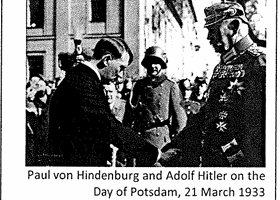
Paul von Hindenburg and Adolf Hitler on the day of Hitler’s appointment as chancellor, 1933
Summarize how Hitler gained more power after becoming chancellor in January 1933.
Key Terms
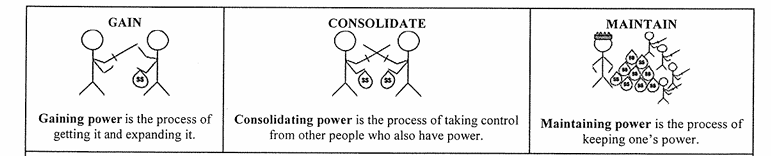
Gaining Power is the process of obtaining it.
Consolidating Power is the process of taking control from other people, but also have power.
Maintaining Power is the process of keeping one’s power.
In your own words, rewrite the definitions of each.
GAIN
CONSOLIDATE
MAINTAIN
In your own words, rewrite the definitions of gaining power Explain clearly.
In your own words, rewrite the definitions of consolidating power. Explain clearly.
In your own words, rewrite the definition of maintaining power. Explain clearly.
Directions: After examining documents on Nazi totalitarian control, fill in the chart for each method of control listed. Indicate if it helped the Nazis gain, consolidate, and/or maintain power in Germany. Then, explain why you think so.
Method of Control | Gain, Consolidate, and/or Maintain Power? |
|---|---|
Hitler’s Youth and indoctrination of youth | |
Mass Demonstrations, Rallies, and Spectacles | |
Numermberg Laws and Kristallnacht | |
SS or Secret Police | |
Propaganda | |
Rearmament & New Alliances |
Choose two methods of control from the chart (for example, Hitler Youth, SS, propaganda). For each one, explain whether it mainly helped the Nazis gain, consolidate, and/or maintain power, and why.
Triumph of the Will (1935) in order - YouTube
Part 2 – Mass Demonstrations, Rallies, and Spectacles
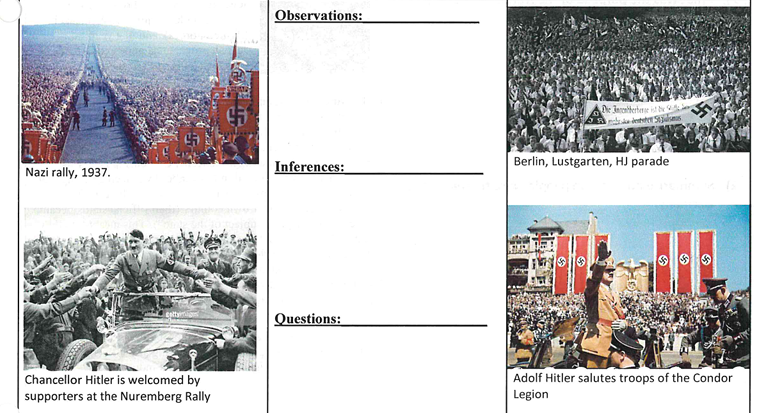
The Nuremberg Rally was the annual rally of the Nazi Party in Germany between 1933 to 1938. These Nazi propaganda events were held in the Nazi Party rally grounds at Nuremberg. The goals were intended to symbolize the solidarity between the German people, to reinforce their enthusiasm for power of Nazi Party, to test out propaganda ideas to be used elsewhere in Nazi Germany before their formal adoption in other areas such as the SS. The Nuremberg marches, shown in this service stock home in merchandise, were worshipful displays of Nazi symbolism such as flags, banners, goose-step marches, martial, and bombastic nationalistic music.
Speeches by Nazi leaders (Hitler) were the occasion of the announcement of the major Nazi laws, such as the 1935 when the Nuremberg Laws were announced. These were used elsewhere such as sports. The event was used by Goebbels cinematographer Riefenstahl. The rallies included marching columns of uniformed Nazi members and military organizations. The spectacle was intended to inspire the German population by means of emotional pageants of German history.
Triumph of the Will is a 1935 German propaganda film by Leni Riefenstahl. It tells the story of the 1934 Nazi Party Congress at Nuremberg, which was attended by more than 700,000 Nazi supporters. The film includes excerpts from speeches by Nazi leaders at the rally, including Hitler. Riefenstahl got Hitler’s personal commission to film it.
Watch Triumph of the Will and respond to the questions below.
While watching Triumph of the Will, list your observations (what you notice), inferences (what you can assume), and questions (what you wonder) about the Nazi rallies shown.

Use the image titled “Nazi Rally, 1937” to record your observations, inferences, and questions about Nazi mass rallies.
Use the image “Chancellor Hitler is welcomed by supporters at the Nuremberg Rally” to write your observations, inferences, and questions.
Use the images “Berlin, Lustgarten, Hitler parade” and “Adolf Hitler salutes troops of the Condor Legion” to record your observations, inferences, and questions about Nazi parades and military displays.
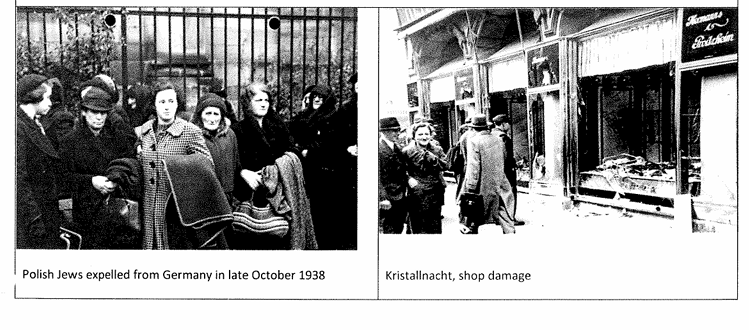
The Nazis coordinated an attack on Jewish people and their property in Germany and German-controlled lands as part of Hitler's anti-Jewish policy. On November 7, 1938, Herschel Grynszpan, a 17-year old German Jew angered at his family's expulsion from Germany, walked into the German Embassy in Paris and shot the first Nazi official he found, diplomat Ernst vom Rath. Two days later, vom Rath died and Germany used his death as a pretext to launch a campaign of violence against Jews.
Kristallnacht was a pogrom (a mob attack against a specific ethnic or religious group) in Nazi Germany on November 9-10, 1938. On a single night, 91 Jews were murdered, and 25,000–30,000 were arrested and deported to concentration camps. In the early hours of November 10 an orgy of coordinated destruction broke out in cities, towns and villages throughout the Third Reich. The consequences of this action were disastrous for the Jews living in the Third Reich. In a single night, Kristallnacht saw the destruction of more than 1,000 synagogues, the ransacking of tens of thousands of Jewish businesses and homes. It marked the beginning of the systematic eradication of a people in Germany who could trace their ancestry to many times and served as a prelude to the Holocaust that was to follow.

What was Kristallnacht? Summarize what happened on November 9–10, 1938.
What impact did Kristallnacht have on Jewish people in Germany? Explain at least two major consequences.
Part 5 – Propaganda
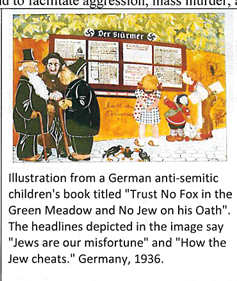
Nazi propaganda drew upon the successful strategies used by the Allies: Socialists; Communists; and Italian Fascists in advance their political campaigns, win public support, and to wage war. As in World War 1, the Nazis limited the German news media, newspaper and radio, through censorship and politicized propaganda as a weapon to unite and control the German people through nationalism, hatred, and fear.
Propaganda under Josef Goebbels (Minister of Propaganda, 1928) was a comprehensive and continued method aimed at raising and unifying a Germany under Nazi ideology. (By 1936), the German press had an anti-Semitic German Nazi perspective. By 1940, anti-Semitic German Nazi propaganda had helped to create a positive image of Nazism, and a negative image of Jews. By 1944, the Nazi Party’s aim had essentially been achieved.
The table below summarizes some key features and examples of Nazi propaganda:
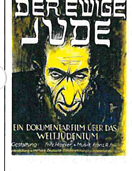
1. The German Film Institute, located in UFA the largest film studio, produced many anti-Semitic and pro-Nazi propaganda films, such as “Jud Süss” (1940). Along with posters, the Nazis produced a number of films and books to spread Nazi beliefs. “Most successful of German Nazi anti-Semitic propaganda, this movie, filmed in 1939, justified anti-Semitism in Germany.”
2. Posters for the Hitler Youth demonstrated the government’s use of propaganda to recruit youth and present an ideal Nazi youth. The posters often showed healthy, strong, blonde youth in uniform taking an oath to Hitler.
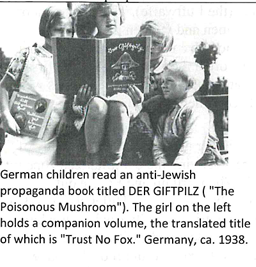
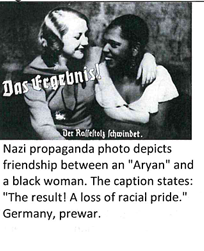
3. Nazi propaganda photo depictions of German women idealized motherhood and women’s roles in the home as necessary for the creation of a strong Aryan race. Female roles were romanticized and glorified; the result was loss of women’s legal rights, and the friendship between women and Aryan men became strictly controlled.
4. The Nazis devoted the propaganda as a vital aim to achieve their goals. Adolf Hitler, Germany’s Führer, was presented with the power of a living god. During World War II he achieved a cult of personality similar to the collapse of morale and revolts in the German home front navy in 1918.
5. The Ministry of Propaganda, Josef Goebbels was effective in change for their beliefs. Most successfully in Germany was produced for this Ministry for the press, the arts, music, theater, film, literature, radio. Hitler and artists were required to register with one in the Ministry’s subordinate chambers for each profession. Lectures and trials on criminals were used as propaganda.
6. Senior Ministry officials and the Press Ministry required to receive party line on world events. Broadcasts and journalists required approval before their works were disseminated.
What forms of media did Hitler and the Nazi Party use as propaganda? List and briefly describe at least three examples from the passage.
What was the purpose of propaganda in Nazi Germany? Explain how it helped the Nazis gain, consolidate, or maintain power.
Who benefited from Nazi propaganda and who was hurt by it? Explain your answer using examples from the passage.
Objective: Describe how Hitler gained, consolidated and maintained power in Germany prior to the Great Depression.
How did Hitler gain, consolidate and maintain power in Germany before the Great Depression?
Using your packet, use the RACES format to write a paragraph that answers that guiding question for the week:

Using the RACES format, write a paragraph answering: What methods did Adolf Hitler use to gain, consolidate, and maintain power in Germany? Include at least one example of each (gain, consolidate, maintain).
https://youtu.be/7cVSjzuvThE?si=swe499FDFKmh0Z38
Optional:
https://youtu.be/XULMUWmg1Uo?si=fF9uad95HXMAB3Xu
Background
World War I created a huge boarder [broader] range of available jobs for women in a number of contexts, including mostly participation of the British workers, for example, traditional “women’s work”, workplace mostly within the home. But between 1914 to 1919, about 2 million British women replaced men to represent American frontlines. Women now supported the war and brought a new era of professional work. Internationally, the 1918 pamphlet outlining the wartime accomplishments of French, British, the provisal [provisional] sort of new found selves. Suffragist Beatrice Hancock Seton reported British women sought to organize around greater sense of personal satisfaction and independence.
Nationally, the suffrage movement, they believed that women’s recent gains had been gained by the result of women’s emergency during everyday, including women, had been forced to shoulder much of the labor burden and blub and fellow suffragists were now certain that it had been a vital step on the path to women’s equality and women’s right to vote. They also did not want the war effort to rest their history. In 1920 the Nineteenth Amendment to the U.S. Constitution was ratified, giving women the voting rights, and thereby changing life for all British women the same voting rights as those of men.
In power Great Britain, women began in 1918 when women over the age of 30 years who were property owners, business??? who had earned a university degree were granted the right to vote. In 1928, these restrictions were then demographics on the northern declaration forever.
From the video and the background passage, summarize three ways the role of women changed during World War I.
1) ________________
2) ________________
3) ________________
Why were broadcasters and journalists required to receive prior approval before their works were disseminated in Nazi Germany?